

Death: half a sun on the water
Content version · · Sources & references
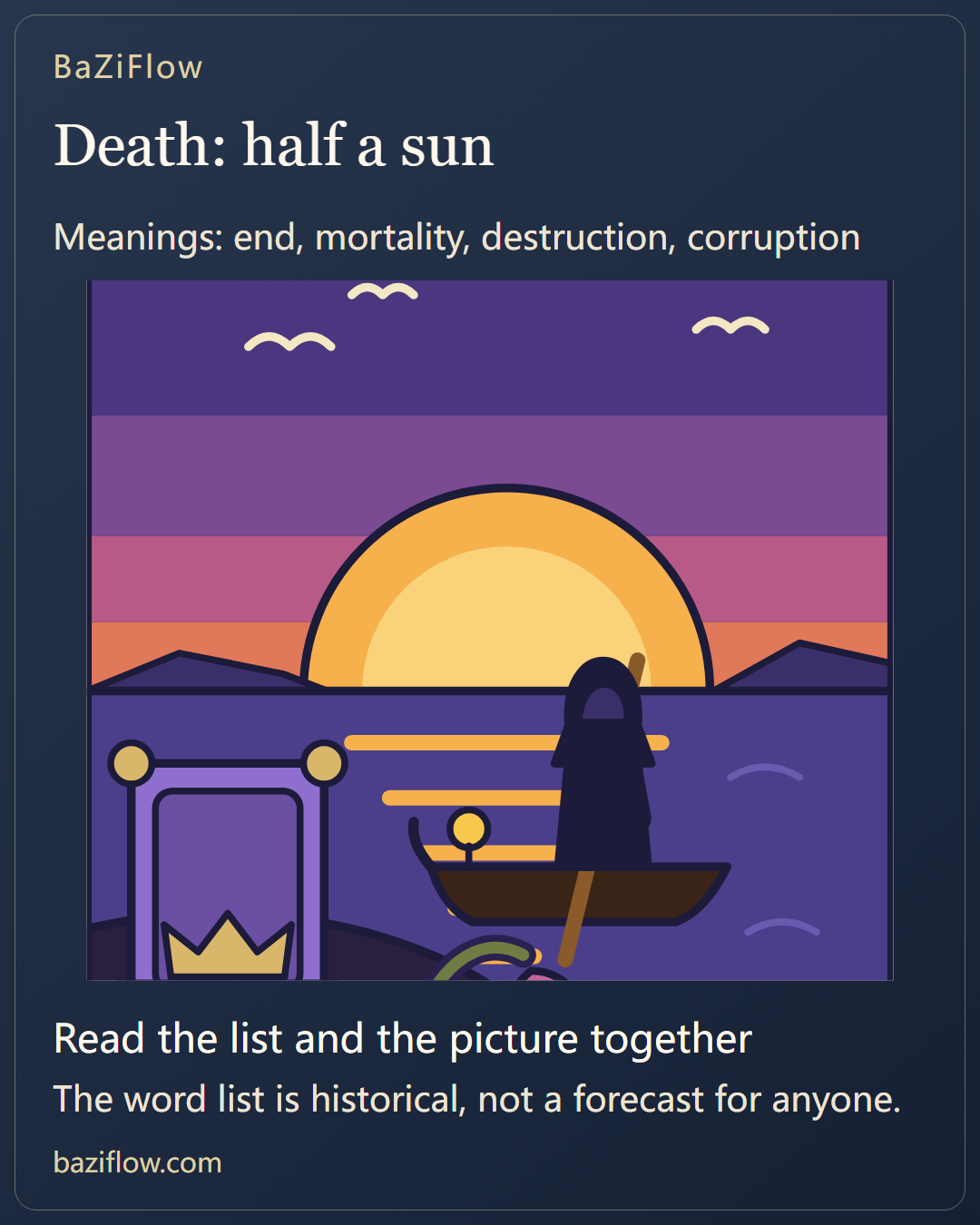
Death's word list holds end, mortality, destruction and corruption, while Waite explains the picture as change and passage. Keep the list, the picture and his two kinds of death apart, then practice on a work handover.
The short version8 min read
The word list for Death is blunt, while the description of the picture writes death as change and passage. Both are Waite's, so the first job is to set the two side by side and drop neither.
- Waite writes a horseman moving slowly with a black banner bearing the Mystic Rose, which signifies life, and the sun of immortality at the horizon. He carries no visible weapon; king, child and maiden fall before him while a prelate waits with clasped hands.
- The divinatory list plainly reads end, mortality, destruction, corruption, plus three 1910 lines divided by man, woman and maid. Part II explains the picture as change, transformation and passage from lower to higher.
- The reversed list is inertia, sleep, lethargy, petrifaction, somnambulism, and hope destroyed. The practice takes three places in the picture, the fallen, the banner and the waiting prelate, and uses them on a work handover.
Read first
The picture: a slow rider, a rose on a black banner, a sun far off
Waite opens with a general thought: the veil or mask of life is perpetuated in change, transformation and passage from lower to higher. In the rectified Tarot, he says, this is better shown by one of the apocalyptic visions than by the crude notion of the reaping skeleton, and behind it lies the whole world of ascent in the spirit.
Then the picture: the mysterious horseman moves slowly, bearing a black banner emblazoned with the Mystic Rose, which signifies life. Between two pillars on the verge of the horizon there shines the sun of immortality. The horseman carries no visible weapon, but king and child and maiden fall before him, while a prelate with clasped hands awaits his end.
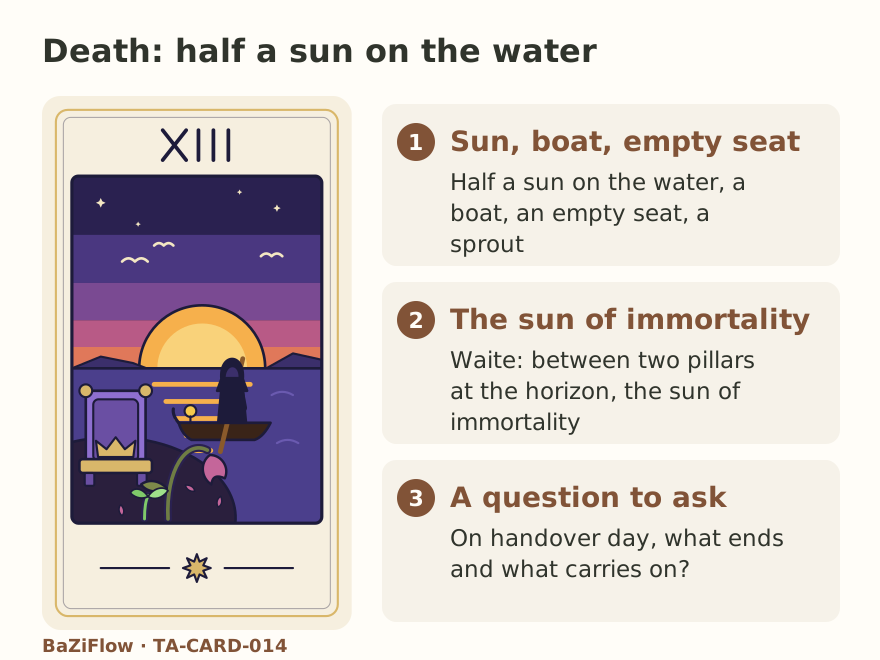
BaZiFlow's original Death with three ways to read it
The lead picture here is BaZiFlow's own transcription: half a sun on the water, a figure in a small boat, an empty chair with a crown on the shore, and a sprout beside a drooping flower. It carries Waite's few sentences in another form and does not copy the skeleton rider of the RWS card.
Looking at the original RWS card: a black-armored rider on a white horse, a skull's face under the helmet, holding a black banner that bears a white rose and the number XIII; a king lies before the horse with his crown beside him; at the right a prelate in a bishop's mitre has his hands joined, with a child and a maiden near him; on the far horizon, between two tower-like pillars, there is a sun.
Enlarge diagram · scroll sideways to read
What Waite lists: end, mortality, destruction, corruption, quoted as written
Waite's divinatory meanings are set down here as written, without cushioning and without rewording:
End, mortality, destruction, corruption; also, for a man, the loss of a benefactor; for a woman, many contrarieties; for a maid, failure of marriage projects.
The first four words are general. The second half divides by man, woman and maid, which is 1910 wording; read it today only as a historical fortune-telling formula, never as a verdict on a real person.
Enlarge diagram · scroll sideways to read
Banner, sun and the fallen: how Waite explains the picture
Waite names three sets of elements: the black banner with the rose, the sun on the horizon, and the people before the horseman. For each he gives the look or the act; what the king, child, maiden and prelate each stand for, he does not say.
Three sets of elements, each with its source
- Black banner, rose
- Waite: the banner is black and emblazoned with the Mystic Rose, which signifies life. It is the one place in this entry where he hands over a meaning directly.
- The sun
- Waite: between two pillars on the verge of the horizon there shines the sun of immortality. He does not say whether it is rising or setting.
- The people
- Waite: king, child and maiden fall before the horseman, and a prelate with clasped hands awaits his end. Only acts are given, with no meaning for each person.
Enlarge diagram · scroll sideways to read
Waite also separates two kinds of death. He opens by noting that the hint of death in the previous card is meant mystically; here that is not so. The natural transit of man to the next stage of being either is or may be one form of progress; the entrance, while still in this life, into the state of mystical death is a change in the form of consciousness, and to that state ordinary death is neither the path nor the gate.
His last word is on the existing occult explanations of the card: on the whole better than usual, rebirth, creation, destination, renewal and the rest.
How to read it: three lists for handover day, taken from three places in the picture
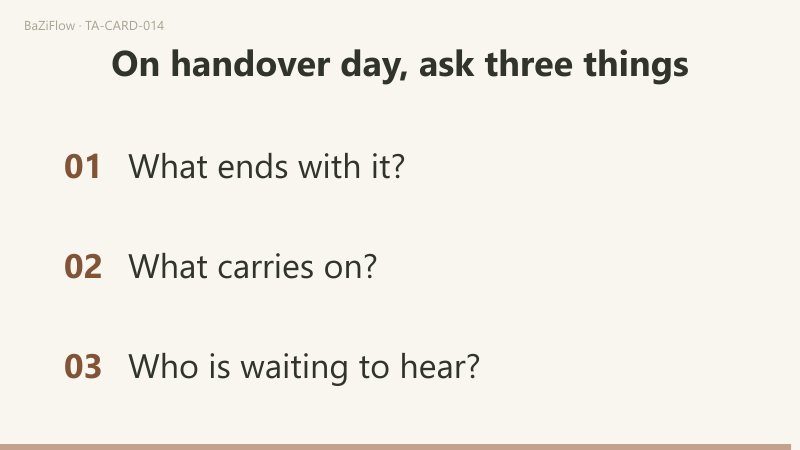
Three places in the picture are quite different: those who fall, the banner above, the figure who waits with clasped hands. Put onto a work handover they become three lists. This is an exercise borrowed from the picture; Waite never used it that way.
The fallen: what ends with the handover
List everything that stops being yours after the handover, each with the date and hour it ends: access, approvals, routine tasks. An ending needs a clear point, not a slow fade.
The banner: what carries on
The banner shows a sign of life. List what must continue after the handover: documents, definitions, agreements in progress, each with the name of whoever takes it over.
The one who waits: who must be told
Someone in the picture is waiting. List the people who would go to the wrong person after the handover: counterparts, users, and who will tell them by which day.
Say a colleague moves to another team at month end and hands over a monthly report. The three lists give one sheet:
Enlarge diagram · scroll sideways to read
What each list can hold
Fits on the lists
- The hour things end
- An owner for each carry-on
Beyond the lists
- How the other person feels
- Old promises nobody can recall
On the day
- Check each line of the three
- Add an owner where none is named
Reversed and neighboring cards: inertia, sleep, petrifaction, and the cards on either side
Waite's reversed list reads:
Inertia, sleep, lethargy, petrifaction, somnambulism; hope destroyed.
Nearly every word here is a word of not moving: inertia, sleep, lethargy, turning to stone, sleepwalking. The upright words, end and destruction, belong to a change taking place; the reversed words sound like a change that has not. Reading it as "what should have changed did not" is a way of arranging the list, not Waite's statement, and for the last item, "hope destroyed", he gives no account.
Enlarge diagram · scroll sideways to read
Three cards on either side
The previous card, with a line on resurrection
The Hanged Man entry ends by speaking of the mystery of death followed by a glorious mystery of resurrection; the Death entry then separates the two layers of "death".
The next card: blending
Its list is made of everyday words, and Waite says it brings the psychic and material natures into accord. Death is about change, Temperance about proportion.
Another card about transformation
Waite calls it the card that registers the accomplishment of the great work of transformation; its list is change of position, renewal, outcome. Both speak of change; Judgement puts its words on the outcome.
Enlarge diagram · scroll sideways to read
Questions readers ask next
Does the Death card predict a death?
The list does contain end, mortality and destruction; the text says so. But it gives no one a date or an outcome, and Part II explains the picture as change and transformation, calling the occult explanations of rebirth and renewal on the whole better than usual.
Why is the RWS Death a rider and not a skeleton with a scythe?
In Part II Waite says the rectified Tarot is better served by one of the apocalyptic visions than by the crude notion of the reaping skeleton. The horseman carries no visible weapon, and his banner bears the Mystic Rose, which signifies life.
What does Death mean reversed?
Waite's reversed list is inertia, sleep, lethargy, petrifaction, somnambulism, and hope destroyed. Nearly all are words of not moving, and none is the opposite of "end"; how they match the upright words is not spelled out.
Was this article helpful?
Sources & references
Continue reading
The Hanged Man: living wood, a calm face, and the readings Waite turned down ↗