

Xun (巽): wind, wood and the southeast
Content version · · Sources & references
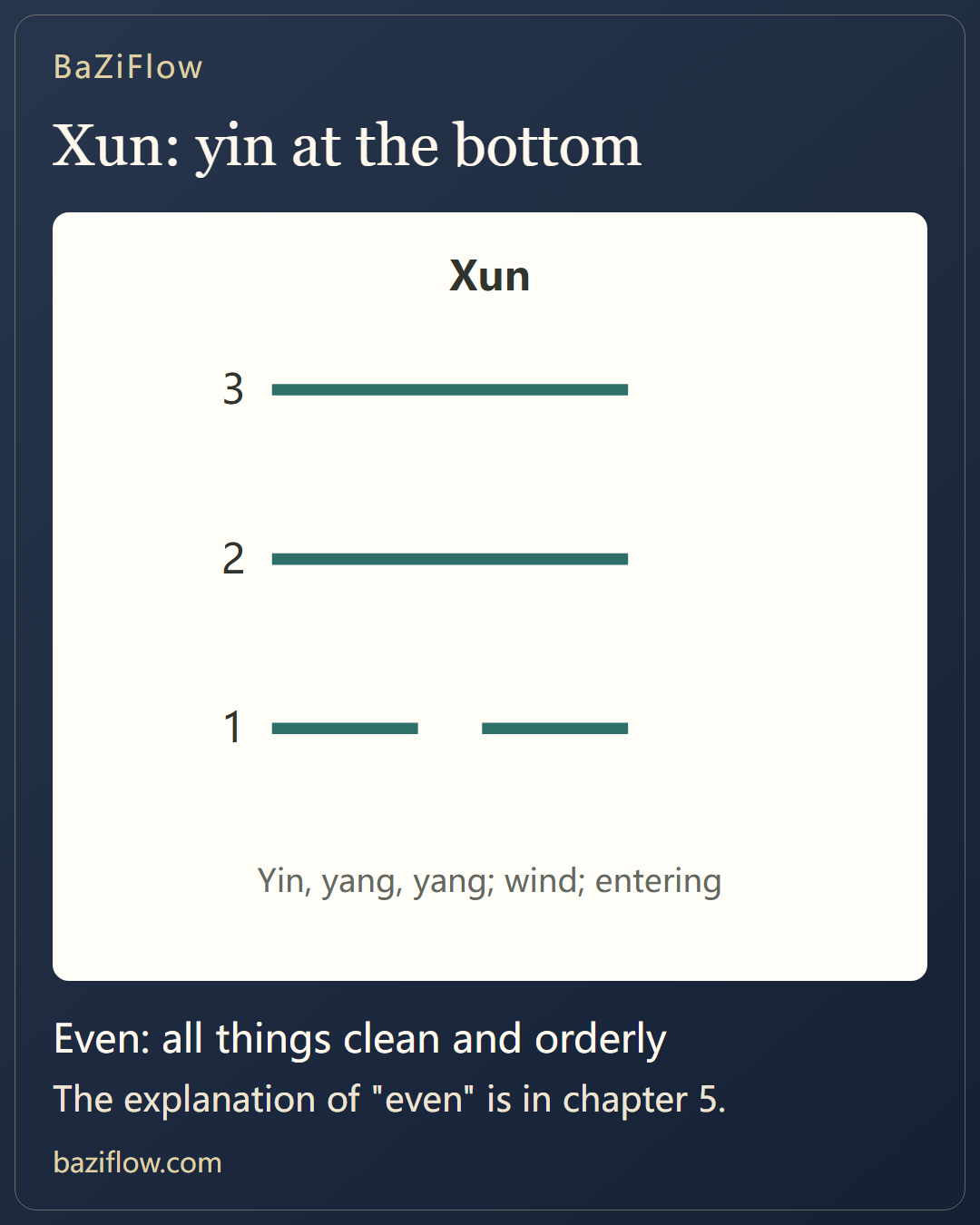
Xun has a yin line at the bottom under two yang lines and is Dui turned over. Read its two images, wind and wood, "set even in Xun" in chapter 5, the indecisive items on its list, and hexagram 57.
The short version5 min read
Of the eight chapter 11 lists, only Xun's does not open with its chapter 3 natural image: it names wood first and wind second. Chapter 5 says "set even in Xun", placing it in the southeast; the figure is a yin line at the bottom under two yang lines.
- Xun and Dui are one string of lines read from opposite ends; the inverse of Xun is Zhen.
- The chapter 11 list for Xun opens with wood and puts wind second; wind appears again in chapters 3, 4 and 6, as "pressing on", "scattering" and "bending".
- In chapter 5 the text explains the word "even" itself as "the cleanness and order of all things"; the chapter 11 list ends with advancing and retreating, indecision and "its end is restlessness".
Read first
Eight Trigrams: Three-Line Structure and Basic Images, Read Through the Shuo Gua ↗
The same three lines, read from the other end
Xun (巽) has a yin line at the bottom and two yang lines above it, and students later remembered it as "Xun is broken below". Turn it upside down and you have Dui (兑): the same three lines, read from the bottom up they are Xun and read from the top down they are Dui.
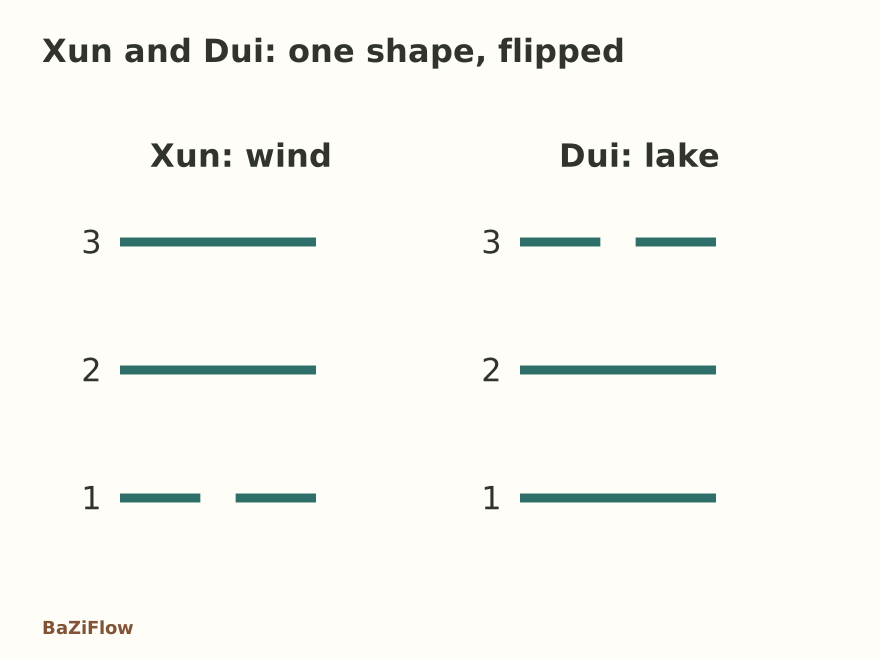
Xun beside Dui: turn Xun upside down and it is Dui; the images are wind and wood for Xun and the lake for Dui.
Enlarge diagram · scroll sideways to read
Xun's inverse is Zhen (震): swap every line, and Xun's yin, yang, yang becomes yang, yin, yin. Chapter 3 of the Shuo Gua (说卦) puts wind and thunder together as "press on each other", and chapter 6 rewrites that as "do not go against each other"; see the Zhen trigram. The one it turns into when flipped is the Dui trigram, the trigram of delight.
Wind and wood: one trigram, two natural images
For other trigrams the first item in the chapter 11 list is the natural image they have in chapter 3: Qian is heaven, Kun is earth, Zhen is thunder. Xun is the odd one out: the first item on its list is wood, and wind comes second.
Xun's two natural images
Xun is wood
The list for Xun begins with wood; wind and the eldest daughter come only after it.
Press on · scatter · bend
Chapter 3 has wind and thunder pressing on each other, chapter 4 has wind scattering things, and chapter 6 says nothing bends the ten thousand things faster than wind, so that they sway and give.
The two items right after the eldest daughter
One is the straight cord and the other is the craftsman. They are often tied to woodworking, but the text simply lists them.
So the answer to "is Xun wind or wood?" depends on the chapter: the three places that speak of wind are describing what it does, and the one that speaks of wood is an image on a list. How to read the chapter 11 lists is taken up in the limits of reading images.
Even: the "cleanness and order" of the southeast
In chapter 5 Xun is the second stop of the eight-stop journey, and the entry is concrete:
Things are set even in Xun. Xun is the southeast. "Even" means the cleanness and order of all things.
The text gives the direction first, the southeast, and then explains the word "even": things clean and in order. On the Later Heaven diagram Xun sits between Zhen in the east and Li in the south. On the Prior Heaven diagram Xun is in the southwest, opposite Zhen in the northeast.
Enlarge diagram · scroll sideways to read
Advancing, retreating, indecision: a run of hesitation on the list
The first sentence of the chapter 11 entry for Xun runs from wood and wind all the way down to this:
Xun is wood, wind, the eldest daughter, the straight cord, the craftsman, white, long, tall, advancing and retreating, indecision, smell.
Enlarge diagram · scroll sideways to read
The earlier items are named things. By "advancing and retreating" and "indecision" the list has moved to conditions: going back and forth, unable to settle. The second sentence opens with "in people", names sparse hair, a broad forehead and much white in the eye, and ends on gaining threefold at the market; the whole entry then closes with "its end is restlessness", so the list ends in restlessness.
Following wind: the six-line Xun and the Xu Gua
The six-line Xun is hexagram 57, and its Great Image reads:
Wind following wind: Xun. The noble person repeats the command and then acts.
With Xun above and Xun below there are two winds, one after the other, and the noble person "repeats the command and acts": states the order again, then goes to work. The Commentary on the Judgments also says "Xun doubled, to repeat the command". The Xu Gua places it right after Lü (旅), the hexagram of the traveler:
Enlarge diagram · scroll sideways to read
"Travelers find no place to rest" speaks of drifting without a place to stay, and what follows is entering. The six-line Xun is read in Xun, the hexagram; next in this series comes the Kan trigram.
Questions readers ask next
Is the natural image of Xun wind or wood?
Both. Chapters 3, 4 and 6 speak of wind, and the chapter 11 list names wood first and wind after it. Different chapters take different angles, so say which chapter you are relying on whenever you use the image.
Why is Xun called entering?
Chapter 7 writes only "Xun is entering" and does not take the lines apart. The Xu Gua says "after travelers find no place to rest, Xun follows", linking entering to having nowhere to stay. Wind slipping into cracks is a later association, not the text's explanation.
Is Xun as eldest daughter the mirror of Zhen as eldest son?
In line pattern, yes: Zhen has yang at the bottom and Xun has yin at the bottom, so they are inverses, and chapter 10 uses one sentence for each, "by one seeking got a son" and "by one seeking got a daughter". The text gives no reason for the symmetry; it is a comparison of the figures.
Was this article helpful?
Sources & references
Continue reading
Zhen (震): yang at the bottom, and the first stop of "the sovereign emerges in Zhen" ↗
Kan (坎): a yang line held in the middle, and the words sinking, toil and return ↗
Trigram imagery: why a round clay bowl has two possible routes ↗