

Hairpin and Bracelet Metal: Yang Metal Dog and Yin Metal Pig
Content version · · Sources & references
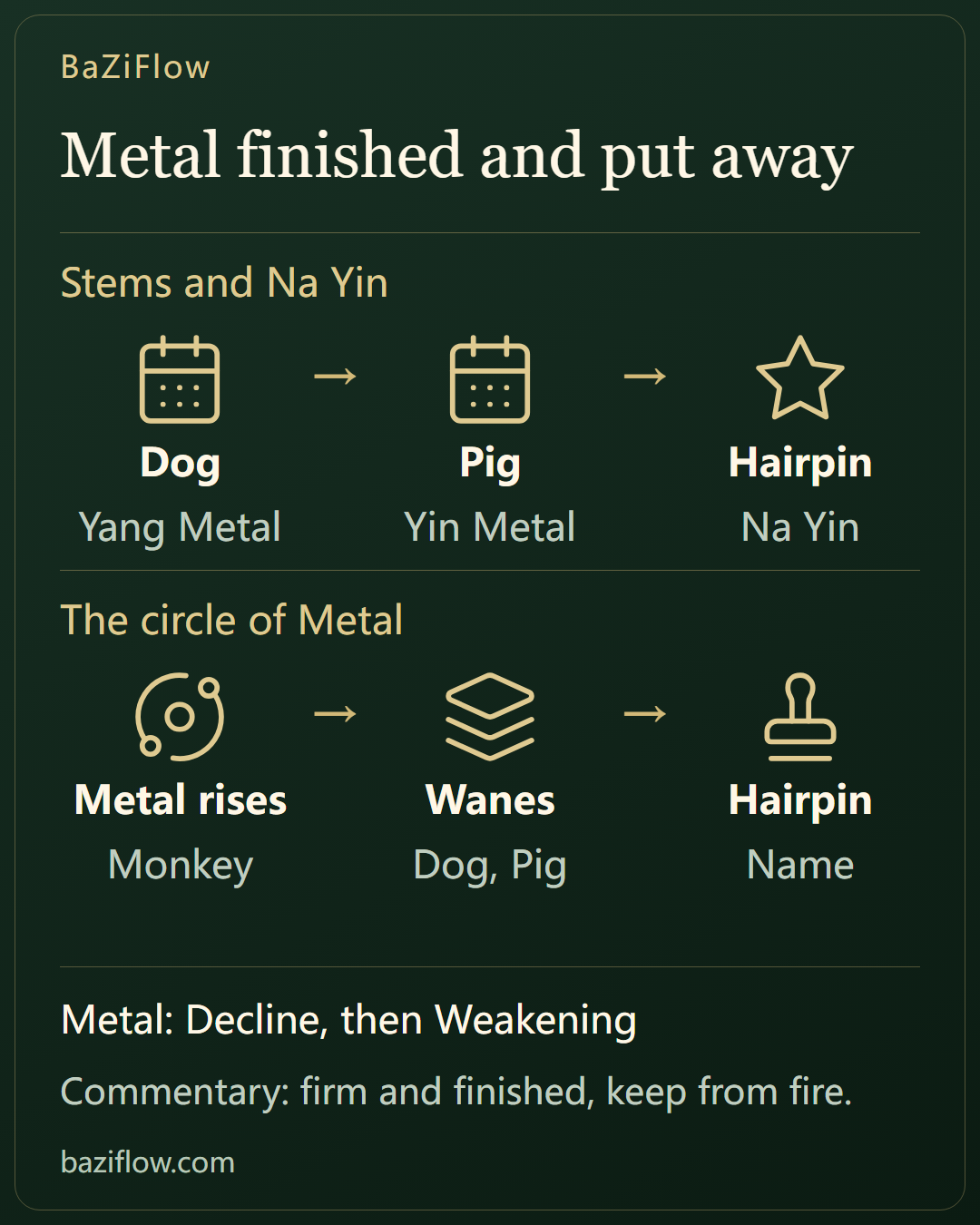
The twenty-fourth Na Yin name goes to Yang Metal Dog and Yin Metal Pig. The Sanming Tonghui reads it as finished jewelry put away; the calendar specialists put Metal at Decline and Weakening. Year conversion checked.
The short version10 min read
The Na Yin of Yang Metal Dog and Yin Metal Pig is Hairpin and Bracelet Metal, the last of the six Metal names when counted by branch from the Rat. The Sanming Tonghui says that by here the jewelry is finished and put away in the women’s chambers, with nothing left to do.
- Both stems, Yang Metal and Yin Metal, are already Metal, but the Metal of a stem and the Metal of the Na Yin are two layers: they are not added, and they do not mean “a lot of Metal”.
- The Sanming Tonghui gives two reasons: by the Dog and Pig the Metal’s qi is stored away and the jewelry finished; the calendar specialists count from the life-stage table, with Metal at Decline on the Dog and Weakening on the Pig, hence “soft”.
- In the same entry Yang Fire Horse is a taboo for Yang Metal Dog but harmless for Yin Metal Pig. The book gives a fire-frame reason for the first and none for the second; the table shows a Horse–Dog half-combination and a Yang Fire–Yin Metal combination.
Read first
What is Na Yin in BaZi? Why Yang Wood Rat Gold in the Sea does not replace Yang Wood ↗
The last of the six metals
Hairpin and Bracelet Metal (钗钏金) is the twenty-fourth Na Yin name, shared by Yang Metal Dog (庚戌) and Yin Metal Pig (辛亥). Metal has six names, and counting the branch pairs from Rat-Ox to Dog-Pig this is the last: Gold in the Sea, Gold Foil Metal, White Wax Metal, Sandstone Metal, Sword Edge Metal, and then this one.
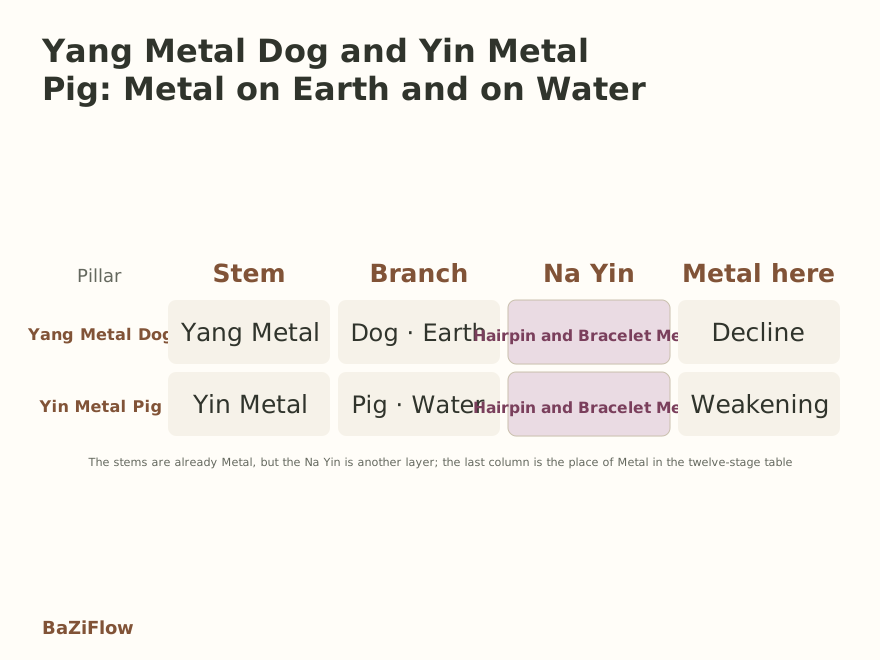
Comparison sketch: stem and branch attributes use the usual entry-level assignments, the Na Yin name follows the Sanming Tonghui, and the last column is the place of Metal (counted by Yang Metal) in the twelve-stage table.
Unlike most pairs, both stems here are already Metal; the branches are the Dog, which is Earth, and the Pig, which is Water. The right-hand column gives the positions used below: Decline on the Dog, Weakening on the Pig.
The life of Metal ends in finished jewelry
In juan 1 of the Sanming Tonghui (三命通会), the imagery of the six Metal names reads like one history, from ore wrapped in earth to a finished piece:
Enlarge diagram · scroll sideways to read
When it comes to Yang Metal Dog and Yin Metal Pig, the book says:
At the Dog and the Pig the Metal’s qi is stored away and its form is used up. The forging is done and the jewelry is finished. Its state is to be kept in the women’s chambers with nothing left to do, and the service of Metal is complete. So Yang Metal Dog and Yin Metal Pig are called Hairpin and Bracelet Metal.
“Nothing left to do” is not a criticism; the use has simply run its course. When the same volume sums up its “paired” images, it sets this metal beside White Wax Metal: the Dragon and Snake sit at Xun (巽) and the Dog and Pig at Qian (乾), and the verdict is that “Qian and Xun lie in different directions, and each has reached its own form and color”, one just taking shape and the other a finished piece.
Decline and Weakening: how the calendar specialists say “soft”
The second reason belongs to the calendar specialists (日家), whose words the book quotes. They work backward from the twelve-stage table:
Yang Metal Dog and Yin Metal Pig: Metal reaches Decline at the Dog and Weakening at the Pig. Metal being in Decline and Weakening, it is soft indeed. So it is called Hairpin and Bracelet Metal.
So “soft” comes from the two positions, Decline and Weakening. Sword Edge Metal (Yang Water Monkey and Yin Water Rooster) uses the same pattern the other way round: Metal is at Establishment on the Monkey and Peak on the Rooster, “strong indeed”. Monkey, Rooster, Dog and Pig are four neighbors on the circle of Metal: up to the peak, then down into Decline and Weakening.
Further on in juan 1, where a commentary goes through the sixty pillars one by one, the tone changes. This pair is “firm, finished metal that must not meet fire”, noble “if water and earth support it”, and it is later grouped with the Sword Edge pair as “four metals with strong qi”. “Soft” in the imagery section and “firm” in the commentary describe different things, so say which passage a quotation comes from.
Enlarge diagram · scroll sideways to read
The circle counts Metal by its Yang stem, the usual way to place a Na Yin element. If Yin Metal Pig’s own Yin stem is counted backward instead, Yin Metal on the Pig is at Bath rather than Weakening; say which count you use. The twelve positions are drawn out in full in the life-stage and void-branch article.
A short table in the same volume gives each pillar an object, and here the two differ:
Two images under one name
What is left of blade and sword
The table adds: it likes a little fire, and wood.
Treasures of bell and tripod
The table adds: it likes wood, fire and earth.
One Yang Fire, two verdicts
The entry first says where this metal goes: it is “kept in the women’s chambers” and suits only still water. Water from wells, ravines and streams is auspicious, although too much “floods”; the sea is worse, and the book writes “poverty and early death”; as for the Heavenly River water, Yin Metal Pig may meet it without harm. Fire has to be told apart pillar by pillar. The book calls Yang Fire Horse “true fire”, a taboo for Yang Metal Dog, and Fire in the Furnace is Yang Metal Dog’s worst taboo, while for Yin Metal Pig it says “Yang Fire and Yin Metal combine into Water, a little favorable”. Here is what the table finds:
Enlarge diagram · scroll sideways to read
Read the rows in pairs. Wherever the book treats Yang Metal Dog and Yin Metal Pig differently, the table has a matching relation, but some of the reasons are the book’s and some are only what the table shows, so keep them apart:
- Yang Fire Horse: the book gives its reason for Yang Metal Dog, “the Horse and the Dog join into a fire frame and harm this metal”, and the table shows a Horse–Dog half-combination. For Yin Metal Pig it says only “harmless”, with no reason; the table shows Yang Fire and Yin Metal combining.
- Fire in the Furnace: the book calls it Yang Metal Dog’s worst taboo and gives no reason. In the table the Tiger shares the fire frame with the Dog and the Rabbit forms a Six Harmony with it, so both furnace pillars bind with the Dog. For Yin Metal Pig the book says “Yang Fire and Yin Metal turn into Water, a little favorable”; the table shows that combination and a Tiger–Pig Six Harmony.
The phrase “yin and yang crossing” needs a careful reading. In the table, the same-polarity pairs, Yang Metal Dog with Yang Wood Dragon and Yin Metal Pig with Yin Wood Snake, are a stem clash and a branch clash together. Across polarity, Yang Metal Dog with Yin Wood Snake has the Yin Wood–Yang Metal combination and no branch tie, while Yin Metal Pig with Yang Wood Dragon has neither a stem combination nor a branch clash. The book does not say which pair its phrase means.
The sentence on Metal meeting Metal is the shortest: Metal likes Sword Edge and then it takes shape; Gold Foil adds luster; the hairpin needs a little fire to help it; apart from these two, other metals are of no use. That echoes the Sword Edge entry, which says that finished metals such as Hairpin and Bracelet Metal “are also fine to meet”: two worked metals put to use together.
Three Starts of Spring: three changes of pillar, two changes of Na Yin
The year 1970 is Yang Metal Dog and 1971 is Yin Metal Pig, and the pair also falls on 2030 and 2031 and on 1910 and 1911. The pillar changes at each Start of Spring (立春), which in Beijing time came at 13:45 on 4 February 1970, 19:25 on 4 February 1971, and 01:20 on 5 February 1972, by then past midnight.
Enlarge diagram · scroll sideways to read
Two exercises
Born at 8 p.m. on 4 February 1971: what are the year pillar and the Na Yin?
8 p.m. has passed the 19:25 Start of Spring, which makes the year Yin Metal Pig and the Na Yin Hairpin and Bracelet Metal. At 6 p.m. the year is still Yang Metal Dog, with the same Na Yin.
Born at 12:30 a.m. on 5 February 1972: what is the Na Yin?
At 12:30 the 01:20 Start of Spring has not yet arrived, so the year stays Yin Metal Pig and the Na Yin Hairpin and Bracelet Metal. Born at 02:00, the year is Yang Water Rat and the Na Yin becomes Mulberry Wood.
Its Metal neighbors are Sword Edge Metal and White Wax Metal, and the next pair in the sixty-cycle is Mulberry Wood. For where Na Yin stops and the plain five elements start, see what separates Na Yin from the regular elements.
Questions readers ask next
The imagery section calls this metal “soft”, but the commentary calls it “firm and finished” with “strong qi”. Which is right?
They are about different things. On the Images of Na Yin borrows Decline and Weakening from the twelve stages to say “soft”, as a reason for the name. The commentary says “firm and finished, it must not meet fire”, meaning the piece is already made and fears more firing, and groups it with the Sword Edge pair as four metals with strong qi. Cite the passage you use rather than merging them; neither is a verdict on the person born then.
Does Hairpin and Bracelet Metal tie this pillar to jewelry?
No, it is not a match with an object or a trade. The name is the book’s picture of the stage Metal has reached: it has been worked into a finished piece and put away in its case with nothing left to do. It describes the image of the Na Yin and points to no occupation.
Yin Metal Pig’s stem is Yin. Is it looked up on the stage table the same way as Yang Metal Dog?
No. The Na Yin element is counted by the Yang stem of Metal, which puts Metal at Weakening on the Pig; if the Yin stem is counted backward on its own, Yin Metal is at Bath on the Pig. The two counts answer two different questions, so say which one is meant before using it.
Was this article helpful?
Sources & references
Continue reading
Earth of the Great Post Road (大驿土): Kun and Dui, and the Phrase “Earth at Growth” ↗
Mulberry Wood (桑柘木): No Wood in Yang Water Rat or Yin Water Ox, So Why This Name ↗
Five Elements cycles: learn the relationships, not just the order ↗