

Keep two owners in a compatibility reading
Content version · · Sources & references
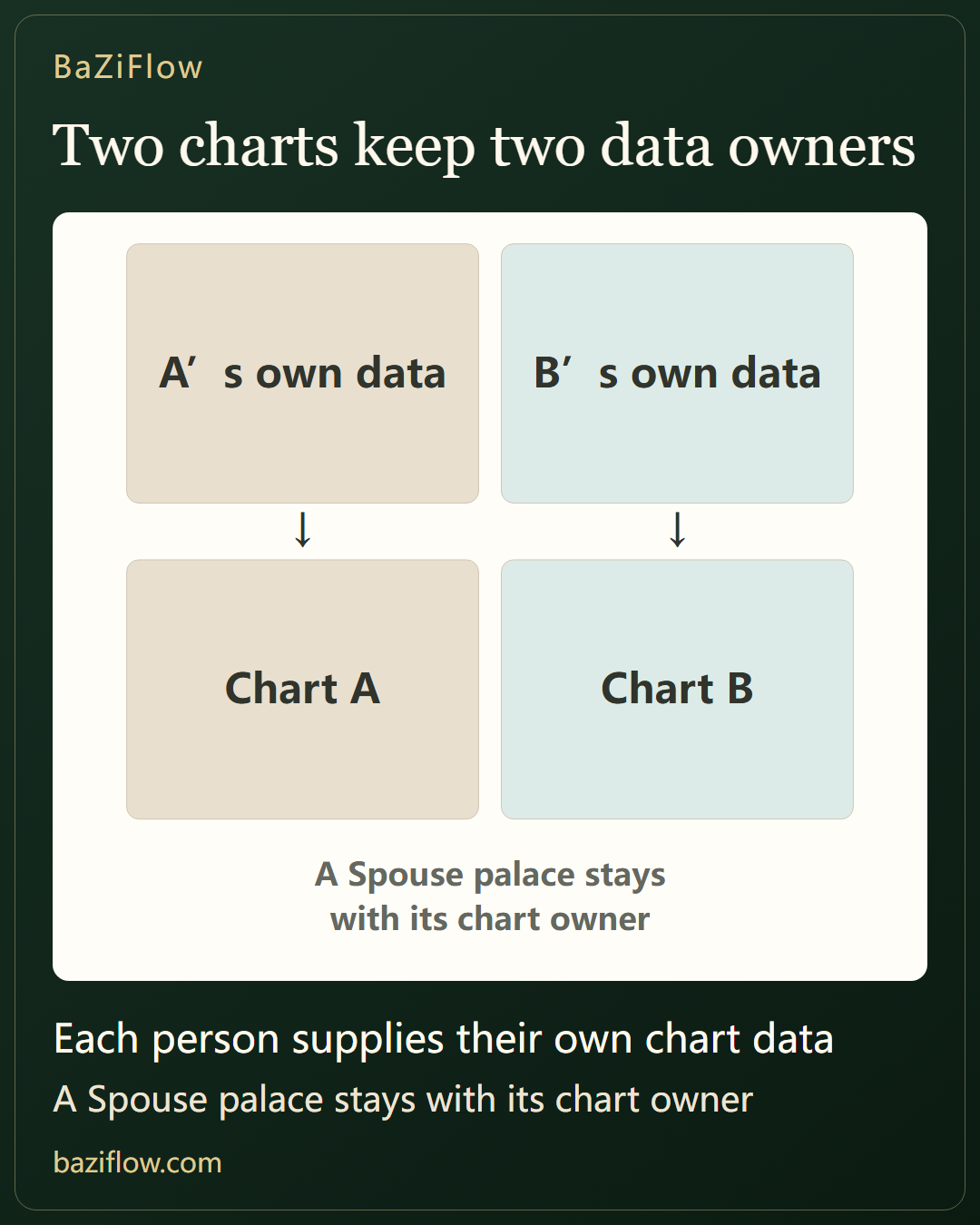
Keep two people and two charts distinct when exploring compatibility. A palace-order example shows why one person’s Spouse palace is not the other person’s natal data.
The short version6 min read
A compatibility reading compares two charts under a stated method; the cited introduction includes both people’s Life and Spouse palaces. Each Spouse palace remains part of its own chart. It cannot supply the other person’s birth data. Establish the separate positions and conditions before discussing a concrete relationship question.
- A’s Spouse palace belongs to chart A; B’s Life placement must come from B’s own data rather than a copied symbol from A.
- Life at Tiger puts Spouse at Rat, while Life at Horse puts Spouse at Dragon; each naming sequence stays within its own chart.
- Changing only B’s Life origin to Goat moves B’s Spouse to Snake while A’s remains at Rat; update only the affected owner.
Read first
A compatibility reading has two data owners
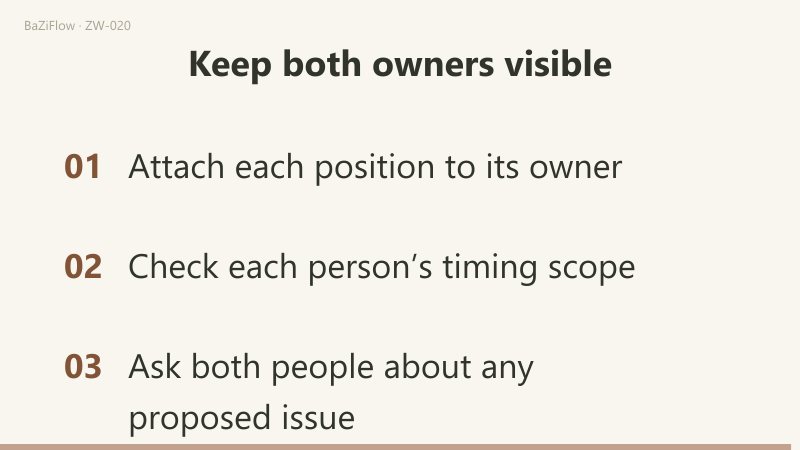
Before comparing any symbols, label the charts A and B. Each observation needs to retain its owner. This may sound elementary, but relationship language can quietly erase the distinction: an interpretation of A's Spouse palace becomes a claim about B, and then that claim is treated as though it came from B's chart.
A palace used to discuss relationships is still a field in its owner's chart. It is not access to another person's birth data, thoughts or consent. If B's chart is missing, A's relationship symbolism cannot manufacture it.
The cited iztro palace introduction describes comparison of both parties' Life and Spouse palaces. We use that as evidence of the method's stated reading scope, not as proof that the method measures relationship success. A pair of major-star names is an even smaller summary than that scope.
A Spouse palace stays with its chart owner
Four positions are enough to expose an ownership mistake
Here is a deliberately partial example. A's natal Life palace is at Tiger (寅). B's is at Horse (午). Following the reverse order Life, Siblings, Spouse gives Rat (子) for A's Spouse palace and Dragon (辰) for B's.
| Chart owner | Natal Life position | Path to natal Spouse |
|---|---|---|
| A | Tiger | Tiger: Life; Ox: Siblings; Rat: Spouse |
| B | Horse | Horse: Life; Snake: Siblings; Dragon: Spouse |
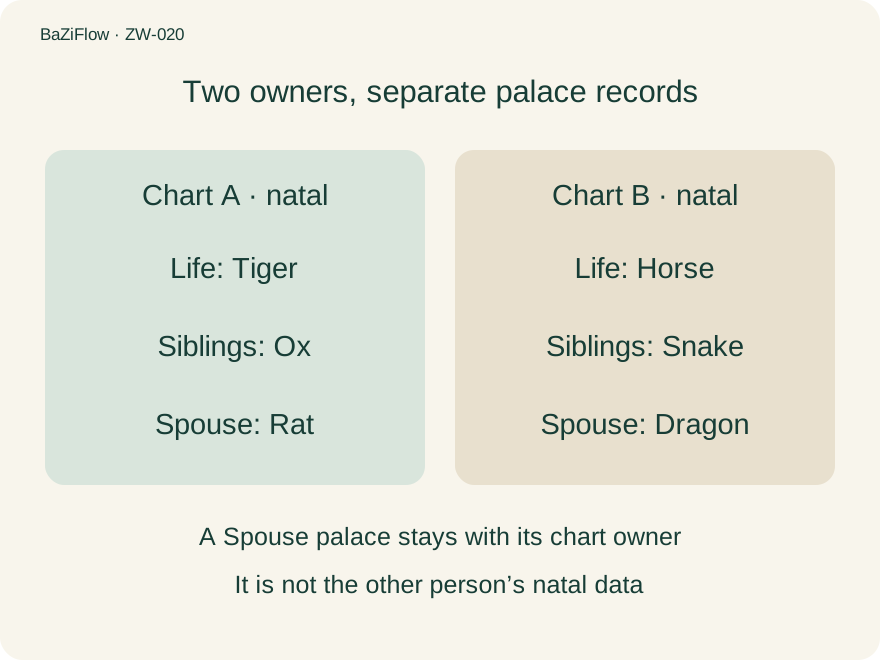
Original BaZiFlow two-chart ownership exercise, with positions derived from palace order and no stars, birth dates or compatibility score supplied.
No birth dates or stars have been assigned. These are palace-order conditions, not a compatibility calculation. The useful result is that all four positions remain attached to the correct chart.
Suppose someone now copies a star from A's Spouse palace into a description of B's Life palace and calls the match confirmation. They have reused one input, not obtained a second piece of evidence. B's natal placements must come from B's own information and charting rules.
Change only B’s starting condition. Keep A’s Life at Tiger, but move B’s Life from Horse to Goat (未). B’s order becomes Life at Goat, Siblings at Horse and Spouse at Snake (巳); B’s Spouse therefore changes from Dragon to Snake. A still has Life at Tiger, Siblings at Ox (丑) and Spouse at Rat. A note that also moves A’s Spouse to Snake has transferred B’s changed input into the wrong chart.
This exercise tests ownership, not which pair is more compatible. Neither version supplies stars, transformations or the people’s actual relationship experience. The established change is B’s Life origin and the palace names derived from it. “More stable” or “more conflict-prone” would add a relationship conclusion that the exercise does not provide.
Shared star names leave many conditions unresolved
Two Life palaces with the same major-star name may still differ in position, companion stars, transformations and surrounding relationships. Different major stars likewise do not establish incompatible values. Traditional symbolism is not a completed personality assessment.
The star-combination guide explains why co-location and a wider comparison area are different observations. With two charts, those distinctions need an additional owner label. More material should make the reasoning more traceable, not merely produce a longer list of adjectives.
Try a substitution check on a proposed reading. If swapping A and B changes nothing, ask whether the reasoning ever depended on their separate conditions. If replacing the star names also leaves the advice untouched, the text may be a generic relationship paragraph with labels added. Differences should arise from stated evidence rather than random wording.
A numerical compatibility score would need its own defined method and validation. Nothing in this article's four-position exercise yields a percentage, marriage date or probability of separation.
Shared condition
- One star name
Separate conditions
- Position, companions, marks
Align the comparison without flattening the people
Record the reliability of each person's birth information separately. An exact recorded time for A does not make B's approximate time exact. Calendar choices, leap-month treatment, day boundaries and transformation-table versions should also be identified before interpreting differences between tools as differences between people.
For a question about a current period, retain the date and each person's relevant timing layers. Their decade periods need not cover identical ages. The goal is to align the question and the conventions, not force two distinct charts into one period. The timing-layer article provides the basic distinctions.
Avoid combining A's natal symbol with B's annotation for one particular year as though both were permanent traits. Even two references to a Spouse palace may use different scopes.
A careful comparison therefore ends with a traceable set of observations and clearly framed questions. It can remain a cultural or reflective exercise without pretending that two star names decide a relationship. The people, their information and their real responses remain separate and essential throughout.
Agreement is something the people can actually discuss
Consider a concrete situation: one person wants travel plans settled early, while the other prefers flexibility. First establish whether both people recognize this description. If it was inferred solely from star names, present it as a question, not a discovered conflict.
If it is an actual issue, the discussion can turn to which bookings need early confirmation and which choices may remain open. Those are arrangements the people can accept, reject or revise. A symbolic reading should not overrule their answers by declaring that one is inherently controlling and the other inevitably evasive.
This is a useful distinction between a prompt for conversation and a verdict. Neither a favorable label nor an unfavorable one supplies the other person's wishes. A missing participant cannot be made to agree through an interpretation of a chart.
Questions readers ask next
Who owns the Spouse palace in a compatibility comparison?
It belongs to the owner of that chart. A traditional method may use it to discuss relationships, but it does not become another person’s birth chart. Copying A’s Spouse information into B’s Life palace does not create independent confirmation.
What changes if only B’s Life origin moves from Horse to Goat?
Reverse palace order gives B Life at Goat, Siblings at Horse and Spouse at Snake, so B’s Spouse changes from Dragon to Snake. A’s Life at Tiger and Spouse at Rat remain unchanged. This is an ownership exercise, not a judgment of relationship quality.
Why do matching major stars not establish compatibility?
They establish one shared condition. Positions, companion stars, transformation sources and timing scopes may differ. The people’s actual responses and circumstances also matter; a pair of star names supplies no validated compatibility percentage.
Was this article helpful?