

Your first Zi Wei chart: make a map before a reading
Content version · · Sources & references
A practical sequence for identifying settings, natal placements and palace relationships without turning a star name into a personality verdict.
Keep placement, reading convention and interpretation in separate columns. Start with one time layer and one limited question.
Read first
What is Zi Wei Dou Shu? A first guide to palaces and stars ↗
Start with one question you can point to
Can you show another reader exactly which palace and time layer a statement refers to? Use that as the test for your first session. You do not need to produce a personality profile. Choose a natal placement, write its location and ask a partner to find it without hearing your interpretation.
Turn off the overlays
Display the natal chart alone. Locate Ming Gong, its branch position and the stars actually shown there; then locate the Shen Gong marker within an existing palace. Shen Gong is not an extra thirteenth box. Check the legend before interpreting colours or arrows. A transformation belonging to an annual overlay must not enter the natal inventory merely because both are visible together.
Set up three columns: placement, convention and interpretation. “This star is in the natal Career palace” is a placement. The method used to relate palaces is a convention. A proposed description of someone's working style is an interpretation. Moving between columns requires an argument.
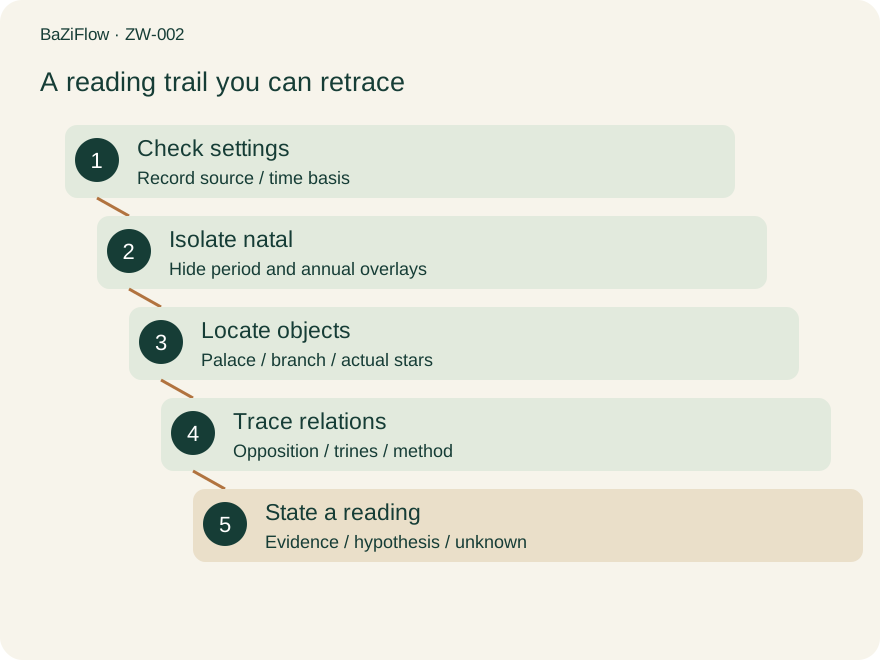
Original BaZiFlow teaching diagram; schematic, not a personal chart.
Follow relationships without relocating the stars
In a common San Fang Si Zheng introduction, the Life palace is read with its opposite Travel palace and the Wealth and Career palaces in its trine relationship. For a different focal palace, locate the corresponding relationships again; do not recycle the Life palace's group for every question. Other schools organise emphasis differently, so name the method you are learning.
An “empty” palace usually lacks the fourteen major stars; it does not lack every star or every relationship. If a text instructs you to consult the opposite palace, preserve that instruction as a reading operation. Do not copy those stars into the focal palace's natal contents. It is the difference between looking at a neighbour and claiming the neighbour lives in your room.
Check the record behind the screen
Searching the personality of a prominent star is an easy first step, but it is not a reliable way to learn the chart. A better first-session outcome is a record another reader can locate on the same screen. If the vocabulary is new, begin with what Zi Wei Dou Shu is.
Save the input and settings with the chart: calendar, historical time zone, treatment of leap months and day boundaries, and any solar-time correction. Record whether the time came from a document or a recollection. An attractive interpretation cannot establish a missing birth hour. When two programs disagree, compare their inputs and conventions before comparing their prose.
Match the next action to the evidence
Try three screen conditions. With settings and the natal layer intact, transcribe the placements and their relationships. With an unexplained annual overlay, first restore the natal display or obtain the legend. With a birth interval spanning two hours, retain both candidate charts and mark what changes. Use each condition to decide which part of the chart can be read now and which needs another piece of information.
Ask someone to find your observation on the chart using only your notes. If they cannot, improve the location record before adding interpretive language. Feeling that a sentence fits you is not a substitute for this exercise: broad statements may fit several incompatible charts.
Choose a small question and stop at its boundary
You might examine how work and resources are connected in the selected method. That is narrower than promising an income or an appointment date. Palace symbolism cannot replace evidence about health, another person's intentions or financial circumstances.
Volume two of Zi Wei Dou Shu Quan Shu is a historical source for arrangement rules. Its social categories and prognostic language are not modern guarantees. Continue with the twelve-palace map, then Life and Body palaces. The first reading is complete when you can show what is observed, which convention you used and what remains a hypothesis.