

The Serpent: second in line after the Chief
Content version · · Sources & references
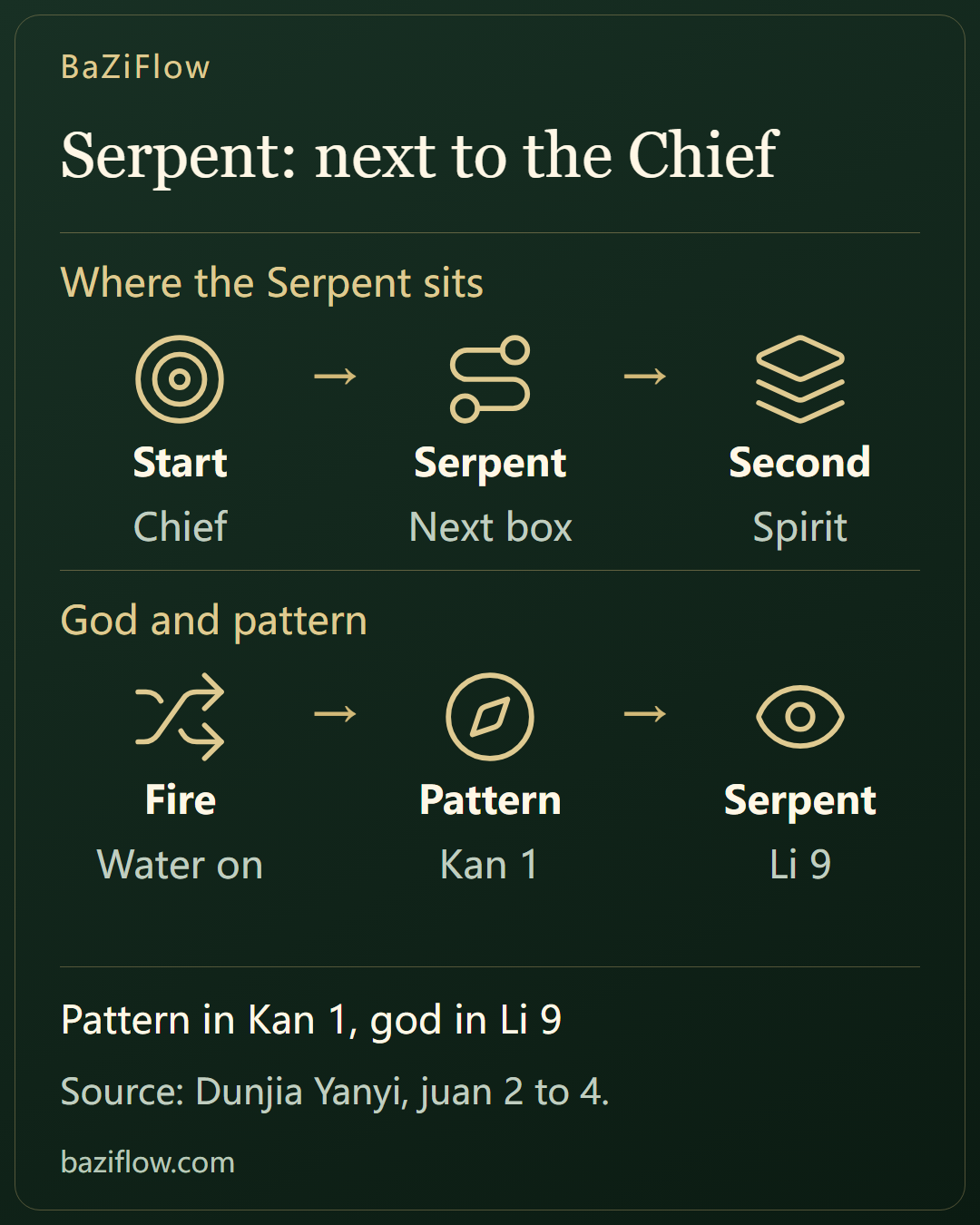
The Serpent is the second of the eight gods, right behind the Chief. The Dunjia Yanyi gives it one verdict, names a stem pattern after it, and lists the name elsewhere, which keeps the chart spirit apart.
The short version8 min read
The book gives the Serpent a single line in which the verdict and its exception sit together. It follows the Chief on the chart, and a stem pattern is named after it too, though the two need not land in the same palace.
- In the order of the eight, the Serpent comes second. The two boxes that touch the Chief belong to Nine Heaven and the Serpent, and the position verse names only the first.
- Juan 3 calls it the "spirit of falsehood and deceit" and the second half adds an exception: where a wonder and a gate meet in its direction, there is no taboo. The lines on Black Tortoise and White Tiger carry the same exception.
- "Yin Water on Yin Fire" is named the Serpent's leap after the north emblem that Water takes, the Black Tortoise with its snake. The palace where it lies has nothing to do with the palace of the spirit.
Read first
Two words: the book's verdict on the Serpent
The book gives the Serpent (螣蛇) one line, and the exception is already inside it:
The Serpent is a spirit of falsehood and deceit. Whoever goes out by this direction is mostly clouded in mind, in dreams and sleep ... ; where a wonder and a gate meet in the direction, it is not to be avoided.
The first half gives the Serpent its character, falsehood and deceit, and says that going out by its direction mostly goes with a clouded mind and uneasy sleep. The second half is a condition: if a wonder and a gate meet in that direction, the Serpent need not be avoided. This passage does not spell out what "meet" means; how wonder, gate and spirit are counted in one palace is in the article on Great Yin.
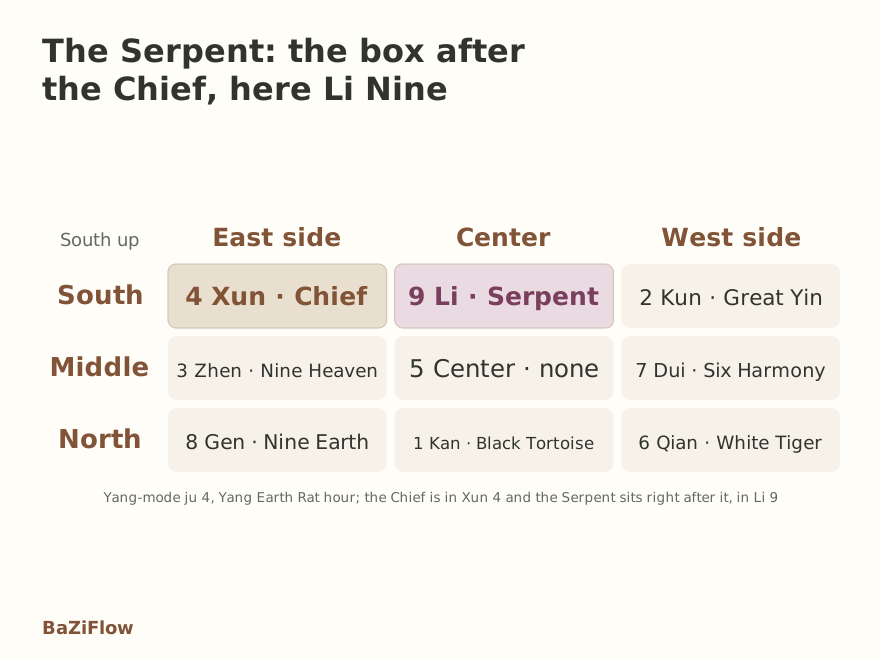
Nine-palace base grid with south at the top and east on the left; the order of the spirits follows juan 3 of the Dunjia Yanyi and the positions come from this site's rotating-plate method. Beige is the Chief and pink the Serpent.
The chart shown is a Yang-mode ju 4 board for the Yang Earth Rat (戊子) hour: the Chief is in Xun Four and the Serpent falls in the next box, Li Nine.
Enlarge diagram · scroll sideways to read
The box after the Chief: how to count the Serpent
The Serpent is second of the eight gods, right behind the Chief. The book's position verse names only a few: two ahead is Great Yin, three ahead Six Harmony, one back Nine Heaven, two back Nine Earth. The Serpent is not named; its place follows from the order. Of the two boxes touching the Chief, one holds Nine Heaven and the other the Serpent, and the verse leaves that second box out.
Enlarge diagram · scroll sideways to read
Yang mode steps forward and Yin mode reverses. In the Yin-mode ju 9 chart for a Yang Fire Tiger (丙寅) hour the Chief is in Kun Two, the Serpent steps back to Li Nine, and Nine Heaven steps on to Dui Seven, which is where juan 2 puts that chart's Nine Heaven. Recomputed palace by palace with this site's method, the Serpent lands in just these places for both the Yang-mode ju 4 Yang Earth Rat hour and the Yin-mode ju 9 Yang Fire Tiger hour.
Yin Water over Yin Fire: a pattern named for the Serpent
The Dunjia Yanyi (遁甲演义) also has a pattern named for the Serpent. It uses stems and is a different thing from the spirit layer. The verse in juan 2 reads:
Yin Water on Yin Fire: leaping and stumbling, the road is lost. Anxious and unable to advance, sitting still yet uneasy.
The note under the verse explains the name plainly: Yin Water (癸) belongs to Water, Water to the north, and the north's Black Tortoise has the image of a tortoise and a snake; Yin Fire (丁) belongs to Fire. So heaven-plate Yin Water laid over earth-plate Yin Fire is called the Serpent's leap. The entry just before it is the mirror image: Yin Fire is Fire, matched with the Vermilion Bird (朱雀), and Yin Fire over Yin Water is the Vermilion Bird entering the river. (Heaven and earth plates are set out in the article on the three wonders and six instruments.)
The book's example is the Yang-mode ju 4 chart for a Yang Earth Rat hour on a Yang Fire or Yin Metal day in the lower phase of the Winter Solstice: the chief star Tian Xin is carried to palace four, where the time stem Yang Earth (戊) sits, and Tian Ying, carrying Yin Water, is carried to palace one, right on top of earth-plate Yin Fire. That is the chart above. Put back on the chart, it shows something curious:
Enlarge diagram · scroll sideways to read
The leap is in Kan One, where the Black Tortoise sits; the Serpent spirit is in Li Nine, where the Vermilion Bird pattern lies. A pattern name takes its image from the stems, a spirit name takes its place from the order, and neither causes the other. The conditions differ too. The spirit's line says "where a wonder and a gate meet, no taboo", while the entry on the leap adds a line after its example:
Even with a wonder and a gate present, it still brings groundless alarm and unrest.
One has an exception and the other does not, so the line on the spirit and the entry on the pattern cannot borrow from each other.
One name, four lists
The name Serpent appears in several other places. The chart's spirit layer is one list; the invocations and the noble table are others, and the neighbors around the name differ in every one:
Enlarge diagram · scroll sideways to read
In the "Jade Maiden reverse closing" spell of juan 3 the Serpent follows Gou Chen (勾陈) and comes before Six Harmony; in the travel spell of juan 4 the Serpent again follows Gou Chen, with White Tiger next. The "private gate of the earth" passage of juan 2 sets out twelve nobles, and the Serpent comes straight after the Noble (贵人). The spirit layer of this site's hourly chart has no Gou Chen at all (the hourly chart uses White Tiger and Black Tortoise; Gou Chen and Vermilion Bird are another way of writing the set, used here only on the experimental daily chart), so these lists only look alike.
Does the name match? Two short tests
Self-test
Yang-mode ju 4, Yang Earth Rat hour, the Chief in Xun Four: where is the Serpent?
One box forward along the outer ring is Li Nine; one box back is Zhen Three, which holds Nine Heaven.
In that same chart, does the box with Yin Water over Yin Fire hold the Serpent?
No. Yin Water over Yin Fire is in Kan One, where the Black Tortoise sits; the Serpent is in Li Nine, where Yin Fire over Yin Water is the Vermilion Bird entering the river.
The spirit just before the Serpent is the Chief and the one just after is Great Yin; for what the doors, the stars and the spirits each cover, start with the three layers of a chart.
Questions readers ask next
How do I find the Serpent on a chart?
Find the palace of this hour's Chief, then move one box along the outer ring: forward in Yang mode, the other way in Yin mode. In a Yang-mode ju 4 Yang Earth Rat hour the Chief is in Xun Four, so the Serpent is in the next box, Li Nine.
Is the Serpent in "Serpent leaps" the same as the chart spirit?
No. The leap is a name for heaven-plate Yin Water laid over earth-plate Yin Fire and is judged from stems; the chart spirit is counted out from the Chief. In the book's example chart the leap sits in Kan One, where the spirit is the Black Tortoise, and the Serpent is in Li Nine.
The Serpent, Gou Chen and the Black Tortoise are mixed up all the time. How can I sort them out?
Look at which list the name is in. The chart's spirit layer is one fixed order of eight; the invocation lists and the noble table serve other purposes and each puts different neighbors around the name. This site's hourly chart has no Gou Chen among its eight; the experimental daily chart uses Gou Chen and Vermilion Bird in place of White Tiger and Black Tortoise, and the Serpent is second in both sets.
Was this article helpful?
Sources & references
Continue reading
Zhi Fu: the First of the Eight Spirits, and the Star That Shares Its Name ↗
Great Yin: Two From the Chief, and the Book's Count of Wonder, Gate and Spirit ↗