

Six of Swords: the ferry and the far shore
Content version · · Sources & references
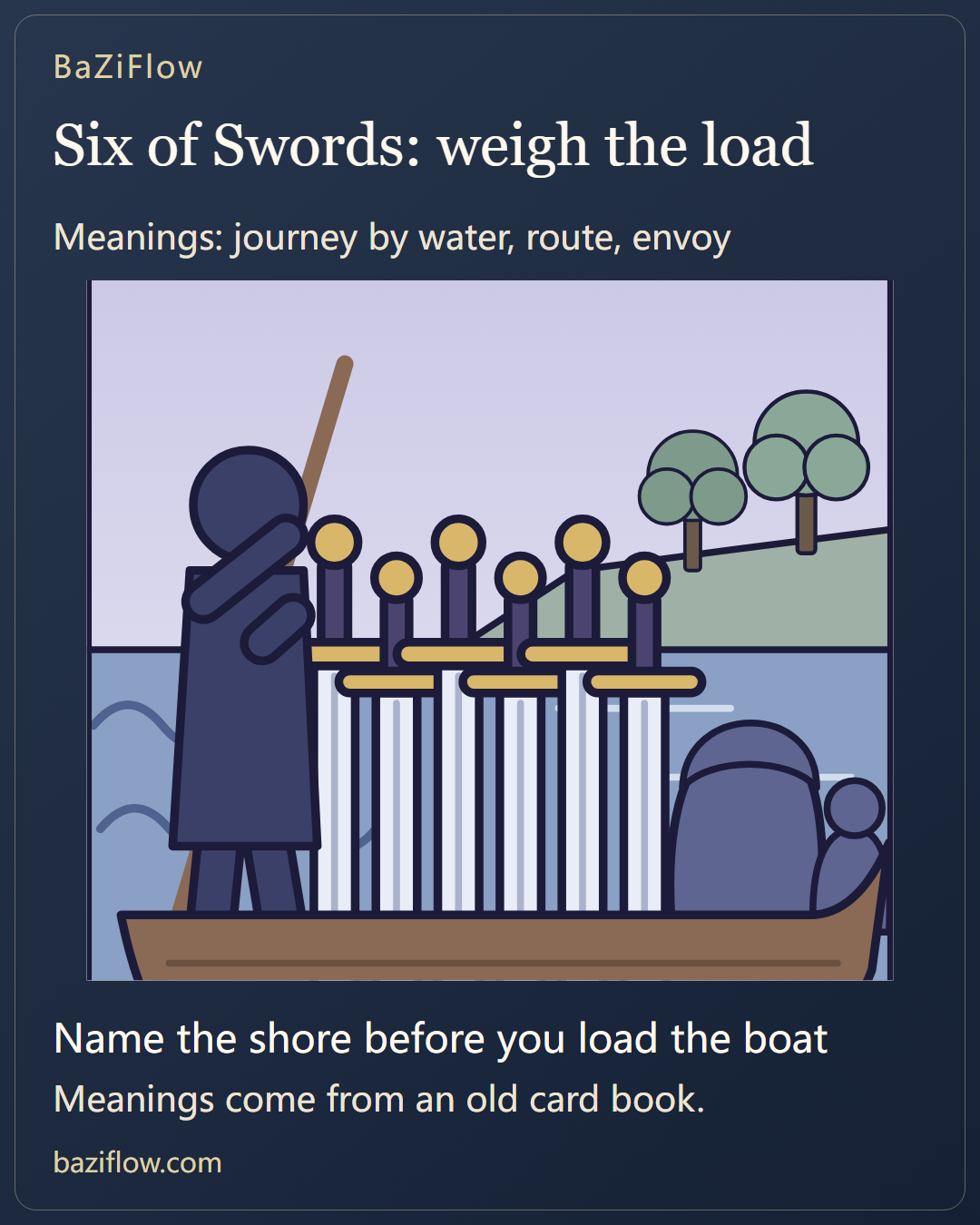
The Six of Swords shows a ferryman poling a punt of passengers and swords to the further shore. See the three notes Waite adds, then use shore, load and strength to sort the items for an internship application.
The short version6 min read
The Six of Swords has a boat, a ferryman, six swords and a far shore, and Waite adds three remarks: the course is smooth, the freight is light, the work is not beyond his strength.
- Waite's description: a ferryman carries passengers in his punt to the further shore; the course is smooth and the freight light, so the work is within his strength.
- The upright words are journey by water, route, way, envoy, commissionary, expedient. His description mentions no swords; the six swords are part of the RWS drawing.
- Reversed: declaration, confession, publicity, with one account calling it a proposal of love. Other readers give a pleasant voyage upright and an ill-fated lawsuit reversed, in period wording.
Read first
Start with the picture: a punt, a ferryman, a further shore
Waite writes: a ferryman carrying passengers in his punt to the further shore. The course is smooth, and seeing that the freight is light, it may be noted that the work is not beyond his strength. He does not mention swords, and he does not say who the passengers are.
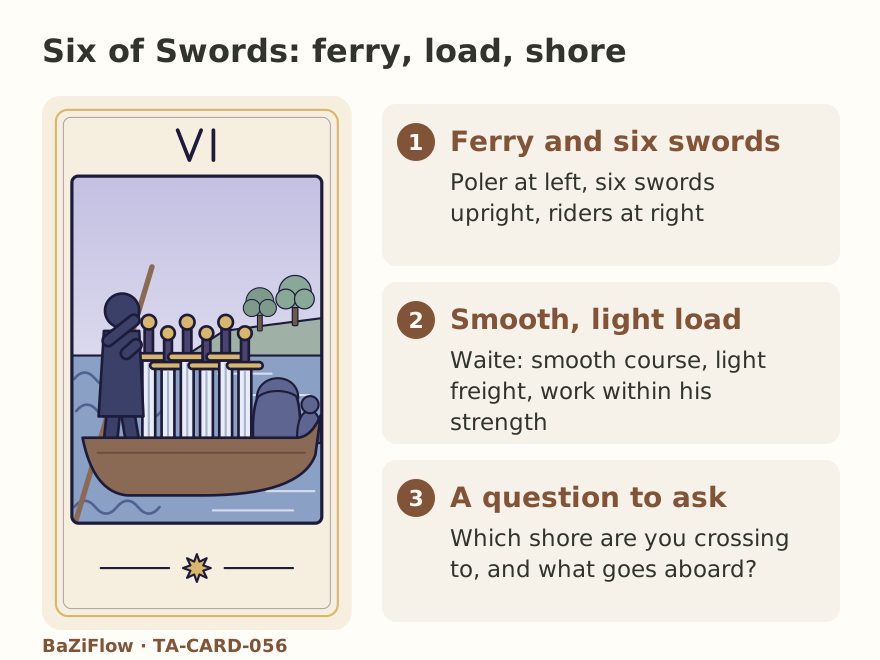
BaZiFlow original Six of Swords with three labels
The RWS card fills in details. The ferryman stands in the stern with both hands on a long pole; two passengers sit in the boat, one cloaked with a bowed head and the other small; six swords stand upright in the boat; the far side is a low bank with a few trees. BaZiFlow's original card follows that plan, with the poler at left and the riders at right. From far to near, the picture has three layers:
Enlarge diagram · scroll sideways to read
What Waite lists: journey, route, envoy, and the word "expedient"
Waite's divinatory meanings are: journey by water, route, way, envoy, commissionary, expedient. All six have to do with carrying across: how to go, which way, on whose behalf, by what means.
Journey by water, route, way, envoy, commissionary, expedient.
Enlarge diagram · scroll sideways to read
In his description Waite adds three remarks outside the word list: the course is smooth, the freight light, and the work not beyond the ferryman's strength. These are a rare plain statement, on this card, about whether the thing is easy or hard.
Ferryman, far shore, freight: three things Waite names
Three things in the picture are worth separating, all named by Waite:
Three named things, and what each points to
- Ferryman
- Waite says the work is not beyond his strength. That is a remark about the state of the ferryman and says nothing of the weight of the passengers or the swords.
- Far shore
- Waite has the punt go "to the further shore", and writes nothing of what is over there.
- Freight
- Waite says the freight is light. In the RWS drawing six swords stand in the boat with two riders, and the boat still moves smoothly.
Enlarge diagram · scroll sideways to read
"The far shore as where you are going" and "the freight as what goes along" are later usages. The next section builds on both. They are borrowed readings, and Waite's own text has neither.
Putting it to use: name the shore, weigh the load, estimate strength, in an internship application
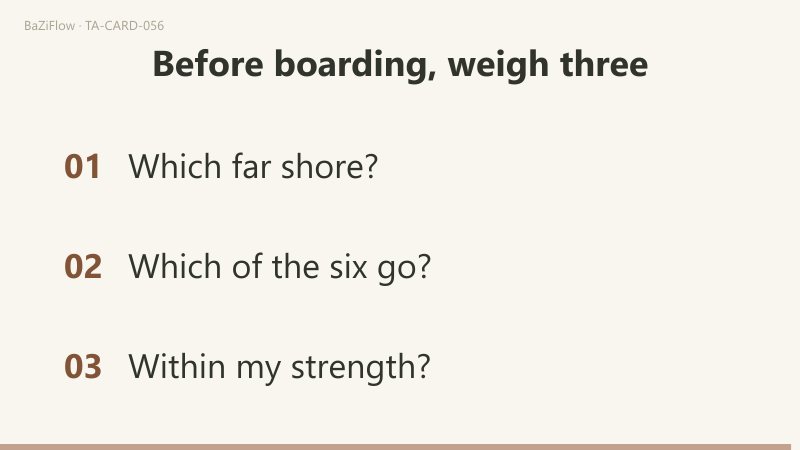
Waite's three remarks line up as three actions: there is a shore first, then a load, and last the question whether you can pole it.
Shore: write down which bank you are heading to
A ferry goes somewhere; it does not drift. Write down the shore for this trip: one particular post and one deadline. If there are several shores, cross them one at a time.
Load: what goes aboard should be light
Six swords stand in the boat. Count what you plan to bring on this trip and ask of each item: will it be used on the far side? What stays on this shore is not thrown away.
Strength: can the ferryman pole it
Waite makes a point of this. Estimate the hours each item needs, see whether the sum lies within what you can handle, and only then decide how many to take.
An example: an application for a summer internship is due in nine days, and you have six items you could attach. Lay them out by whether they go and how long they take:
Enlarge diagram · scroll sideways to read
How to look at a boat loaded this way
Can read
- What goes, with hours for each
- A total within strength
Cannot read
- Taking all six is the serious way
- The two left behind are lost
Next step
- Give the two a condition
- Check the hours against the deadline
Reversed, additional meanings and neighbors: from "carried across" to "said aloud"
Waite writes the reversed card as declaration, confession, publicity, and adds that "one account says that it is a proposal of love". It is still a crossing: the upright words say how things get carried across, the reversed ones say what is brought into the open.
Enlarge diagram · scroll sideways to read
Waite also records two short notes: upright, "the voyage will be pleasant"; reversed, "unfavourable issue of lawsuit". This is old card-book wording for a kind of situation, not a judgment on any lawsuit and not legal advice.
Three neighbors: going away, rushing, carrying over
A man leaves the cups
Waite says it shows the decline of a matter, or that something thought important is of slight consequence.
A flight of wands through the air
The list is activity, speed, the haste of an express messenger; the things themselves are what moves.
The next card
A man hurries off with five swords while two stay stuck in the ground; the list leans on design, attempt and hope, with some quarreling.
Questions readers ask next
Is the Six of Swords the leaving-a-sad-place card?
Waite's list is journey, route, envoy, expedient, and it speaks of being carried to the further shore; it names no reason for leaving and no mood. Reading it as "leaving a place of sorrow" is a later reading, and you should say where it comes from.
What do the six swords stand for?
Waite's description does not mention swords. In the RWS drawing six swords stand in the boat, matching the card's number. Reading them as "what you carry across" is a teaching borrowing and not Waite's wording.
What does the reversed Six of Swords mean?
Waite writes declaration, confession, publicity, and says one account takes it for a proposal of love. The weight moves from "carried across" to "said aloud".
Was this article helpful?
Sources & references
Continue reading
Five of Swords: one holds three blades, two lie fallen, and the list speaks of loss ↗
Seven of Swords: five in arms, two in the ground, and a list at odds with itself ↗