

Yi (益): increase flowing down, and a word “someone”
Content version · · Sources & references
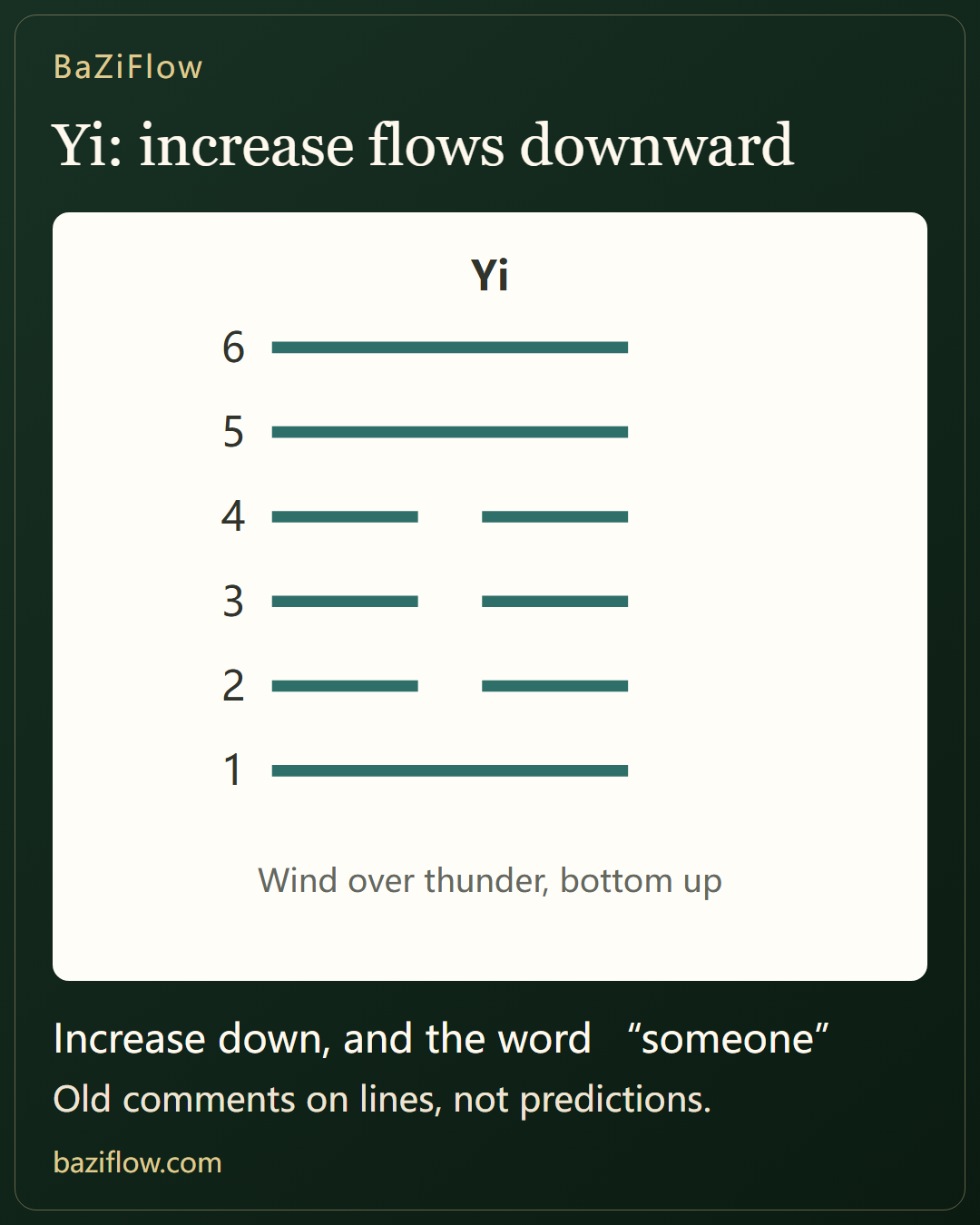
Yi (益) is the 42nd hexagram: Xun (wind) above Zhen (thunder). Read “reduce the above, add to the below”, the Great Image on moving toward good and mending faults, and a Small Image that says “from outside” twice.
The short version7 min read
In Yi the increase runs downward: a little less above, a little more below. Yet the same word “someone” gives a gift in line 2 and delivers a blow in line 6, and the Small Image comments on both with the same words: it comes from outside.
- Yi stacks Xun (wind) on Zhen (thunder). Against Pi only lines 1 and 4 swap polarity, so the upper trigram loses a yang line and the lower gains one, which fits “reduce the above, add to the below”.
- The Commentary says “moving and entering, progress every day has no limit” and links “fitting to cross the great river” to “the way of wood”. The Great Image has two halves: seeing good, move toward it; having a fault, mend it.
- The Small Image gives “from outside” to both a gift (line 2) and a blow (line 6). Two neighboring lines, 3 and 4, walk the middle and report to the duke, and line 5 says “kindness” twice.
Read first
The Sixty-Four Hexagrams: How Upper and Lower Trigrams Form One Figure ↗
Judgment and Line Statements: Whole Hexagram or Single Line? ↗
Wind above, thunder below: entering and moving
The upper trigram of Yi (益) is Xun (wind) and the lower is Zhen (thunder). In the Shuo Gua Xun is “entering” and Zhen is “moving”, and another sentence there puts the two together: thunder and wind press on each other. On the figure the yang lines occupy the first place and the fifth and sixth, with three yin lines between them.
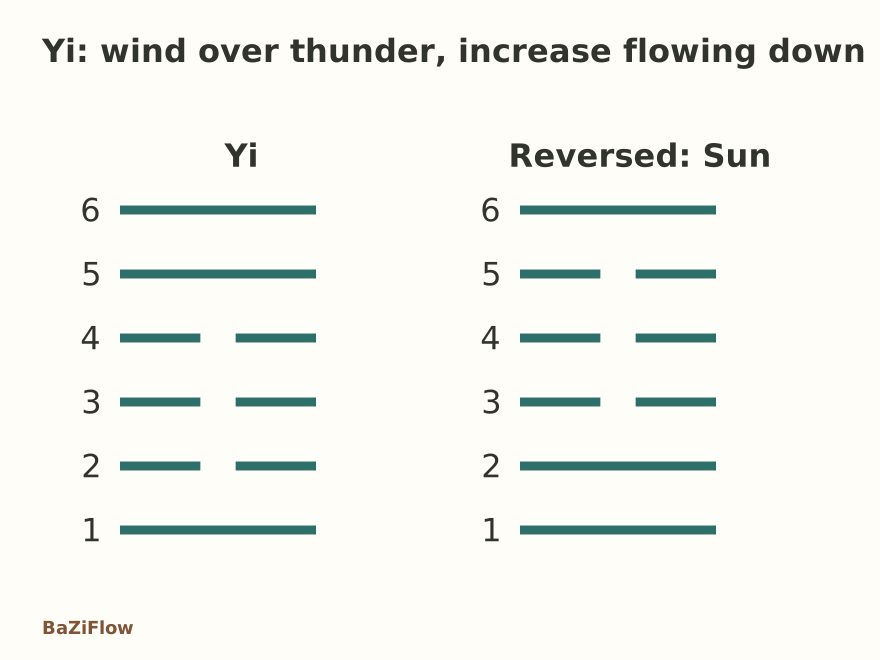
Yi and its reversed hexagram Sun: turned upside down, the Xun above Yi becomes the Dui below Sun, and the Zhen below Yi becomes the Gen above Sun.
Enlarge diagram · scroll sideways to read
Three words: increase, without limit, the way of wood
- Yi
- Literally, to increase. The Commentary defines it in its first words: reduce the above, add to the below.
- Without limit, without fixed place
- The run of “withouts” in the Commentary: the people are pleased without limit, progress each day has no limit, the increase has no fixed place. No boundary and no set destination.
- The way of wood
- After “fitting to cross the great river”, the Commentary says “the way of wood is then moving”. In the Shuo Gua Xun is wood, and tradition usually reads the phrase as boats moving on water.
The judgment and the Commentary: reduce the above, add to the below
The judgment of Yi has only two sentences: fitting to have somewhere to go; fitting to cross the great river. The Commentary on the Judgments says first in which direction the increase runs, and then explains the two sentences.
Yi: reduce what is above and increase what is below; the people are pleased without limit. Coming down from above to below, its way is greatly bright. “Fitting to have somewhere to go”: the middle and the proper bring celebration. “Fitting to cross the great river”: the way of wood is then moving. Yi moves and enters, and progress each day has no limit. Heaven bestows and earth brings forth, and the increase has no fixed place. Every way of increasing goes along with the time.
Enlarge diagram · scroll sideways to read
“Reduce the above, add to the below” can be checked on the figure. Compared with Pi (Kun below, Qian above), line 1 of Yi turns from yin to yang and line 4 from yang to yin: a yang line has left the upper trigram and arrived in the lower. “From above to below” is that increase passing down from the upper trigram to the lower.
“The middle and the proper bring celebration” is traditionally matched to the figure as well. Line 2 is a yin line in the second place and line 5 a yang line in the fifth, each in the center of its trigram and each in its proper place, and the two answer as yin and yang. “Moves and enters” is the lower Zhen moving and the upper Xun entering, and “progress each day has no limit” says the going on never stops. “Heaven bestows and earth brings forth, and the increase has no fixed place”: heaven gives, earth brings forth, and the increase has no set destination. The last sentence closes on going along with the time, a phrase the Commentary on Sun also uses at its end.
The Great Image: seeing good, move; having a fault, mend
The Great Image (大象) of Yi reads:
Wind and thunder: Yi. The noble person, seeing good, moves toward it; having a fault, corrects it.
“Wind and thunder” are the images of the two trigrams, and they are the image in this sentence. What the noble person is to do comes in two halves, each a condition with an act.
Enlarge diagram · scroll sideways to read
The two verbs can be read as pointing in different directions: to move is to go outward, toward the good, and to correct is to work inward on one’s own fault. The word “move” turns up in the lines too: line 4 says “fitting to rely on this to move the state”.
Six lines: one word “someone”, once a gift and once a blow
In the six statements of Yi the comings and goings of increase are handed out to different people.
Enlarge diagram · scroll sideways to read
Line 1 says “fitting to use for a great undertaking”, with “supreme good fortune, no blame”. The Small Image says “the lower carry no heavy affairs”, which tradition usually reads as: one in a low place should not take on weighty matters.
Line 2 and line 6 share the word “someone”. In line 2 someone adds to it, and even ten peng of tortoise shell could not refuse it (a peng is an old unit for counting cowries); the Small Image says it comes from outside. In line 6 no one adds to him and someone strikes him, and the Small Image’s verdict is again “it comes from outside”. The same “someone” and the same comment, once to give and once to strike. Line 6 also says “he sets his heart on nothing lasting”, and only then “misfortune”.
Side by side, lines 3 and 4 use the same words. Line 3 has “sincere, walking the middle, he reports to the duke with a jade tablet”, and line 4 “walking the middle, he reports, and the duke follows”: both walk the middle and both report to the duke. In line 3 he holds a ritual tablet of jade; in line 4 the duke follows, and the Small Image remarks that it “adds to his aim”.
Line 5 reads “sincere, with a kind heart” and then “they take my virtue as a kindness”, so the word for kindness occurs twice in one line: a kind heart first, then virtue received as a kindness. Tradition usually reads the second as others taking my virtue to be a favor. “No need to ask: supreme good fortune”, and the Small Image closes by saying he greatly attains his aim.
Heng, Bo and Guai: neighbors of Yi
Turn Yi upside down and you get Sun, so Sun is its reversed hexagram (综卦; see the figure above). Its inverse hexagram (错卦) is Heng (恒): change each line of Yi to its opposite and Heng appears, and Heng uses the very two trigrams of Yi, Zhen and Xun, with Zhen above and Xun below. The nuclear hexagram (互卦) is read from the middle four lines as two overlapping triples. The triple of lines 2, 3 and 4 is all yin, which makes Kun, and the triple of lines 3, 4 and 5 is yin, yin, yang, which makes Gen. Kun under Gen is Bo (剥).
Enlarge diagram · scroll sideways to read
The Xu Gua puts Yi after Sun, and the hexagram after Yi is Guai: increase that does not stop is bound to break through, so Guai follows Yi.
Questions readers ask next
Is Yi all good news?
No. Line 6 reads “no one adds to him; someone strikes him; he sets his heart on nothing lasting: ill fortune”, and line 3 speaks of increase “used on grave affairs”. The judgment is “fitting to have somewhere to go”, but among the six statements there are those who are given and those who are not.
Does “reduce the above, add to the below” mean the top loses out?
Literally the upper trigram gives up a line and the lower gains one, and the Commentary goes straight on to “the people are pleased without limit” and “its way is greatly bright”. It is the exact opposite of its reversed hexagram Sun, “reduce the lower, add to the upper”; each is the other turned upside down.
How are “fitting to cross the great river” and “the way of wood” connected?
In the Shuo Gua Xun is wood. Tradition usually reads the phrase as travel by boat over water, though the text does not spell it out. The Commentary only ties the judgment’s river crossing to what Xun pictures.
Was this article helpful?
Sources & references
Continue reading
Sun: a lake under a mountain, from “two bowls may be used” to “without reducing, he adds” ↗
Guai: a lake above heaven, from “proclaim in the court” to “no call” ↗
The Sixty-Four Hexagrams: How Upper and Lower Trigrams Form One Figure ↗
Judgment and Line Statements: Whole Hexagram or Single Line? ↗