

Aspect angles and orbs: measure before interpreting
Content version · · Sources & references
Work through circular separation, distance from an exact aspect and a chosen tolerance. Learn why a static angle does not establish applying motion or guarantee a life outcome.
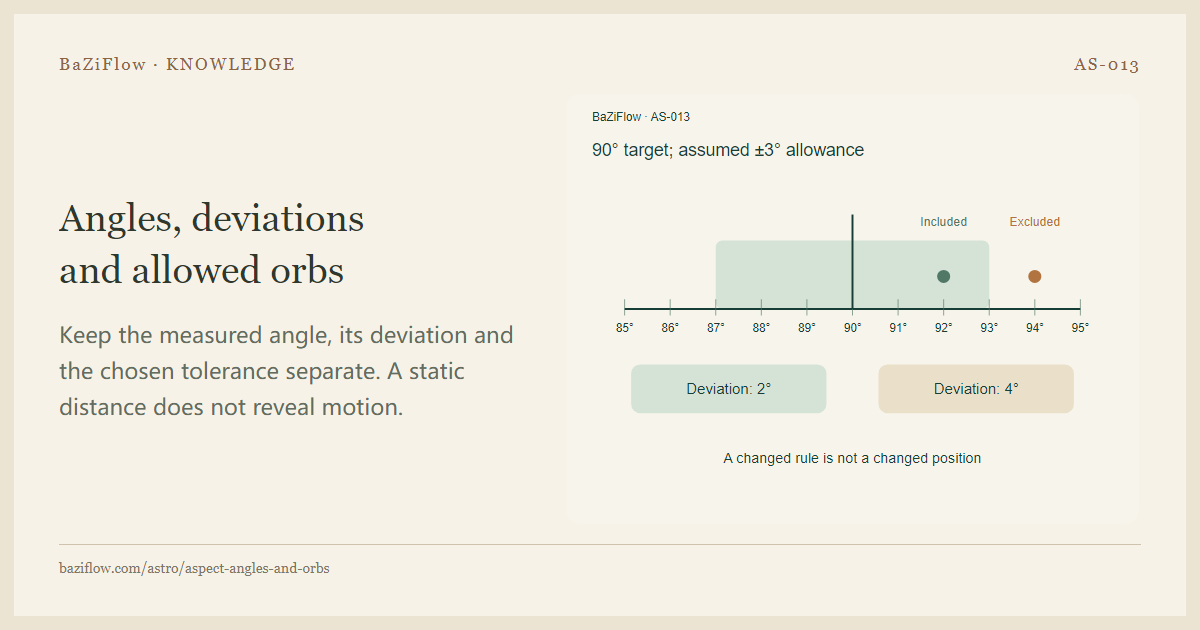
Keep the measured angle, its deviation and the chosen tolerance separate. A static distance does not reveal motion.
Read first
A line on the chart has a test behind it
A coloured line is the end of a calculation, not the calculation itself. To audit it, you need two positions, a target angle and a tolerance rule. Keep those three things separate from the meaning an author attaches to the line. You can reproduce an aspect calculation without accepting a prediction made from it.
Here, “actual deviation” means the difference between the measured separation and an exact aspect angle. “Allowed orb” means the largest deviation a particular method accepts. People often use orb for both, so a note saying only “orb 3°” can be ambiguous. Is three degrees the measured error, or the chosen limit? Write out the distinction when comparing results.
The examples below contain invented positions and rules. They are deliberately simple enough to check with subtraction. They are not a chart for a real or imagined person, nor a recommendation that every aspect should use the same allowance.
Begin with the awkward case: crossing zero
Place one object at longitude 350 degrees and another at 10. Straight subtraction gives an absolute difference of 340 degrees. On a circle, however, the shorter route crosses zero and measures only 20 degrees: 360 minus 340. A calculation that forgets the wraparound can turn neighbours near the origin into apparently distant objects.
For this form of longitude aspect, calculate the absolute difference and, when it exceeds 180 degrees, subtract it from 360. Use full zodiacal longitudes rather than numbers detached from their signs. Ten degrees into one sign is not necessarily near ten degrees into another. The sign's starting longitude must be included before comparing the values. Zodiac origins are a separate coordinate question.
This method concerns separation in ecliptic longitude. It does not calculate a three-dimensional angular distance that also incorporates latitude. Naming the quantity is part of doing the calculation correctly: a precise answer to the wrong geometrical question is still the wrong comparison.
Turn a target into an acceptance interval
Use a square, whose exact target is 90 degrees. Positions of 15 and 107 degrees are separated by 92, giving a deviation of two degrees. Positions of 15 and 109 are separated by 94, giving a deviation of four. If the selected allowance is three degrees and endpoints count, the first pair qualifies and the second does not. The acceptance interval is 87 through 93 degrees.
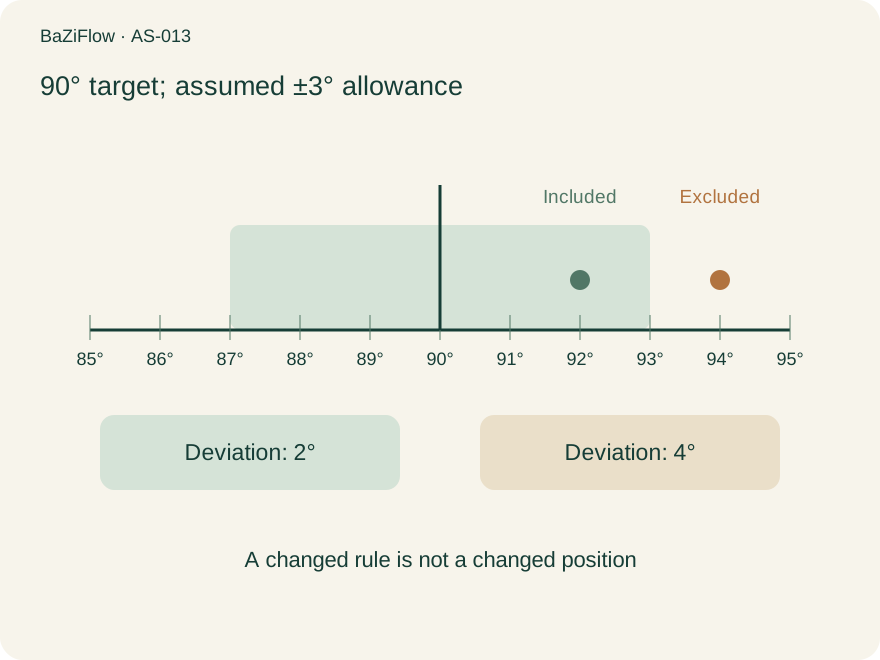
Original BaZiFlow teaching diagram; the ±3° threshold is an illustrative choice.
The original 92-degree separation stays 92. Accepting it as a square does not rewrite the positions or declare that 92 equals 90. Nor is an excluded 94-degree pair missing data: its geometry may be perfectly known while the chosen display rule excludes that aspect. With an allowance of four degrees, including endpoints, the same pair would qualify.
| Separation | Distance from 90° | Rule selected for this exercise | Result |
|---|---|---|---|
| 92° | 2° | At most 3° | Included |
| 94° | 4° | At most 3° | Excluded |
| 94° | 4° | At most 4° | Included |
This is why a disagreement between aspect lists need not be a disagreement between ephemerides. The underlying positions may match exactly. Check the rules before reporting a numerical error. Near an endpoint, also distinguish displayed rounding from the internal value: a printed 3.00 need not be exactly three.
Historical vocabulary does not supply every modern default
In Book I, chapter 13 of the Tetrabiblos, Ptolemy discusses the opposition, trine, square and sextile using their angular structure: 180, 120, 90 and 60 degrees. Modern aspect tables commonly also include the conjunction at zero, and may enable additional angles. This historical text helps locate a tradition; it is not a complete specification for a contemporary application's settings.
A product's official documentation is the appropriate source for its actual defaults. TimePassages, for example, separates allowances by chart type. That is evidence that the rule belongs to the selected method and product, not a universal numerical property of two celestial objects. It does not make that product's values mandatory elsewhere. Preserve the chart type, objects, aspect set and software version when comparing outputs.
Avoid widening a rule only after noticing that a desired line is missing. Such a change can manufacture agreement with an interpretation. If a different method is worth exploring, label it as a different method and keep both results, including the lines that disappear or appear elsewhere in the chart.
Motion requires a sequence, meaning requires more
An instantaneous separation of 92 degrees cannot by itself tell you whether a pair is approaching an exact square. Compare two invented sequences: 94, 92, 90 moves toward the target; 90, 92, 94 moves away. Both contain the same middle value. Their deviations are respectively 4, 2, 0 and 0, 2, 4. Applying and separating require change through time, not just a static distance.
Real bodies can slow, station and reverse apparent direction. A reliable calculation needs the relevant motions of both objects and cannot extrapolate a simple teaching sequence indefinitely. Nor does “approaching exactness” mean a particular event must occur. Motion can be checked against positions; a claim about somebody's life requires a different argument.
Finally, identify whose positions the line connects. A natal-to-natal relation within one chart, a transit-to-natal relation and a relation between two people's charts are different statements even when their angles match. An attractive diagram cannot repair a missing subject or time scope. With the numerical rule made explicit, continue to why major aspects are not simple good-or-bad labels for the interpretive question.