

Kan (坎): sinking, toil, return and due north
Content version · · Sources & references
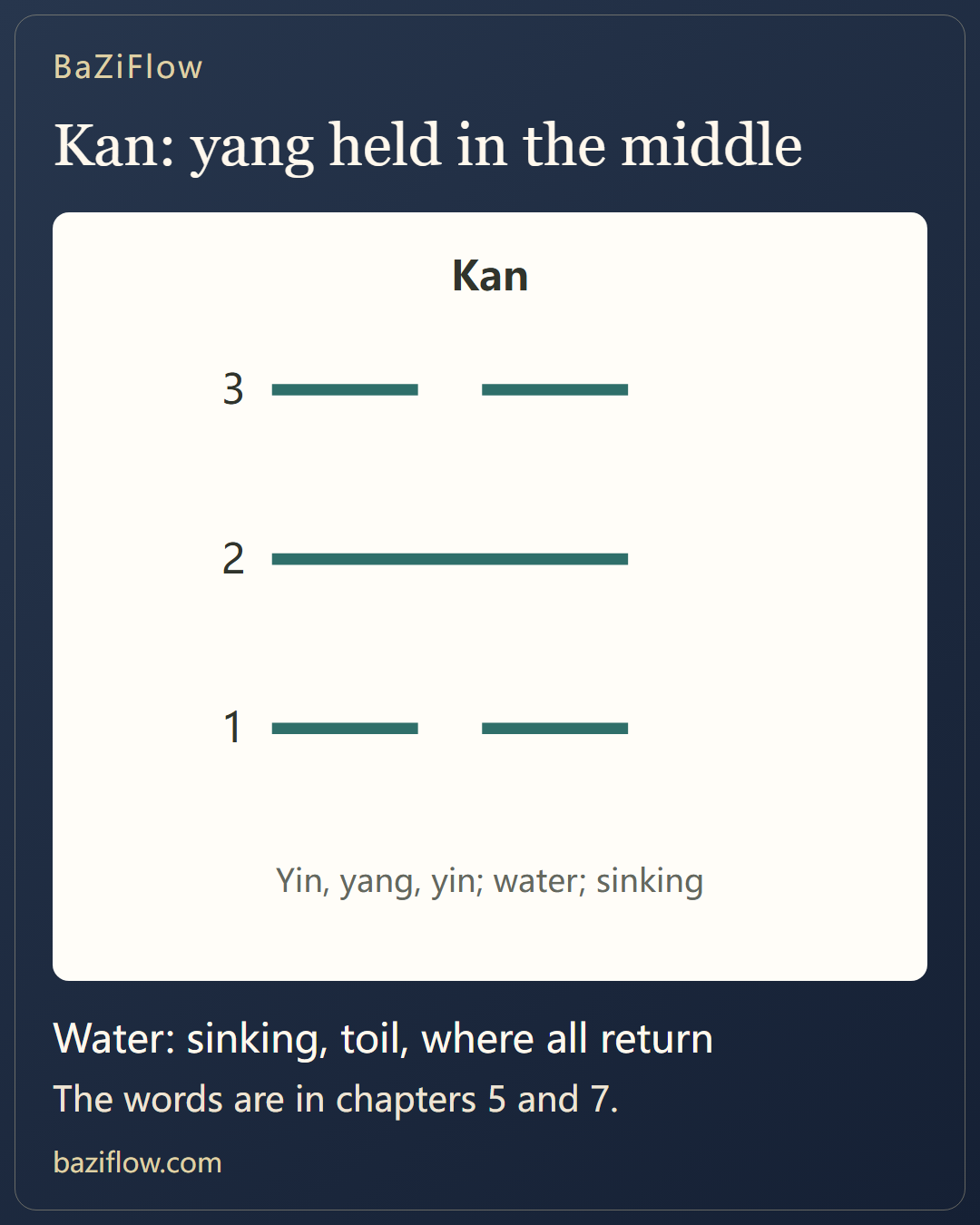
Kan has a yang line held between two yin lines. Read its three words, sinking, toil and return, the two places in chapter 5 that say "due", the twenty-item chapter 11 list, and the repeated Kan of hexagram 29.
The short version5 min read
Chapter 5 uses the word "due" (正) only twice, once for Dui as "mid-autumn" (literally "due autumn") and once for Kan, "the trigram of due north"; the same entry calls it the trigram of toil, where all things return, and chapter 7 gives it the word sinking. Its figure is a yang line held between two yin lines.
- Kan's yang line is held between two yin lines; its inverse is Li, and turned upside down Kan is still Kan.
- Only two places in chapter 5 use the word for "due": Dui's "mid-autumn" and Kan's "due north"; Kan is also called the trigram of toil and where all things return.
- The chapter 11 list for Kan has twenty items, with four sub-lists opening "of people", "of horses", "of carriages" and "of trees", the most such sub-lists of any trigram.
Read first
Eight Trigrams: Three-Line Structure and Basic Images, Read Through the Shuo Gua ↗
A yang line held in the middle
Kan (坎) is one yang line with a broken yin line pressed above and below it, and the memory verse says "Kan is full in the middle". Set it against Kun (坤) and the two differ only in the middle line: Kun is three yin lines, and when the middle one is made yang the result is Kan.
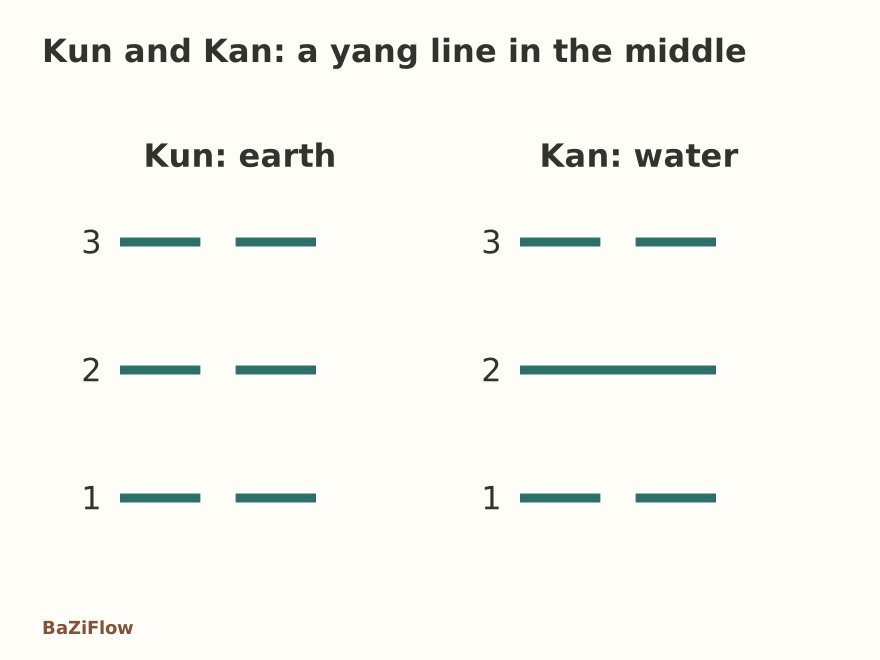
Kun beside Kan: make the middle line of Kun yang and you have Kan; Kun's image is earth and Kan's is water.
Enlarge diagram · scroll sideways to read
Kan's inverse is Li, with every line swapped, and Kan turned upside down is still Kan, which it shares with Li; see the Li trigram. Chapter 10 of the Shuo Gua (说卦) puts Kan in the middle of the family: "by a second seeking got a son", the middle son.
Three words: sinking, toil, return
The word chapter 7 gives to Kan is sinking. Chapter 5 writes it from two other directions:
Three words the Shuo Gua writes for Kan
Kan is sinking
One of the eight nature words: to fall in, to go down.
The trigram of toil
Chapter 5 calls Kan the trigram of toil and sets it at the seventh of the eight stops: "toil in Kan".
Where all things return
The very next sentence: the place all things come back to.
The three words point different ways: sinking is downward, returning is back to one place, and toil is a stop on the journey. The text gives only "the trigram of toil" and "where all things return" and does not take the words apart, so a reader does not need to supply an explanation for it.
Due north: one of two places that say "due"
When chapter 5 gives directions it uses words such as east, southeast, south, northwest and northeast. In the whole chapter only two entries carry the word for "due": Dui is "mid-autumn" (正秋, literally "due autumn") and Kan is "due north".
Enlarge diagram · scroll sideways to read
On the Later Heaven diagram Kan is in the north. On the Prior Heaven diagram Kan is in the west, opposite Li in the east. Autumn goes with the west, so Dui stands in the west on the Later Heaven diagram, one in the north and one in the west.
Of people, horses, carriages, trees: the longest list
Kan's entry in chapter 11 is the longest, with twenty items. The first sentence reads:
Kan is water, ditches and channels, hiding and lying low, straightening and bending, bows and wheels.
Four sub-lists after it open "of ...", taking people, horses, carriages and trees in turn. Under carriages stands "many mishaps"; whether the next three, passing through, moon and thief, still belong to carriages depends on how an edition punctuates, so the table lists them apart. No other trigram has as many of these small sub-lists.
Enlarge diagram · scroll sideways to read
Repeated Kan: water arriving again and again
The six-line Kan is hexagram 29, named "repeated Kan". The Commentary on the Judgments explains the name itself:
Repeated Kan means double danger.
The first half of the Great Image reads:
Water arrives again and again: repeated Kan.
The second half gives the noble person's way: to keep virtue constant and to practice the work of teaching, over and over.
Enlarge diagram · scroll sideways to read
"Arrives again and again" is the sense of the word in the Great Image: wave after wave of water is a repeated Kan. The six-line Kan is read in Kan, the hexagram; the trigram that comes after Kan is Gen.
Questions readers ask next
Does the Shuo Gua call Kan an unlucky trigram?
The word in chapter 7 describes the trigram's nature: to fall in. The Shuo Gua gives Kan no verdict of luck. The judgment of the six-line Kan says "there is sincerity, and the heart prospers", so one word, sinking, cannot fix its tone on its own.
Do "illness of the heart" and "blood" in the list speak about the body?
These words come from the chapter 11 sentence "of people" and are images on the list. They are not a judgment about the reader's body and are not written as cause and effect. When quoting, name the chapter, and do not turn them into a conclusion about anyone's health.
Why is Kan in the west on one diagram and in the north on the other?
The Prior Heaven diagram sets Kan opposite Li in the east, while the Later Heaven diagram follows "the trigram of due north" in chapter 5 and puts Kan in the north. The two diagrams rest on different grounds, and neither diagram is in the Shuo Gua itself.
Was this article helpful?
Sources & references
Continue reading
Xun (巽): yin at the bottom, wind and wood, and "set even in Xun" ↗
Gen (艮): yang pressed on top, and the last stop that is also the first ↗
Trigram imagery: why a round clay bowl has two possible routes ↗