

Palaces for career questions
Content version · · Sources & references
Start from the Career Palace, recompute its three sides and four directions, and split a work question into parts that each need real-world information.
The short version6 min read
A career question extends beyond a job title: begin with responsibilities, then separate resources, setting, collaboration and satisfaction.
- With Career as reference, Life and Wealth are triad partners and Partner is opposite, not Travel.
- Palace geometry differs from practical relevance; explain why Travel or Friends enters a particular question.
- Role descriptions, pay components, locations and reporting relationships require practical records, not star names.
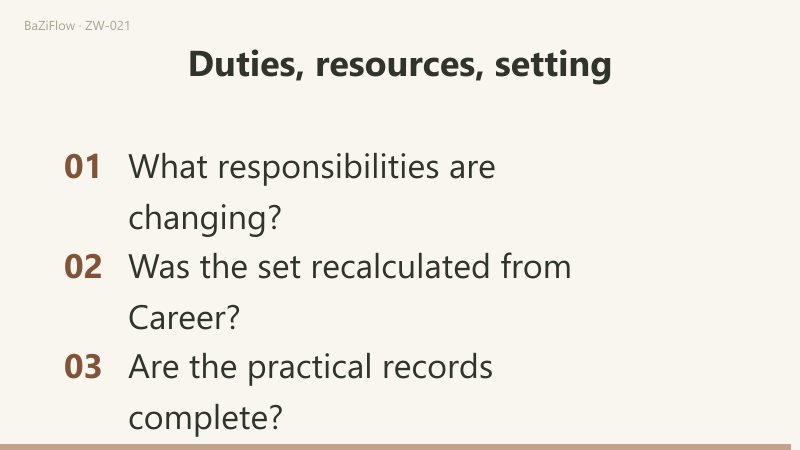
Read first
The twelve Zi Wei palaces: a map of questions ↗
Three sides, four directions: the four palaces read together ↗
Before a job change, separate the questions
A job change may alter responsibilities, pay structure, location and team relationships in different directions. Separate them before assigning palace topics.
Four-palace exercise with Career at Horse
Enlarge diagram · scroll sideways to read
Write down a real career question, such as "should I accept the offer?", and underline each thing it asks. A question like this bundles at least six: duties, motive, pay, setting, colleagues and whether the work feels worthwhile. Zi Wei Dou Shu conventionally treats the Career Palace (官禄宫) as the main entry for work questions. Read only that box and the other threads collapse into one star description. This article covers reading order only, not anyone's forecast; palace basics are in the twelve palaces.
The Career-centred set differs from the Life set
Career as reference selects a different four-palace set from Life as reference. Index eight wraps to Life, Partner and Wealth; Partner enters first as an opposite location.
Enlarge diagram · scroll sideways to read
Volume two of the Zi Wei Dou Shu Quan Shu numbers the palaces in reverse order from the Life Palace, and the full list and the general rule sit in the three-sides article. We simply plug Career in: it is position 8, so treat it as the home palace and apply the rule.
Career is 8, so 12 becomes 0 (Life), 14 becomes 2 (Partner, 夫妻宫) and 16 becomes 4 (Wealth, 财帛宫). Life and Wealth form Career's trine; Partner is its opposite. Run from Life, the formula gives Life, Wealth, Travel and Career instead, so recompute from Career rather than reusing that set.
Career at Horse: triad and opposite
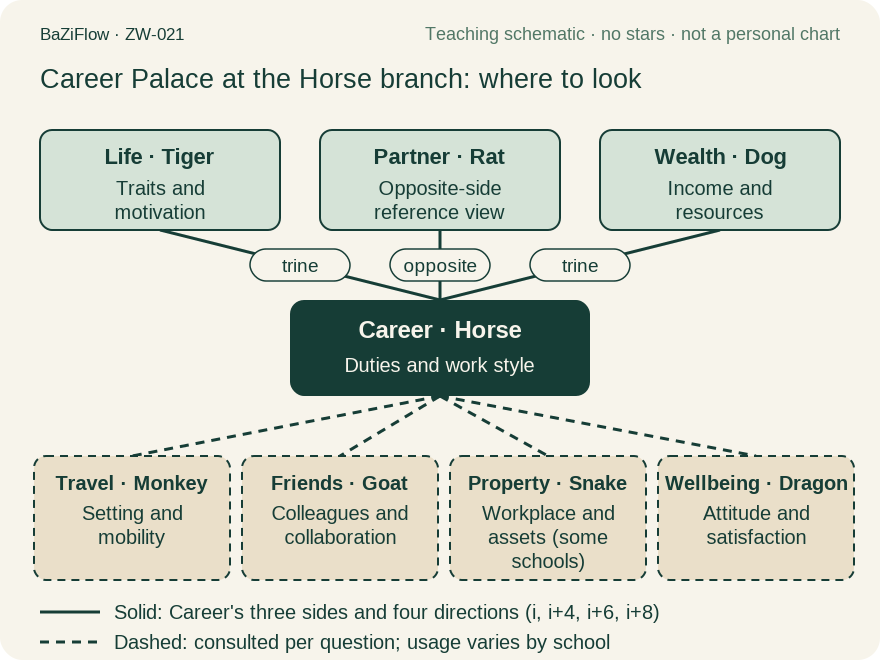
In the Career-at-Horse example, check Horse opposite Rat and the Tiger–Horse–Dog triad. The diagram has assigned topics but no stars to support a vocational reading.
Enlarge diagram · scroll sideways to read
No birth data is needed. Count branches from the Rat (子) as 0, so the Horse (午) is 6. Since palaces run in reverse, a palace's branch is Life's branch minus its number, putting Life at 6 + 8 = 14, wrapping to 2: the Tiger (寅). This is the same layout as the Life-at-Tiger example in the three-sides article, now read from Career. Wealth then falls at the Dog, Partner at the Rat, Travel at the Monkey, Friends at the Goat, Property at the Snake and Wellbeing at the Dragon. Two checks: Tiger, Horse and Dog form a standard trine, and the Rat faces the Horse.
The diagram contains no stars; it shows only where to look. Move Career to another branch and the map must be recomputed.
Pair each topic with practical records
Use checkable practical categories: role description for duties, pay components for resources, reporting lines for collaboration, and location arrangements for setting.
Enlarge diagram · scroll sideways to read
These pairings follow common modern teaching; they are conventions, and schools differ on scope and weight.
- Duties and work style: Career.
- Traits and motivation: Life. For the Body Palace, see Life and Body palaces.
- Income and resources: Wealth, meaning how resources arrive, not a salary figure.
- Setting and mobility: Travel (迁移宫), for relocation, commuting or unfamiliar surroundings.
- Colleagues and collaboration: Friends (交友宫), historically called the Servants Palace.
- Workplace and assets: Property (田宅宫). Some schools extend it to offices or business assets, others keep it to residence; say which you use.
- Attitude and satisfaction: Wellbeing (福德宫).
How the opposite Partner Palace counts varies: some read it as Career's reverse face, others only as part of the frame. Neither supports saying a spouse determines a career.
Separate historical rank from modern work
Historical official rank cannot be translated word for word into a modern career. Qualifications, opportunities, agreements and skills need their own evidence, alongside an explicit timing scope.
The natal chart describes structure. Change within a period is usually read through decade and annual layers, a separate method not covered here.
No star in the Career Palace yields an occupation, an income figure or a promotion outcome. Volume two's Career section ranks official standing by star combinations for a world of imperial examinations, not modern jobs. Industry conditions, skills, opportunities and contracts must enter as independent information.
| Question | Palace | Real-world information |
|---|---|---|
| What does the role involve? | Career | Job description, reporting line, evaluation |
| Why do I want to move? | Life | Written reasons, record of past choices |
| How is pay structured? | Wealth | Pay components, industry data, contract |
| How much does my setting change? | Travel | Location, commute, remote terms |
| Who will I work with? | Friends | Team size, manager, collaboration style |
| Workplace and equipment | Property (some schools) | Office, company assets, stability |
| Will it feel worthwhile? | Wellbeing | Hours, pressure sources, rest |
If the right-hand column is empty, the chart cannot fill it. BaZi Officer stars and the astrological tenth house are different concepts; see why similar terms are not interchangeable.
Write the subquestion
List duties, pay, location and collaboration, then select what actually needs comparison.
Keep two evidence columns
Put placements in the chart column and role descriptions or agreements in the practical column.
State scope and method
Identify natal or timing layers, selected palaces and extensions before checking the claim.
Questions readers ask next
Why does Partner appear in a career set?
It is opposite Career in the palace geometry; that position does not make a partner responsible for career success or failure.
Must Travel be ignored outside the set?
A commute or relocation question may justify consulting it; distinguish this topic-based reason from membership in the fixed four-palace set.
Can a Career star supply an industry list?
Traditional symbolism is not a vocational test; industry choices require skills, interests, role requirements and actual opportunities.
Was this article helpful?
Theme: Career & learning
Sources & references
Continue reading
Life and Body palaces: two placements, not two lives ↗
Your first Zi Wei chart: make a map before a reading ↗
Combination, clash and star in BaZi, Ziwei and astrology: different rules ↗