

Fix the event and window before selecting dates
Content version · · Sources & references
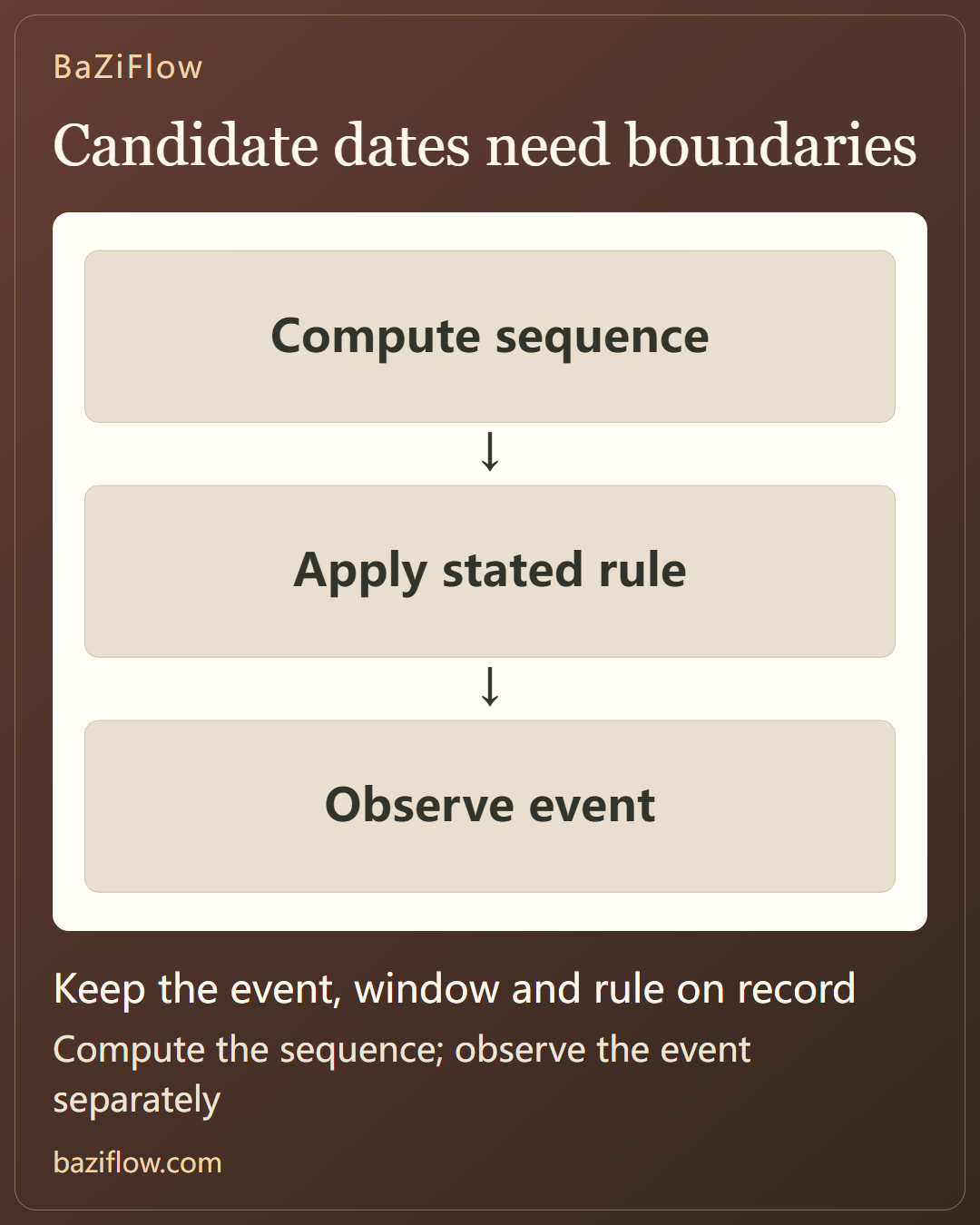
Compute still-Rat and moving-Rat candidates within a fixed twelve-day window, then separate calendar arithmetic, event definitions, and observed outcomes.
The short version7 min read
With Yin Wood Ox as excluded day zero, the next twelve days give still-Rat candidates at +5 Yang Metal Horse and +11 Yang Fire Rat; moving Rat gives +11 Yang Fire Rat and +12 Yin Fire Ox. Sequence arithmetic is reproducible, while selection and observed outcomes need separate evidence.
- Original stillness or movement selects different candidates within the same supplied twelve-day window.
- Sequence accuracy, conditional timing selection and event occurrence are distinct claims requiring different evidence.
- Retain dated revisions and distinguish observed non-occurrence, missing follow-up and cancellation.
Read first
Moving lines and changed counterparts: auditing Xu to Song ↗
Cycle void versus month break: two independent calendar tests ↗
Write the observation rule before the outcome arrives
A timing claim needs an event, a time window, and a rule for deciding whether the event occurred. “A message arrives,” “permission is granted,” and “the person departs” are different events. A precise date cannot rescue a claim whose target changes after the fact.
Zengshan Buyi's timing notes list several conditional routes, including a still line meeting its own branch or an opposing branch, and a moving line meeting its own branch or a combining branch. These are not a single formula that converts any line into one guaranteed calendar date.
This article uses a small candidate-enumeration exercise and proposes a prospective record for reviewing it. The recording discipline is an editorial recommendation, not a claim that the historical source already supplied a modern statistical validation method.
Notification
- Told
Permission
- Formal approval
Departure
- Actually leaves
A twelve-day example makes the selection choices visible
Specify the current day as Yin Wood Ox (乙丑) and define the observation window as the next twelve days, excluding today. Consider two independent inputs: a still Rat (子) Water principal line and a moving Rat Water principal line. Other chart conditions and the concrete question are deliberately absent, so the exercise generates candidates only.
Following the source's simple examples, the still Rat line suggests examining a Rat day by matching and a Horse (午) day by opposition. The moving Rat line suggests a Rat day by matching and an Ox (丑) day by combination.
Advancing stems and branches together from Yin Wood Ox gives Yang Metal Horse (庚午) at offset five, Yang Fire Rat (丙子) at offset eleven, and Yin Fire Ox (丁丑) at offset twelve. The two candidate sets are therefore different, though they share offset eleven.
| Offset from Yin Wood Ox | Day pair | Still-Rat route | Moving-Rat route |
|---|---|---|---|
| 0: today | Yin Wood Ox | Outside the agreed window | Outside the window despite being Ox |
| +5 | Yang Metal Horse | Opposition candidate | Not selected by this simple route |
| +11 | Yang Fire Rat | Matching candidate | Matching candidate |
| +12 | Yin Fire Ox | Not selected by this simple route | Combination candidate |
“Not selected” refers to this limited rule, not to impossibility in every complete reading. Likewise, a shared candidate does not become certain merely because it appears in two different hypothetical inputs. Preserve the original movement state, as explained in moving and changed lines, rather than switching between them to cover more dates.
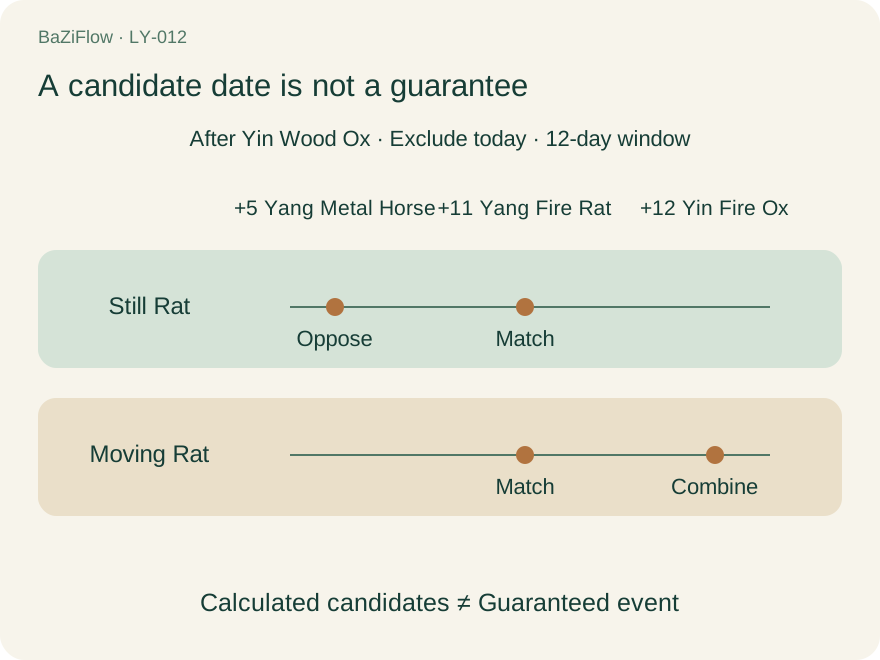
BaZiFlow candidate timeline. The branch sequence is calculated; occurrence of an event is not established.
Today excluded · 0
Today ↔ Next 12 days
- Still +5 · 5
- Both +11 · 11
- Moving +12 · 12
Yin Wood Ox = 0; separate still / moving inputs
Reproducible arithmetic is not a uniquely selected forecast
The offsets can be checked independently. That establishes the sequence arithmetic, not the complete interpretation. A full method would need the selected object, calendar context, movement relationships, and applicable strength or constraint conditions.
No modern calendar date is supplied here. Converting the sequence into actual dates would require a complete calendar anchor and the relevant timezone and day-boundary convention. A month-level claim also needs its month-boundary convention. The computer's current date must not be silently added to an exercise that never supplied it.
The source distinguishes near and distant affairs by time scale while also acknowledging cases that do not follow the expected scale. That flexibility is a reason to state uncertainty, not permission to turn an unsuccessful day claim into a month claim without recording the change. A branch recurs every twelve days; a window that keeps expanding can eventually conceal a poor original selection.
Read historical event wording as carefully as the dates
In the cycle-void chapter's travel account, the text discusses leaving voidness and being able to proceed on a Yang Wood Tiger (甲寅) day, then records actual departure on Yin Wood Rabbit (乙卯). Those are different day labels attached to differently worded events.
An editor should not collapse them into the same date and advertise an exact departure hit. Nor should the wording be ignored in order to declare a simple one-day error. The first task is to identify the proposition being assessed: a condition permitting travel, or a specified day of actual departure. If the original event criterion is unclear, that limitation should remain visible.
This is not a license to rescue a prediction by inventing a new meaning. It is a requirement not to supply precision that the source did not establish. The historical narrative and its author's assessment also do not constitute independent modern statistical evidence. Its reported financial result is not used here as a promise to a present-day reader. See cycle void and month break for the separate classification issue.
Historical event
Yang Wood Tiger permission
- Observation
- Approval received
- Different claim
- Departure already occurred
Yin Wood Rabbit departure
- Observation
- Journey began
- Different claim
- Departure on the prior day
Preserve alternatives, missing conditions, and failed observations
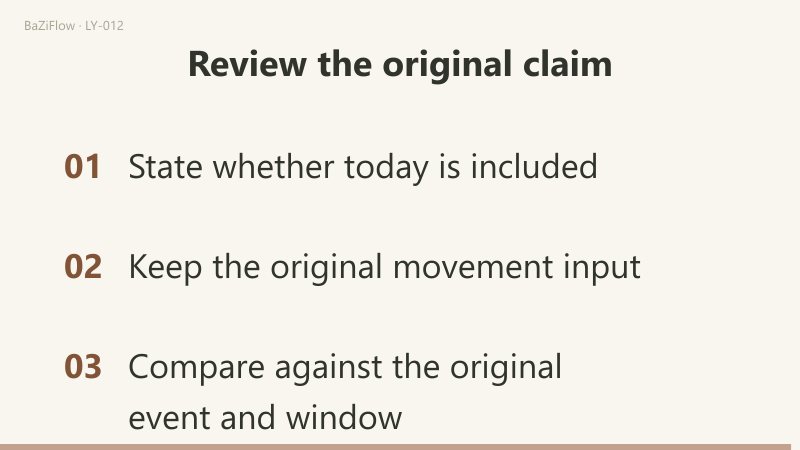
Before observation begins, record the target event, window boundaries, original chart, chosen textual rule, candidate dates, and missing conditions. If two candidates cannot be ranked, say so. A percentage such as eighty percent would require an actual calibration basis; confident wording is not a substitute for one.
New information may justify a dated revision, but the original version should remain available. A twelve-day window must not become a month only after the event fails to occur. A formal confirmation must not become an informal expression of interest after the result is known.
With reliable observation across the full agreed window and no target event, record non-occurrence under that claim. With no follow-up data, record unverified. If the underlying question is cancelled, record cancellation. None of these states should automatically become a successful prediction, and cases outside the candidate dates should not disappear from the review record.
Uncertainty should make the claim more testable
The source proposes additional casting when a reading is unclear. That historical practice is noted rather than converted into an unlimited retry procedure. Repeatedly adding dates or changing the selected event does not establish that the first claim was accurate.
The useful distinction is between a deterministic sequence calculation, a source-based conditional candidate, and an observed outcome. These stages require different evidence. More complicated relations can be traced with combination, clash, tomb, and extinction, but adding terminology does not remove missing inputs.
A responsible timing explanation lets another reader recover what was said before the event, what conditions were assumed, and what would count as a mismatch. Its specificity comes from that record, not from replacing uncertainty with a more forceful tone.
Observed: no event
No follow-up: unverified
Question cancelled
Questions readers ask next
Why exclude today when it is already a combining Ox day?
The exercise defines its window as the next twelve days, starting tomorrow. Matching a branch condition does not override that boundary. A window including today would be a different prospective input and should be enumerated separately.
Does shared Yang Fire Rat make that candidate more reliable?
The two rows represent alternative original movement states, not independent observed evidence. Their overlap comes from the matching-branch route shared by both simple rules. It does not supply a calibrated confidence increase or a unique forecast.
Can absent follow-up be recorded as non-occurrence?
No. It establishes a lack of observation, not a failure of the event to occur. Non-occurrence within the window requires adequate follow-up; cancellation is another status. Keeping these distinct prevents unknown results from being counted as successes or failures.
Was this article helpful?
Sources & references
Continue reading
Combination, clash, tomb, and extinction: keep their layers distinct ↗