

Transits and natal time layers
Content version · · Sources & references
Compare one moving position with two natal records, then separate exact contacts, orb windows, repeat passes and daily-horoscope display choices. Keep the moving and fixed sides explicitly labelled.
The short version6 min read
A transit compares an observation-time body with a fixed natal position. The same sky can make different angles to different natal targets. Entering an allowance, reaching exact contact and displaying a daily paragraph are separate records.
- Keep T for transit and N for natal attached to each object; swapping the time labels changes the relationship being calculated.
- The same transiting Saturn at 130° gives 90° or 75° against natal Moons at 40° or 55°; the natal target is essential input.
- Retrograde motion may repeat a pass, but an interval, exact instant, display date and actual event remain different kinds of information.
Read first
Aspect Angles and Orbs: Calculate One Line from Two Positions ↗
Preserve the direction of the comparison
Use T for the observation-time position and N for the natal record. T Saturn to N Moon is different from T Moon to N Saturn. Neither is the same as T Saturn to T Moon, which describes a relationship within the sky at the observation time. N Saturn to N Moon is another calculation again.
Astrodienst defines transits through moving planetary positions in relation to birth positions. That definition is all that is needed here; the site's interpretive claims do not demonstrate that a contact causes a particular event. The natal position is fixed for the comparison, while the actual celestial body continues to move.
An inner and outer wheel can help display these layers, but placement on the page is not a universal identifier. Read the legend and table headings. Keep the zodiac and coordinate conventions compatible as well: a comparison cannot be reproduced if one side silently uses a different reference system.
Notation
T Saturn / N Moon
- Saturn source
- Observation time
- Moon source
- Birth record
N Saturn / T Moon
- Saturn source
- Birth record
- Moon source
- Observation time
T Saturn / T Moon
- Saturn source
- Observation time
- Moon source
- Observation time
Hold the sky constant and change the natal target
Suppose a transiting Saturn is at longitude 130°. In teaching record A, the natal Moon is at 40°; in record B it is at 55°. The shorter separations are 90° and 75°. With a 3° allowance around a square, A qualifies and B does not. These are constructed numbers, not today's sky or two actual birth charts.
| Record | Moving Saturn | Natal Moon | Separation | Deviation from 90° |
|---|---|---|---|---|
| A | 130° | 40° | 90° | 0° |
| B | 130° | 55° | 75° | 15° |
The same observation time supplies only one side of the comparison. A personal transit also needs the specific natal target. A general statement about the day's sky cannot simply be copied into both records as if it established the same contact for everyone.
This controlled comparison is useful when reading reports side by side. The question is not whether both paragraphs sound plausible. It is whether their claimed relationships correspond to each record's actual inputs. If the position change matters to the calculation but disappears from the explanation, the personal distinction has been lost.
A: N40° → T130°
130° − 40° = 90°
B: N55° → T130°
130° − 55° = 75°
Each dial starts at its own natal Moon; transiting Saturn is unchanged
A window is not an exact moment
For a target angle of 90° and a maximum deviation of 1°, separations of 89° and 91° sit at the inclusive boundaries. The exact contact is 90°. Entering the permitted interval, reaching the target and leaving the interval are distinct events in the calculation.
A one-degree gap does not imply a fixed number of days. Motion changes, and near a station a simple constant-speed extrapolation may be especially misleading. Swiss Ephemeris lists longitude and longitude speed separately. One static position is not the same information as a direction and rate of movement.
If a calendar supplies only daily samples, it may bracket an exact contact without printing its precise time. Finding the instant requires the calculation at suitable times and precision; guessing halfway between two calendar boxes is not generally justified. An exact astronomical relationship also does not establish an exact appointment for a life event.
Time-zone labels matter when comparing outputs. UTC 18:00 and 02:00 on the following date at UTC+8 can describe the same instant. A change in the printed date is not evidence of a second contact. This is a time-conversion illustration, not a forecast for a real day.
Exact 90° · 90
88° ↔ 92°
- Allowance 1° · 89–91
- Exact contact · 90
89° and 91° are inclusive boundaries, not exact 90°
Repeated passes need a trajectory, not a three-act story
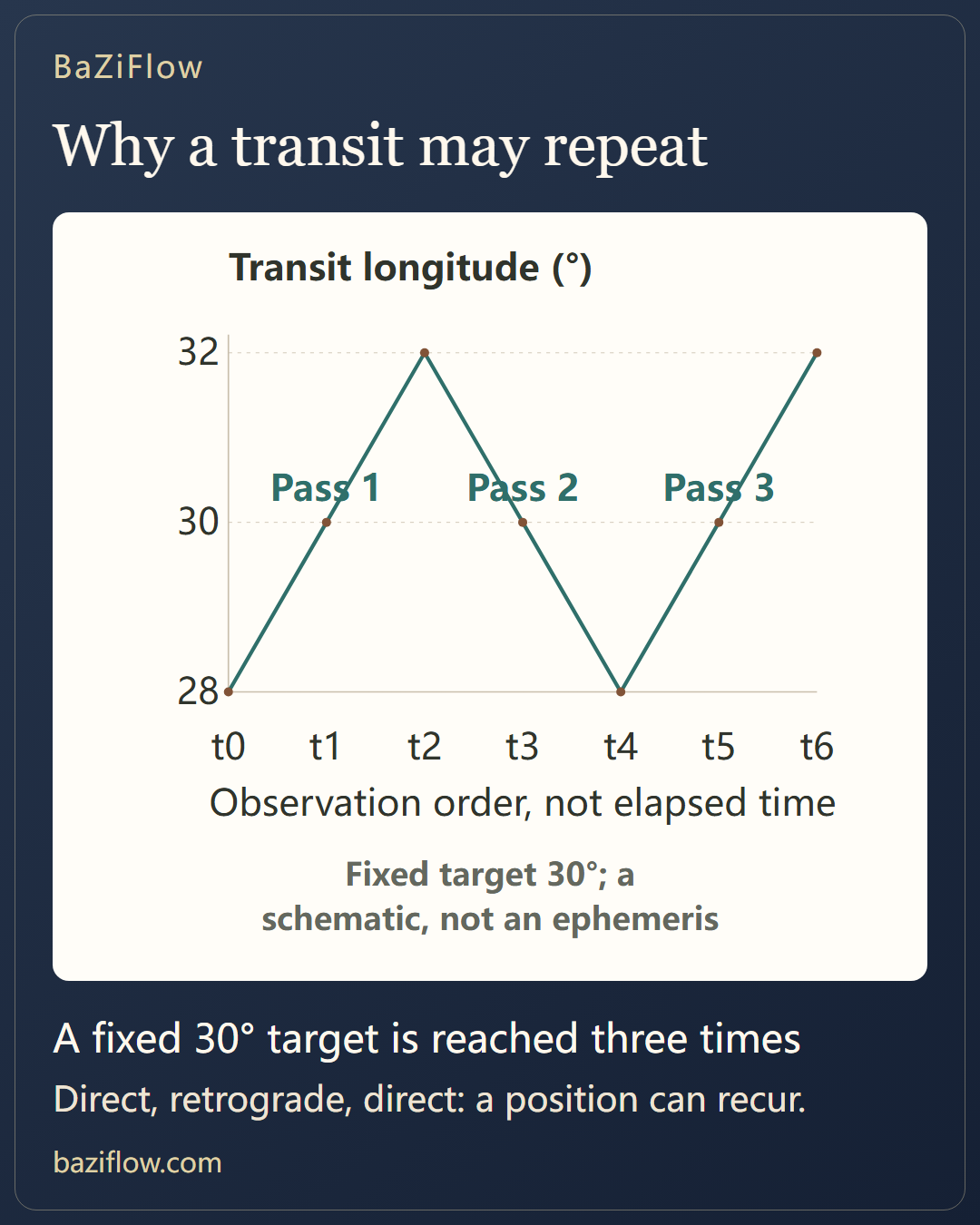
Fix a natal target at 30°. Imagine the moving longitude taking the sequence 28°, 30°, 32°, 30°, 28°, 30°, 32°. It first increases, then decreases, then increases again, crossing the target three times. The observation labels below specify order only; their intervals are not assigned a duration.
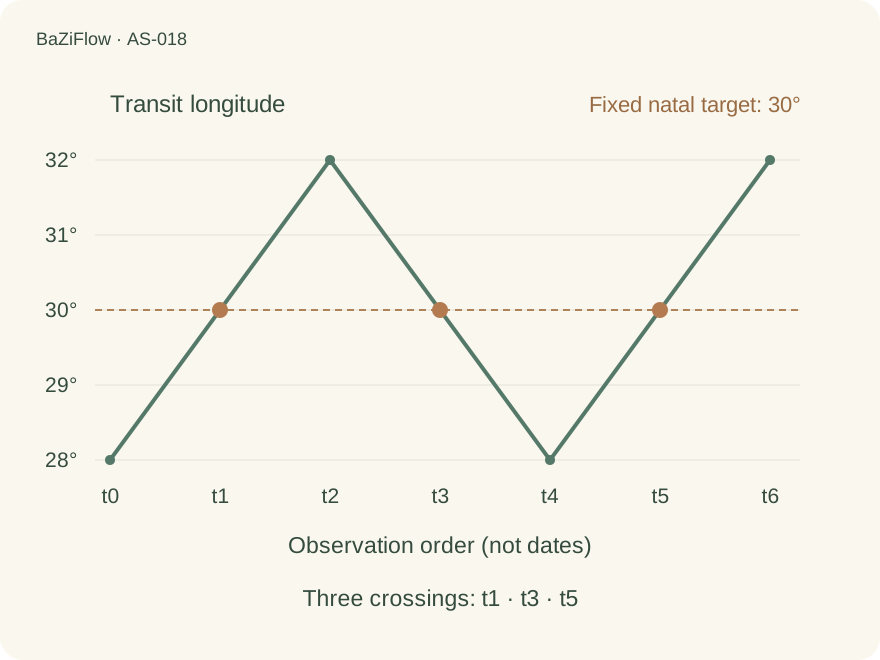
Original schematic sequence, not an ephemeris. Repeated crossings are possible, not compulsory for every retrograde cycle.
Astrodienst's return-chart instructions note Mercury as an example where retrograde motion can produce repeated returns. Our abstract sequence illustrates the geometry without claiming to reproduce a Mercury ephemeris. A retrograde loop that does not cover the natal target cannot create these crossings merely by being retrograde. Not every transit has three passes.
Record the actual dates and directions when repeats are present. Describing the first as an introduction, the second as a crisis and the third as resolution is an interpretive narrative, not a fact contained in the coordinates. It should not be imposed when the person's experience does not support it.
A record of no corresponding event is also information. It should remain visible rather than being replaced with a vague incident to complete the expected sequence. Define which contacts belong to the same comparison before looking for a story that links them.
The day a paragraph appears may be an editorial choice
Astrodienst explains that its Personal Daily Horoscope selects among candidate transits and distributes their presentation across daily slots. Within that particular product, seeing a paragraph today does not necessarily mean the transit is exact today. This is a documented display policy, not a claim about every horoscope service.
To check timing, consult the underlying contact table or ephemeris and its time-zone settings. To check meaning, identify the selected interpretive method and the relevant natal context. To check what actually happened, use the person's own dated information. Those are three different checks, and a polished daily card does not complete them all.
Keep the timing method and natal context visible
A natal overview can help establish the participants' roles; see whole-chart reading order. Transits also differ from symbolic timing methods such as secondary progressions and solar arc. Using a real observation-time position on one side is part of the transit method's definition. Preserve that source and the fixed natal target before offering any limited interpretation of the relationship.
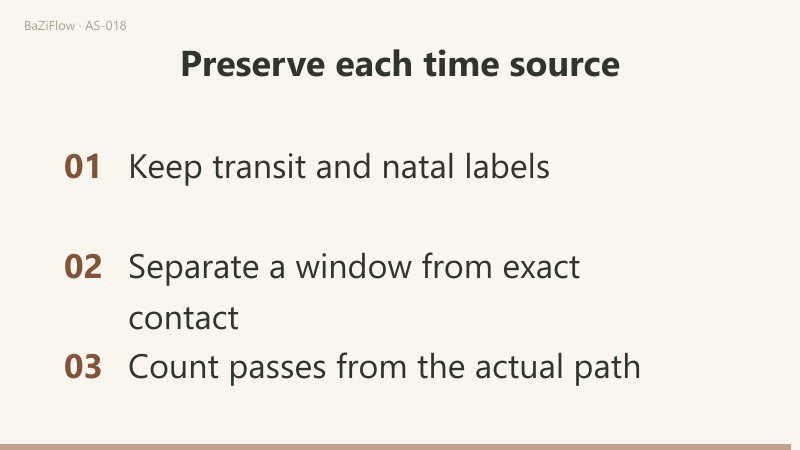
Fix the two sources
Identify T and N objects, coordinate conventions and natal data.
Calculate angle and timing
Declare the target and allowance, then use the actual path for entry, exact contact and exit.
Check display and experience separately
Distinguish product dates from personal records without turning precision into an event guarantee.
Questions readers ask next
Does the same sky produce the same personal transit?
No. The sky supplies only one side of the comparison. A personal natal target supplies the other: 130° minus 40° is 90°, while 130° minus 55° is 75°, so the recognised contact can differ.
Is entering an allowed interval an exact contact?
No. For a 90° target and inclusive 1° allowance, 89° through 91° qualifies as in range, while only 90° is exact. Duration depends on the actual trajectory and speed.
Does every retrograde transit make three passes?
No. Repetition requires the trajectory to cover and revisit the target. The three-pass sequence illustrates one possibility; it does not establish a beginning, crisis and resolution in someone’s life.
Was this article helpful?
Part of a learning path
Astrology: from four components to the whole chart · Step 6 of 6 available