

Ten of Cups
Content version · · Sources & references
Read Waite’s adults, unnoticed rainbow, and independently happy children. Explore shared contentment without making one family image a universal standard.
The short version6 min read
Ten cups in a rainbow, adults looking upward and children dancing nearby form the scene. Waite explicitly says the children have not noticed the rainbow but are happy in their own way. A shared good occasion can contain different attention and experience.
- Adults and children share a joyful setting without attending to the same thing, giving a concrete clue to connection and difference.
- Finding books, talking and reading quietly can each matter in one reading corner without a compulsory shared statement of happiness.
- A specific inconvenience can improve the common result: a shelf being too high is not a rejection of everyone’s work or affection.
Read first
The children have not noticed what the adults notice
On the RWS card, a man and a woman stand in the foreground with their backs to the viewer, his arm around her, each with one arm raised. Ten cups follow the arc of a rainbow overhead, two children dance hand in hand at the right, and a river, trees and a red-roofed house lie in the distance.
Waite describes ten cups in a rainbow, a man and woman apparently husband and wife expressing wonder, and a home scene beyond. He explicitly says that the two children have not observed the rainbow but are happy in their own way.
The detail permits a careful modern question: what is shared in this scene, and where do individual experiences remain different? It does not mean that Waite was presenting a contemporary theory of family life. It does mean that identical attention is not necessary even within his description of a joyful setting.
His main meanings include contentment of the whole heart, human love and friendship, and the town, village, or country where the Querent lives. The particular family depicted belongs to the image's historical context. It is not a test that every reader must pass by marrying, having children, or reproducing the same household structure.
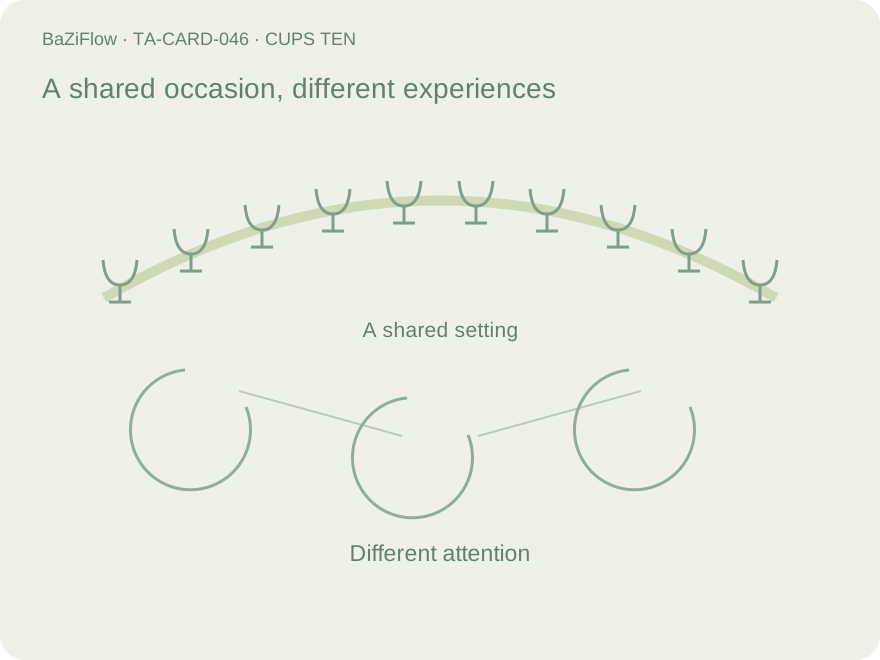
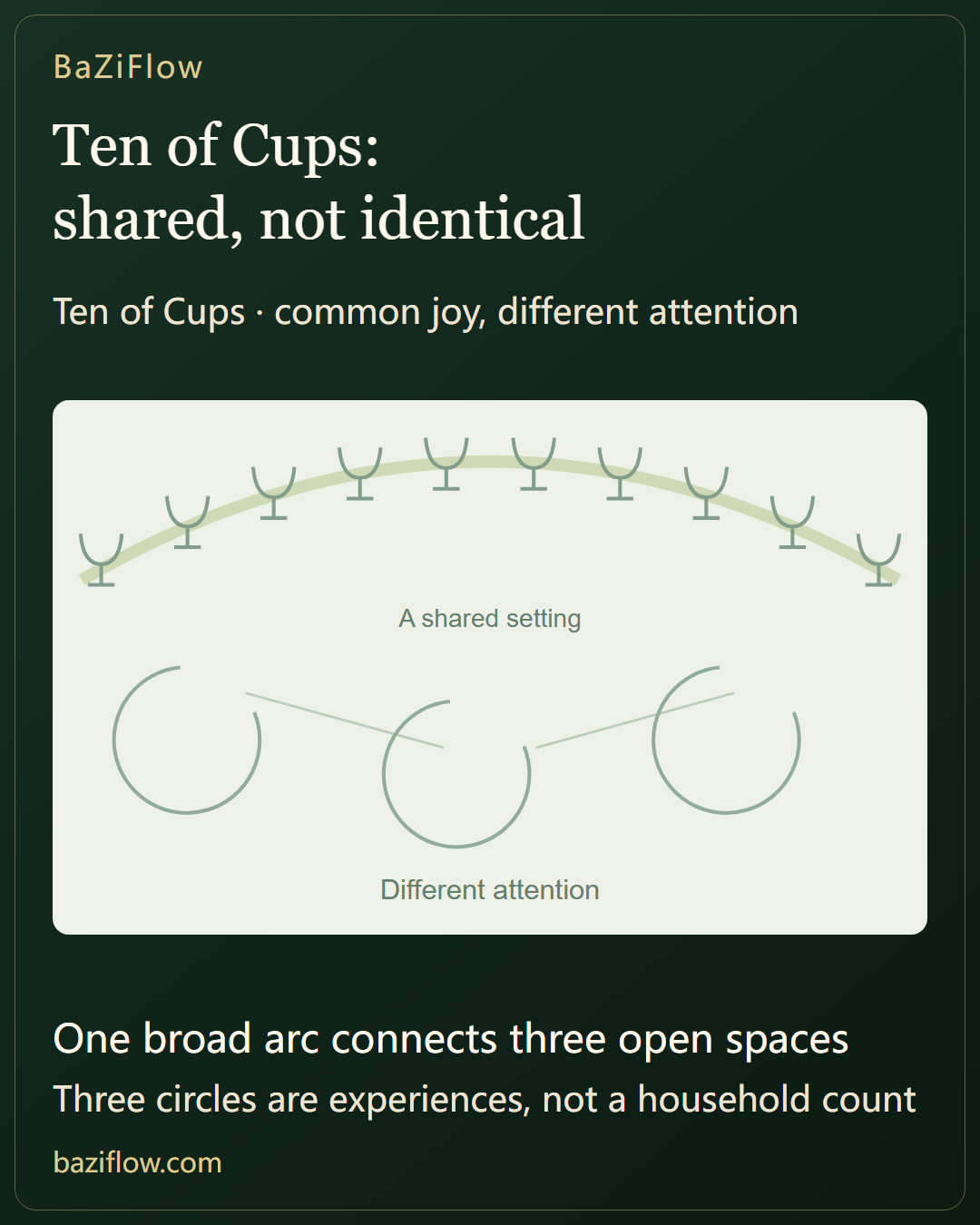
An original BaZiFlow shared-contentment diagram. The arc connects experiences without prescribing family composition or promising marriage or children.
Adults
- Arms raised toward the rainbow
- Wonder and joy
Children
- Dancing nearby, not noticing the rainbow
- Happy in their own way
A shared scene with different attention: the distinction is explicit in Waite’s description.
A successful occasion does not settle its future arrangements
Friends have finished setting up a small reading corner. The opening goes well: some enjoy the organized shelves, some value conversation, and another person is pleased simply to read quietly for a while. That shared success does not determine who will open the room next week or maintain it afterwards.
The distinction is useful when reading the RWS Ten of Cups. Shared warmth can be acknowledged without treating it as collective consent to an indefinite commitment. Enjoying an event, agreeing to help again, and accepting a continuing role are different responses.
Nor must everybody value the same part. Asking what worked for each person can reveal a richer picture than requiring a unanimous declaration of happiness.
| Question after the opening | An assumption to avoid |
|---|---|
| Which part suited you today? | Everyone valued the same activity |
| How might you use the space again? | Everyone has agreed to attend weekly |
| What was inconvenient? | Any criticism rejects the whole achievement |
A visitor who prefers quiet reading is not necessarily rejecting companionship. Someone who leaves early is not thereby less affectionate. Their account should come from what they choose to say, rather than from the emotional story a host wants the gathering to represent.
A practical complaint can coexist with appreciation. If a shelf is difficult to reach, the relevant issue is access to that shelf. Treating the comment as disloyalty to the group would turn a useful observation into a conflict about belonging. A joyful occasion need not be protected from all specific improvement.
Reading corner
Find books
- May enjoy
- Clear categories
- Possible request
- Easy access to favorites
Conversation
- May enjoy
- Exchange impressions
- Possible request
- A suitable talking area
Quiet
- May enjoy
- Read a few pages alone
- Possible request
- An undisturbed period
Use connection without assigning permanent roles
Ten cups span the drawing. Three open circles underneath are linked lightly, representing different experiences within a setting. They are not assigned to parents, children, partners, or any required number of household members.
For this example, the circles might hold ease of finding books, conversation, and quiet time. These are three responses that happened to arise, not a universal personality scheme. One person can value several of them; another may name something not yet represented.
The open boundaries also remind the group to distinguish forms of participation. A person can help set up the room while declining a public photograph. Permission to publish an image does not necessarily include permission to attach a name or a private story. Shared celebration does not erase individual choices about publicity.
A specific observation can improve the shared result without becoming a judgment against the group.
Keep historical conditions and difficult words in their place
One of Waite's person-related readings is conditional on the appearance of several picture cards. It should not be detached from that condition and used to guarantee that a particular person will protect the reader's interests. The reversed entry's language of false-heartedness, indignation, and violence is likewise not evidence for an accusation or a prediction of harm.
The supplementary chapter contains older marriage omens and references to sorrow or quarrelling. These are records of a divinatory tradition, not findings from an investigation into a present household. They cannot establish that somebody is dishonest, that a relationship is ideal, or that a family is about to fail.
Compared with the Nine of Cups, this Ten brings love, friendship, and a shared setting into view. It does not require individual satisfaction to disappear into one official story. Be explicit about your convention when using upright and reversed methods.
At review, ask whose needs were heard, which arrangements remain undecided, and whether each person's answer about publicity was respected. Deal with an unresolved item at its actual scale. The unnoticed rainbow and independently happy children offer room for a shared good moment without demanding a single account of what made it good.
Name the shared achievement
For example, shelving and opening the room, before assigning everyone a feeling.
Allow different ways to enjoy it
Finding books, talking or a short quiet stay can each be expressed.
Turn needs into negotiable arrangements
Respond through space, timing or the position of books.
Questions readers ask next
Must the Ten of Cups mean marriage, children or a standard household?
No. The picture uses a historical family image, while the main meanings also include human love, friendship and a place of residence. It can frame shared life and joy without requiring the reader to copy the depicted number, gender or household structure.
Why does it matter that the children have not noticed the rainbow?
The detail places different attention within one scene. The adults marvel at the rainbow while the children are happy in their own way. A modern exercise can ask what each participant values rather than requiring one account of a shared activity.
Does a complaint mean the Ten’s harmony has been destroyed?
Not necessarily. A shelf that is difficult to reach is a specific problem that can be adjusted, not automatic rejection of the group. Appreciation and improved access can coexist without silencing a participant to preserve a perfect public image.
Was this article helpful?
Sources & references
Continue reading
Nine of Cups: enjoy a specific satisfaction without promising the future ↗