

Queen of Pentacles: a gaze beneath blossoms
Content version · · Sources & references
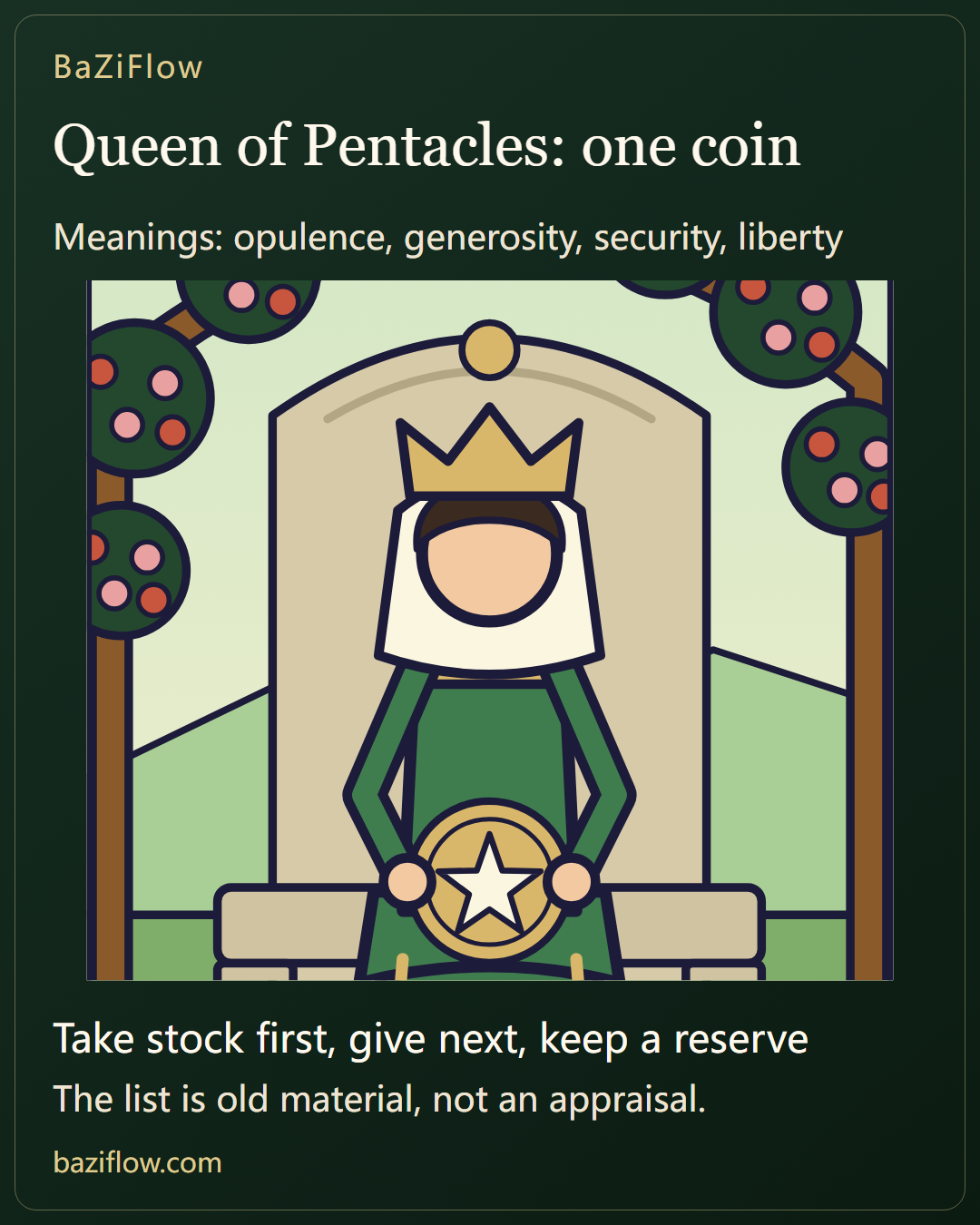
The Queen of Pentacles sits beneath blossoming boughs and gazes at the coin in her lap. Separate Waite’s description, word list and extras, then practice stock-taking, flow and a reserve on a craft workshop’s materials.
The short version6 min read
The Queen of Pentacles does one thing: she looks down at her coin. Waite’s list circles how much there is, how it is given and how secure it is, so the first question is what is actually in your hands.
- Waite first describes her look (greatness of soul, a serious cast of intelligence), then her act: she contemplates her symbol and may see worlds therein.
- The divinatory list is opulence, generosity, magnificence, security, liberty; reversed it is evil, suspicion, suspense, fear, mistrust. The extras add presents from a rich relative, and reversed one phrase: an illness.
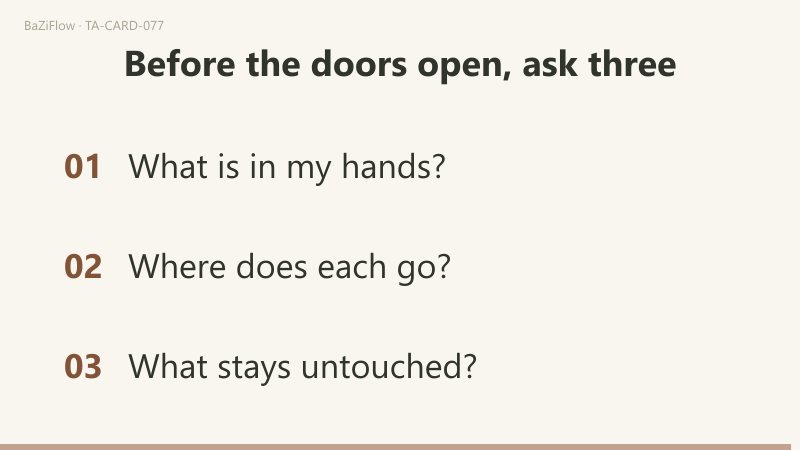
- In a question, work in three steps: lay out what you hold, write where each item goes, and keep one part unassigned.
Read first
The coin in her lap and the lowered gaze: looking in from the boughs
Waite describes this queen first by her look and then by her act. For the look, the face suggests that of a dark woman (period wording), whose qualities might be summed up as greatness of soul, with the serious cast of intelligence. The act is single: she contemplates her symbol and may see worlds therein.
Queen of Pentacles: a gaze beneath blossoms
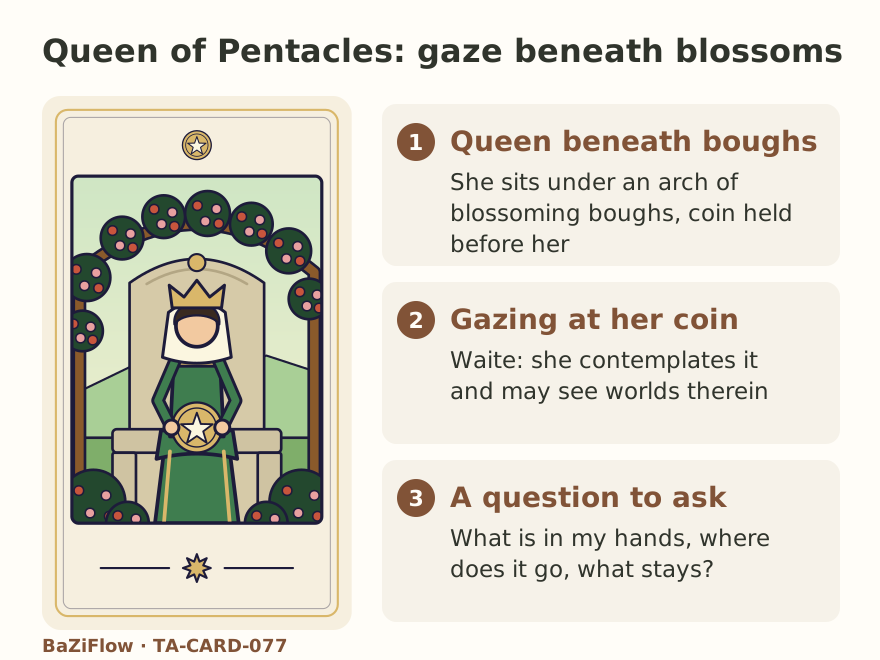
In Pamela Colman Smith’s original drawing the queen wears a crown set with red ornaments, a red gown with white sleeves and a green mantle over her shoulders, and sits in a tall stone chair carved with ornate patterns; the coin rests in her lap and her head is bowed over it. Branches with red flowers hang from above to both sides, and blue hills lie far off. In the version BaZiFlow drew for this article she sits before the throne with the coin held out in both hands, the boughs bend into an arch overhead, and green hills rise behind her.
Read the picture from the outside in and the view narrows layer by layer until it stops on the coin in her hands:
Enlarge diagram · scroll sideways to read
What Waite lists: opulence, generosity, security, and “greatness of soul”
The list Waite gives runs to five words: opulence, generosity, magnificence, security, liberty. By sense they fall into two groups: the first three speak of how much there is and how it is given, the last two of how safe and how unbound. That grouping is a reader’s tidying, not Waite’s arrangement.
Opulence, generosity, magnificence, security, liberty.
“Greatness of soul” and “serious intelligence” sit in the description, as marks of her look, and are not part of the list. The additional meanings give three more: a dark woman; presents from a rich relative; a rich and happy marriage for a young man.
Enlarge diagram · scroll sideways to read
The gazed-at coin, the boughs, the throne: who said what
Three things in the picture merit a word: the coin, the boughs and the throne. Waite wrote about the first only.
Three things, and who said what
- Coin
- Waite writes that she contemplates it and may see worlds therein. That is all he says about it, and he does not say what those worlds are.
- Boughs
- Not mentioned in the entry. In the original drawing red-flowered boughs surround her; teaching often reads them as “the area being tended”, which is a later reading.
- Throne
- Also unmentioned. In the original drawing it is a tall stone chair carved with ornate patterns; borrowing it for teaching, you can ask what this abundance rests on.
Enlarge diagram · scroll sideways to read
Reading the coin as resources in hand and the boughs as the tended area are borrowings from teaching, and the stock-taking sheet below grows out of them.
Practice: a workshop kit counted three ways
The shape of the card is one person looking down at the coin in her lap, ringed by boughs. Applied to a real errand it yields three habits: take stock, trace the flow, keep a reserve.
Look into the coin: what is in it?
Waite says she may see worlds there. Lay out what you hold as one coin: materials, space and helpers’ time, one line each, without yet asking whether it is enough.
Let it flow out: to whom, for what
Generosity is in the list. Next to each item write who will use it and at which stage; where you cannot name a destination, mark it blank for now.
Keep a portion in the lap: the reserve
Security and liberty are in the list too. From each item hold back a small part, not assigned in advance, so that you have room to adjust on the spot.
An example: you are leading a craft workshop on candle making for eight people and supplying everything yourself. Stock, flow and reserve for three items could be noted like this:
Enlarge diagram · scroll sideways to read
What this queen leaves on your list
Visible
- What is in your hands
- Where each item goes
Still hidden
- How guests will respond
- Whether supplies last next time
Check again
- Confirm numbers with guests
- Write the reserve on the list
Reversed and neighboring cards: suspicion beside fear, and an old line about illness
Waite’s reversed reading is five words: evil, suspicion, suspense, fear, mistrust. The additional meanings give only one short phrase for the reversed card: an illness, which is another reader’s old wording, set here for contrast and carrying no judgment on anyone’s health.
Evil, suspicion, suspense, fear, mistrust.
The upright five speak of having and giving. In the reversed five, “evil” carries a judgment, while the other four read more like attitudes toward what one holds and toward the people nearby: suspicion, suspense, fear, mistrust.
Enlarge diagram · scroll sideways to read
Three cards, three ways of looking at one’s own things
One who looks into a cup
Waite says she sees visions in a cup and also acts. The list: a good, fair woman, loving intelligence, the gift of vision, success and happiness.
A woman in her garden
A bird on her wrist, a great abundance of grapevines around her; the list: prudence, safety, success, accomplishment, certitude, discernment. She stands in her own garden; the Queen sits before her own coin.
The same coin, another seat
Bulls’ heads on the throne; the list: valour, intelligence that realizes things, business and normal intellectual aptitude.
Questions readers ask next
Does the Queen of Pentacles only mean a rich woman?
Waite’s list names a condition: opulence, generosity, magnificence, security, liberty. “Dark woman” and “a rich relative” appear in the description and extras as period wording. A steadier teaching reading is a posture of tending abundance, not tied to a particular person.
How should the reversed word “evil” be understood?
Waite’s reversed list opens with evil and goes on to suspicion, suspense, fear, mistrust. He does not explain the word; quote it as his word, then check whether the four that follow, which describe states of mind, fit the matter you are asking about.
Why are there flowers and boughs all over the card?
They belong to the original drawing; Waite’s entry neither mentions nor explains them. Reading them as “the area being tended” is a later borrowing in teaching, and labeling it as such is enough.
Was this article helpful?
Sources & references
Continue reading
Knight of Pentacles: a slow, heavy horse, a coin shown and not looked into ↗
King of Pentacles: the king on a throne of bulls, and a suit note Waite tucked in ↗