

Peak: the cell of the sun at noon
Content version · · Sources & references
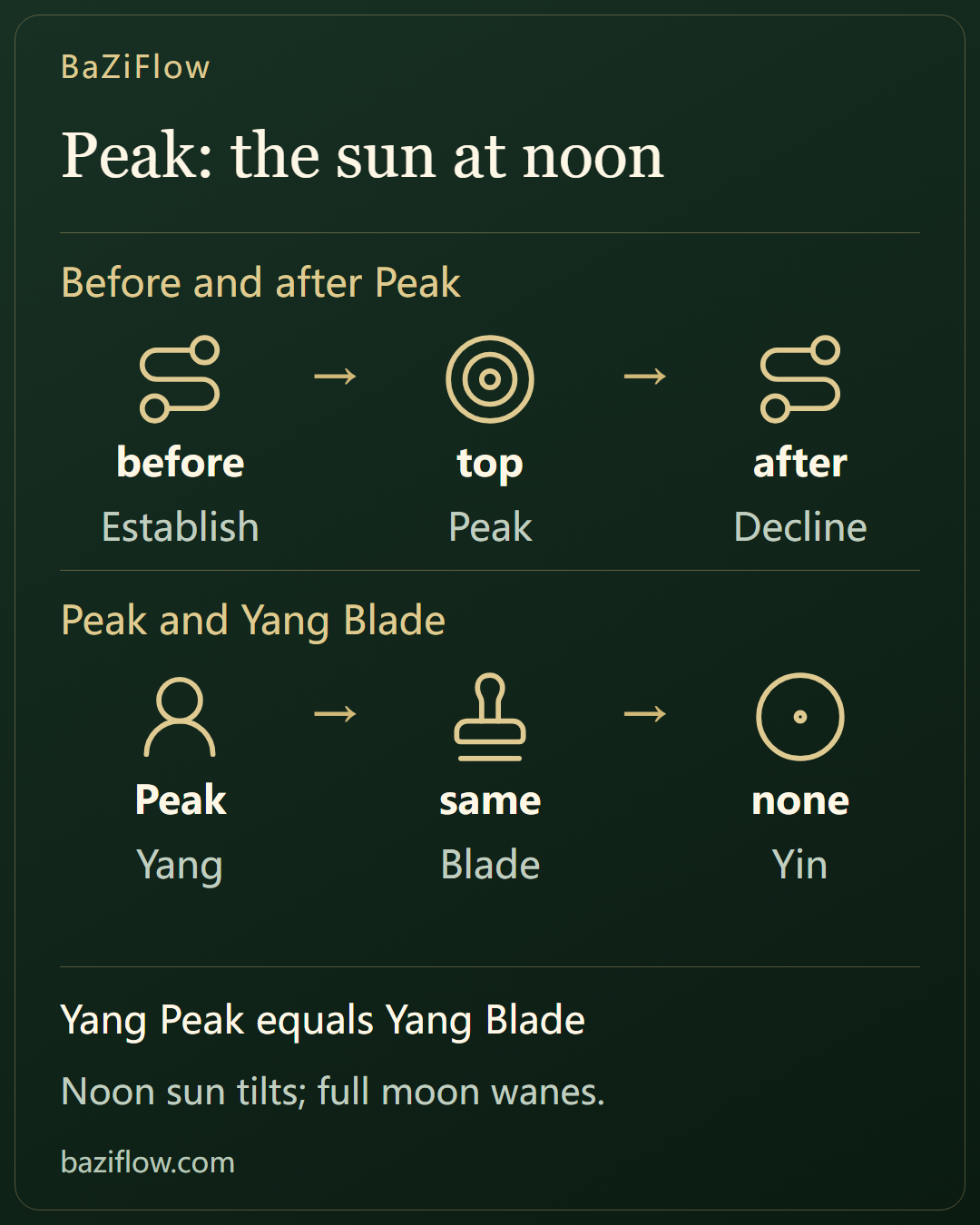
Peak is the fifth cell of the twelve life stages. A map of the ten stems, a table setting Peak beside the Yang Blade, the "sun at noon" passage and the two meanings of "strong" show where it sits and what it covers.
The short version7 min read
Peak is the fifth cell of the twelve life stages, taking the image of things ripe and a person flourishing: Yang stems land on Rat, Rabbit, Horse and Rooster, Yin stems on Tiger, Snake, Monkey and Pig, and the Peak of a Yang stem is also its Yang Blade in the site's Symbolic Star table.
- The Peak of a Yang stem is on Rat, Rabbit, Horse or Rooster, the months that hold the solstices and equinoxes; the Peak of a Yin stem is on Tiger, Snake, Monkey or Pig, where it trades places with Establishment.
- In the site's Symbolic Star table the Yang Blade is given to Yang stems only, on exactly their Peak branch; a Yin stem has no blade on its Peak branch.
- The book writes Peak as "ripe" and Decline right after as "form fading"; the same section uses "the sun at noon starts to tilt" for fullness turning to fall, yet the "thriving" of the five seasonal states it opens with is a different table.
Read first
Twelve Life Stages and Void Branches: Two Tables, Two References ↗
Strong and weak Day Masters: references, relationship directions and evidence ↗
Peak: the sun at its highest point
At noon the sun stands as high as it will ever stand, its light at full strength, a breath before it leans west. That position of ripeness gives the fifth cell its name, Peak (帝旺), literally "the emperor flourishing".
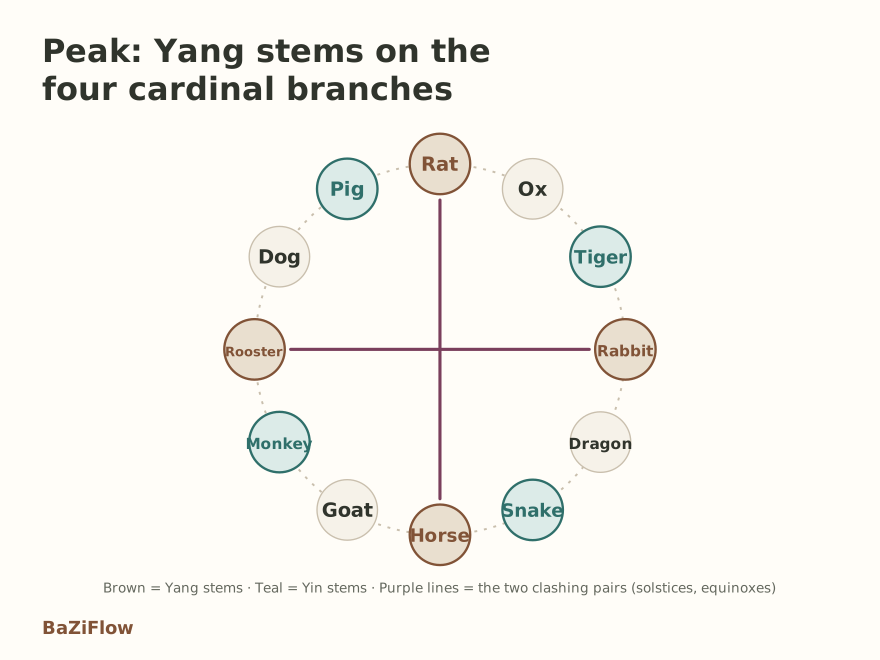
Position sketch: the positions come from the site engine's twelve-stage table; the purple lines join the two clashing pairs, Rat with Horse and Rabbit with Rooster, the months of the solstices and the equinoxes.
The Sanming Tiyao (三命提要), preserved in juan 2 of the Sanming Tonghui (三命通会), gives the cell a single sentence:
Peak: things have ripened, like a person at the height of his prosperity.
From the "flowering and fruit" of the previous cell to the "ripening" of this one, the fruit is ready. Then look at the positions: the Peak of a Yang stem falls on Rat, Rabbit, Horse or Rooster, and each of those four months holds a solstice or an equinox (the Rat month holds the winter solstice, the Rabbit month the spring equinox, the Horse month the summer solstice and the Rooster month the autumn equinox); the Peak of a Yin stem falls on Tiger, Snake, Monkey or Pig.
The Peak position is also the site's Yang Blade position
The site engine's Symbolic Star table has a Yang Blade (羊刃) with a simple rule: it is taken for Yang stems only, on that stem's Peak branch. Put the two tables next to each other:
Enlarge diagram · scroll sideways to read
The two tables coincide completely for Yang stems, yet they are not one table: one gives the stage of a Day Stem, the other is a Symbolic Star. In an "alternative method" in its section on Luck Pillars, the Yuanhai Ziping (渊海子平) puts the Yang Blade on the "unlucky" side, yet in the same passage puts Peak on the "lucky" side; the book itself reads the two apart, and a reading of the Symbolic Star cannot be carried over to the stage name. For how Symbolic Stars sit in a chart, see where Symbolic Stars sit in a chart.
"The sun at noon starts to tilt": at the limit, the turn begins
The Sanming Tiyao writes the cell after Peak, Decline (its entry nine), as "things' forms fade, like a person's energy fading". Decline sits right after Peak, and with three cells side by side one can see an order in the book:
Enlarge diagram · scroll sideways to read
Juan 2 of the Sanming Tonghui states the principle in one passage:
The order of the seasons: when a term is full it withers. The nature of the five elements: when work is done it overturns. So Yang at its limit descends and Yin at its limit rises; the sun at noon begins to tilt and the full moon begins to wane. This is the constant way of heaven.
A season that has run its course fades and a finished work topples; Yang at its limit turns down and Yin at its limit turns up; the sun at noon starts to lean and the full moon starts to wane. In the book this passage follows the seasonal ranking of the five states and leads into the twelve stages (the three lines above among them); it is not said of Peak alone. Read against the twelve stages, Decline comes right after Peak, which fits "Yang at its limit descends". So Peak is the name of a summit position, and the cell right after it is already Decline.
Two kinds of "strong", set side by side
The Peak of the twelve stages and the "thriving" of the five seasonal states appear one after the other in the same section of juan 2, yet they have different references. The first asks which branch a Day Stem has reached; the second asks where an element ranks in which season:
Enlarge diagram · scroll sideways to read
Compare them and you find that Yang Wood has Peak at Rabbit (spring), Yang Fire at Horse (summer), Yang Metal at Rooster (autumn) and Yang Water at Rat (winter), each in the season when its own element rules, so for these four stems the two meanings of "strong" point to the same place; Yang Earth has Peak at Horse (summer), while this section puts Earth's strength in the sixth month, the Goat month, and another passage of the same juan has Earth thriving in the last month of each season; neither includes Horse, so the two no longer coincide. So when the word "strong" appears, first ask which table it comes from.
How the book puts Peak into Luck Pillars
When it discusses Luck Pillars the book splits the stages into those you "meet" and those you "turn your back on", quoting the monk Ying (瑩和尚):
Meet it with Establishment and Peak, and what is yet to come advances; turn your back with resting, discarded, dead and extinct, and what is accomplished retreats.
Enlarge diagram · scroll sideways to read
This is the Sanming Tonghui's reading of luck, and it goes on to attach conditions such as "one must check the foundation of the birth chart". When you find Peak in a table, put the cell back where it belongs: after Establishment and before Decline, the name of the summit; whether a Luck Pillar is good has a whole separate set of conditions.
Try two lookups
The Day Master is Yang Metal. Where is Peak, and where the Blade?
Yang Metal has Establishment at Monkey; one step forward gives Peak at Rooster, and the site's Yang Blade is also at Rooster.
On the Horse branch, which Day Masters have Peak?
Yang Fire and Yang Earth. Horse is also the Establishment of Yin Fire and Yin Earth, for which it is Establishment, not Peak.
The cell before is Establishment and the next is Decline; the full table is in the twelve life stages and void branches.
Questions readers ask next
Is Peak the strongest and best position?
It is the name of one position in the table, with the image of ripeness. The book puts it just before Decline, which says that fullness turns to fall. A judgment such as strongest or best depends on how the whole chart fits together, and one cell cannot supply it.
Yang Wood has its Peak at Rabbit, so why is Yin Wood's at Tiger?
Yang Wood runs forward: Establishment at Tiger, then Peak at Rabbit. Yin Wood runs in reverse: Establishment at Rabbit, then one step back to Tiger. For the two stems of one element, Establishment and Peak trade places.
Is the Yang Blade the same as Peak?
In the site engine the blade is taken for Yang stems only, on that stem's Peak branch. Yin stems have no blade, so you cannot say that every Peak position is a Yang Blade.
Was this article helpful?
Sources & references
Continue reading
Establishment (临官): Eight Branches, Each One Stem's Emolument, and What the Books Say ↗
Decline (衰): The Step After Peak, and Why All Ten Stems Land in a Storehouse ↗
What is Na Yin in BaZi? Why Jia-Zi Gold in the Sea does not replace Yang Wood ↗