

Earth on the City Wall: Yang Earth Tiger and Yin Earth Rabbit
Content version · · Sources & references
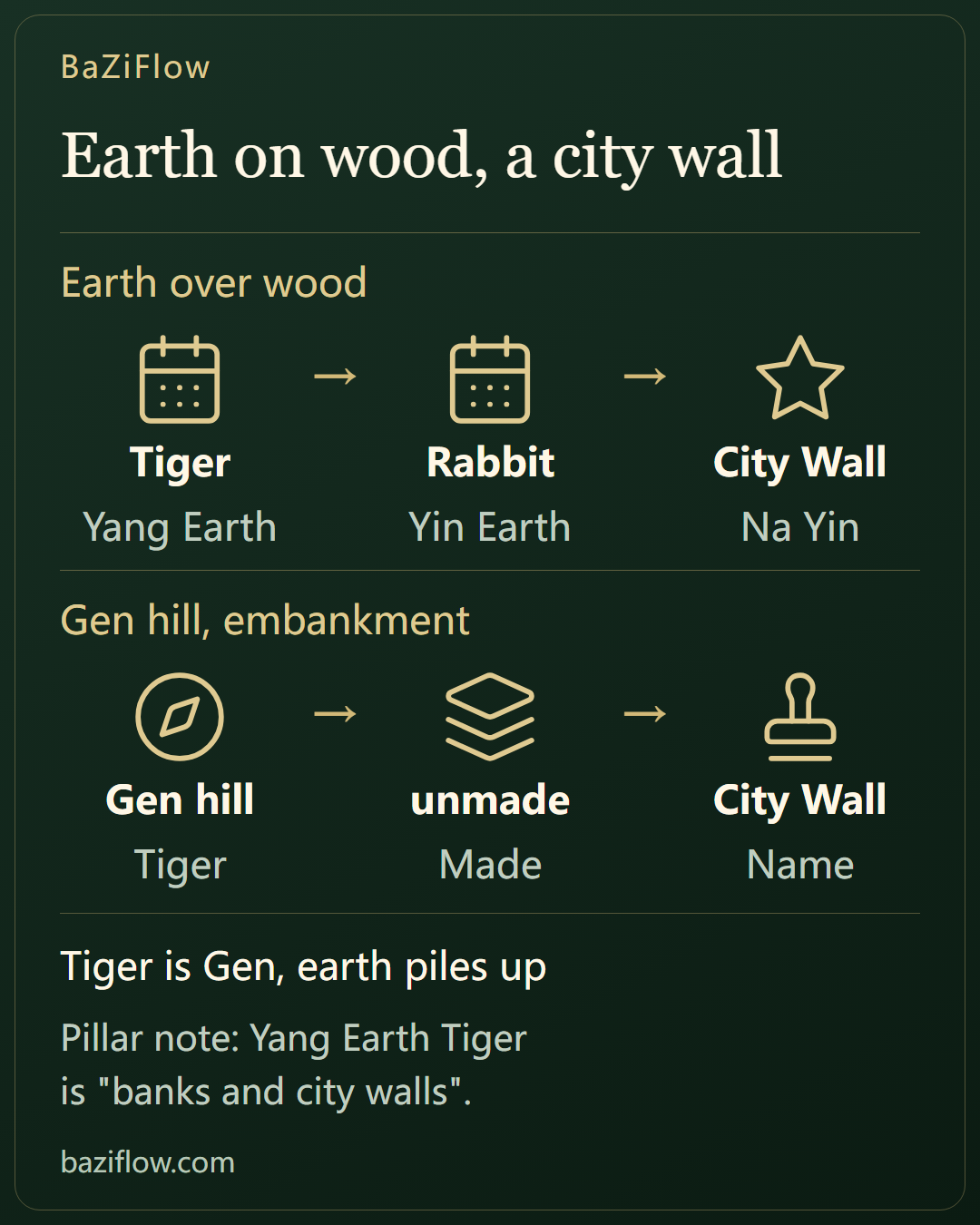
Yang Earth Tiger and Yin Earth Rabbit share Earth on the City Wall. Read the naming from the Tiger as a mountain, the contrast with post-road earth and the "made or unmade" rule, then check the wood it names.
The short version10 min read
Earth on the City Wall is the eighth Na Yin name, shared by Yang Earth Tiger and Yin Earth Rabbit. The name takes the image of an embankment and city wall, and what sets the entry apart is that it reads this earth in two cases, "made" and "not yet made".
- Both pillars are earth over wood, with each branch's Wood checking the Earth stem; Earth is at Growth on the Tiger and at Bath on the Rabbit, yet the name is a wall.
- The Sanming Tonghui names it two ways: qi able to complete things, nurturing them from root to calyx; and both stems are earth, the Tiger is the Gen mountain, and earth piled up becomes a hill. The survey calls its work that of an embankment.
- The entry's distinguishing mark is a two-way rule: with road earth in the chart it is made earth and needs no fire; without it, it is unmade and needs fire. Wall earth also needs wood, and Yang Metal Tiger and Yin Metal Rabbit check it in place.
Read first
What is Na Yin in BaZi? Why Yang Wood Rat Gold in the Sea does not replace Yang Wood ↗
Earth on wood, named for a wall
The eighth Na Yin name is Earth on the City Wall (城头土), shared by Yang Earth Tiger (戊寅) and Yin Earth Rabbit (己卯). Both stems belong to Earth and both branches to Wood, so each pillar is soil sitting on timber, yet the name is that of a wall.
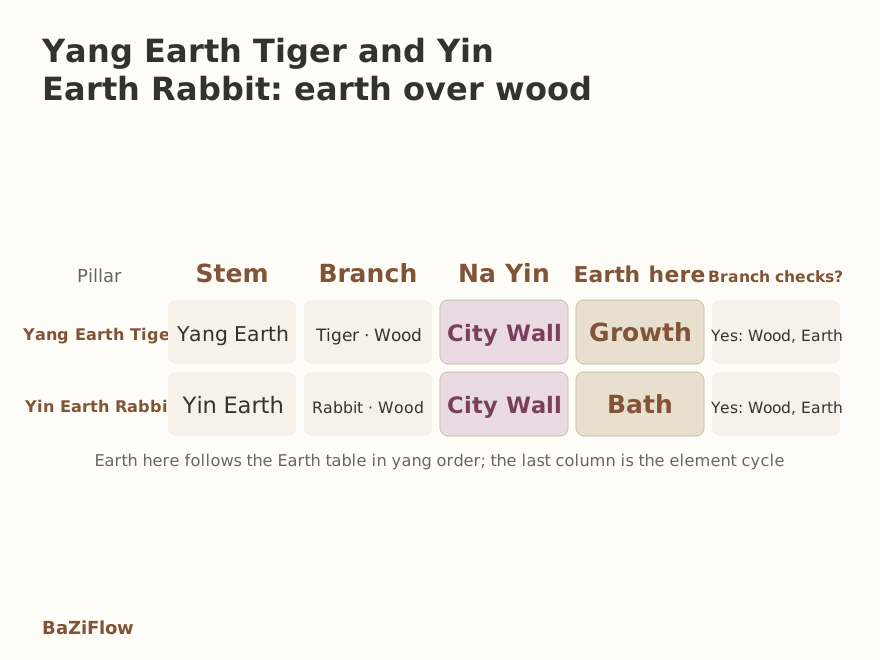
Comparison sketch: stem and branch attributes use the usual entry-level assignments, the Na Yin name follows the Sanming Tonghui, and the stages of Earth come from the engine's twelve-stage table.
The fourth column of the table reads the twelve life stages: Earth is at Growth on the Tiger and at Bath on the Rabbit. The last column uses the element cycle: the Wood of each branch checks the Earth of its stem, in both pillars. Soil that has just been born is checked by wood at the same time, and every remark in the entry about "feeding on wood" and "checking in place" turns on that.
How the book names it: roots, calyx and the Gen mountain
The Sanming Tonghui (三命通会) gives two reasons for the name in juan 1. The first is in the general survey:
Yang Earth Tiger and Yin Earth Rabbit: the qi can complete things, its work is to nurture them, starting from the roots and sprouts and fortifying them up to the calyx and stamens; hence earth on the city wall.
The earth here completes and nurtures: it carries a plant from the root sprout all the way to the calyx and stamen, and its merit lies in holding up growth. The second reason comes from the calendar specialists (日家) and turns to direction:
Yang Earth Tiger and Yin Earth Rabbit: both stems are Earth, the Tiger is the mountain of Gen, and earth piled up becomes a mountain; hence earth on the city wall.
Both stems are Earth; the Tiger sits at Gen, the mountain trigram; and earth heaped up and up becomes a mountain. The specialists do not explain the step from mountain to city wall; on our reading it is earth raised high enough to hold and guard. One reason looks at function and the other at direction, and both land on earth raised high.
Enlarge diagram · scroll sideways to read
Set against the post road: the Tiger at Gen, the Monkey at Kun
The survey also sets this pair beside another:
Yang Earth Tiger and Yin Earth Rabbit against Yang Earth Monkey and Yin Earth Rooster: city wall and post road, east and west, north and south, the proper places of Kun and Gen.
Yang Earth Monkey and Yin Earth Rooster are Earth of the Great Post Road: the same stems, with branches half a circle from the Tiger and Rabbit. The calendar specialists' reason for post-road earth is that the Monkey belongs to Kun, the earth, and the Rooster to Dui, the marsh; earth of both stems laid over Kun and the marsh is no thin or fleeting soil.
Enlarge diagram · scroll sideways to read
The two groups draw on different material: city-wall earth relies on a mountain and post-road earth on land and marsh. The stages on the table also run the other way, Growth and Bath on the Tiger and Rabbit but Weakening and Death on the Monkey and Rooster. Stages do appear in the book, but on a different scale. Its notes on single pillars call Yang Earth Tiger "injured earth, the weakest of all" and Yin Earth Rabbit "earth at its own Death"; the post-road entry calls Yang Earth Monkey "earth at Growth" and Yin Earth Rooster "earth at its own defeat". Those verdicts hold only if Earth is born on the Monkey and sickens on the Tiger, as Water does: a mirror image of the engine, whose Earth keeps Fire's cycle. We print the engine's stages and quote the book beside them without merging the two.
Made or unmade: the entry's two-way rule
The entry for city-wall earth is distinctive for splitting this earth into two cases:
This earth is either made or not yet made, and is argued in two ways. When it meets earth by the road it is made earth and needs no fire; without earth by the road it is unmade earth and must use fire. In general wall earth needs wood to feed it.
Earth by the road is Yang Metal Horse and Yin Metal Goat. With it in the chart the earth counts as "made" and gains nothing from fire; without it the earth is "unmade" and fire has to bake it. The thrust of the entry is "feed on wood", and the test below is only its first step:
Enlarge diagram · scroll sideways to read
Next comes the arrangement for wood:
City earth generally needs wood to feed it: willow with Yin Water Goat is best and Yang Water Horse is avoided; mulberry with Yin Water Ox is first and Yang Water Rat next; Yang Metal Tiger and Yin Metal Rabbit, checking it in place, make the wall fall and unsettle it.
Enlarge diagram · scroll sideways to read
Row by row: the Yang Earth of Yang Earth Tiger and the Yin Water of Yin Water Goat or Yin Water Ox make one of the five stem combinations, while the Rabbit of Yin Earth Rabbit and the Goat of Yin Water Goat are two of the three in the Pig-Rabbit-Goat wood union; Yang Metal Tiger and Yin Metal Rabbit occupy the same branches as Yang Earth Tiger and Yin Earth Rabbit, and wood checks earth, hence "checking in place". Yang Water Dog is water of the great sea: the entry first says to avoid Thunderbolt Fire and the great sea, then that Yang Water Dog is not to be avoided and its unions count as auspicious; the book does not say which union it means. More than one fits on the table: among branches the Tiger and Dog form a half union of fire and the Rabbit and Dog combine, and the other great-sea pillar, Yin Water Pig, joins Yang Earth Tiger through the Yang Earth and Yin Water stem combination. We list them and do not choose for the book.
4 February 1999: two year pillars in one day
A Yang Earth Tiger year is 1998 and a Yin Earth Rabbit year is 1999; sixty years on they are 2058 and 2059, and sixty years back 1938 and 1939. The Start of Spring in 1999 falls at 14:57 on 4 February (Beijing time), against 08:56 in 1998 and 20:40 in 2000. Looking at 4 February 1999 alone, the turn of spring splits the morning from the evening.
Enlarge diagram · scroll sideways to read
Two judgments
Yang Earth Tiger meets Yin Water Ox and the book says "mulberry with Yin Water Ox is first". What can the table confirm?
Yang Earth and Yin Water make one of the five stem combinations, and that is as far as the check goes; the book gives no reason for "first", so this row can only be confirmed at the level of the stem combination.
A chart holds city-wall earth and earth by the road. Read it as made or unmade?
By the entry, meeting earth by the road means made earth, needing no fire; only without it is the earth read as unmade and fire required. Check for earth by the road first, then go on to wood.
The previous pair is Water Below the Ravine and the next is White Wax Metal. The cycle in which wood checks earth and earth gives birth to metal is drawn out in full in the cycles of the five elements.
The combination of Yang Earth with Yin Water is in the five stem combinations, while the half union and harmony of the branches are a separate kind of relation. How the two layers split the work is set out in what Na Yin keeps and what stems and branches keep.
Questions readers ask next
The pillar commentary calls Yang Earth Tiger "injured earth" and Yin Earth Rabbit "earth at its own Death". Are people born in those years weak?
No. Both phrases judge the earth of the year pillar itself: in the book's count, with Earth travelling with Water, Earth sits at Weakening on the Tiger and at Death on the Rabbit, and the branch wood checks it as well, hence "injured" and "without strength"; the commentary goes on to ask for strong, living fire to feed it. The site's table runs Earth with Fire, giving Growth and Bath, and both counts coexist. Neither is a verdict on the health or fortunes of the person.
Does "made" and "unmade" say whether someone has already succeeded?
No. These are the entry's two ways of reading this earth: if the chart holds earth by the road, treat the earth as already formed and add no fire; if not, treat it as unformed and use fire to bake it. Made and unmade describe the state of the earth and not the circumstances of a person.
Why are the city wall and the great post road so often set side by side?
The Sanming Tonghui sets Yang Earth Tiger and Yin Earth Rabbit against Yang Earth Monkey and Yin Earth Rooster: the stems match and the branches sit half a circle apart. The Tiger belongs to Gen, in the northeast, and the Monkey to Kun, in the southwest. City-wall earth is earth piled into a hill; post-road earth is earth laid over land and lake, so their images lie in different directions.
Was this article helpful?
Sources & references
Continue reading
Water Below the Ravine (涧下水): Why Yang Fire Rat and Yin Fire Ox Carry This Na Yin Name ↗
White Wax Metal (白蜡金): Why Yang Metal Dragon and Yin Metal Snake Carry This Na Yin Name ↗
Five Elements cycles: learn the relationships, not just the order ↗