

Emptiness: a starting point cut in two
Content version · · Sources & references
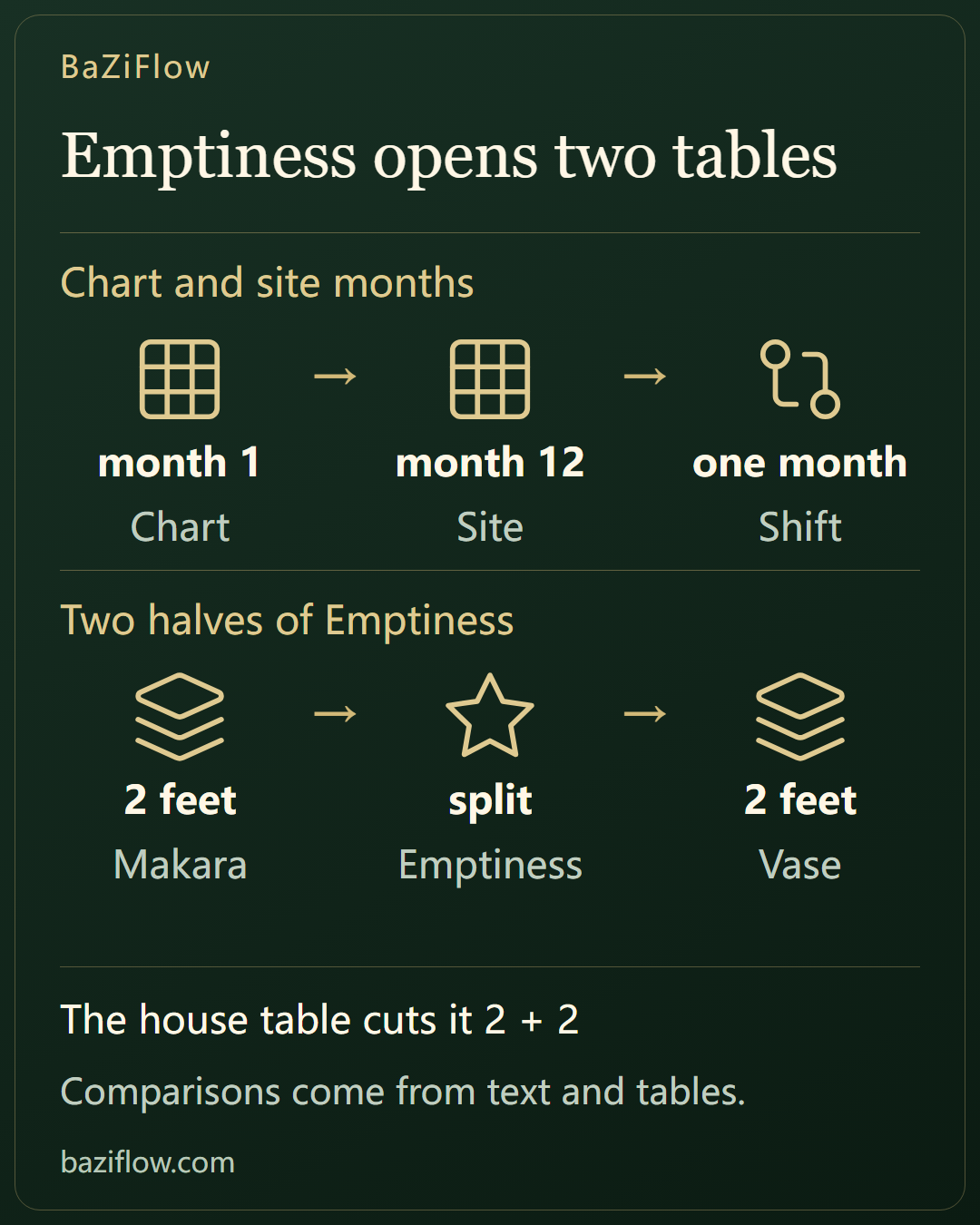
Emptiness is the twenty-first of the twenty-seven mansions. It opens month 1 of the sutra month chart and month 12 of the site table, and the house table cuts it between Sun and Moon. Picture four stars, note two.
The short version6 min read
Emptiness is the twenty-first of the twenty-seven mansions, counted from Hairy Head. The Tang month chart opens its first month on Emptiness, the site's month table opens month 12 on it, and the house table draws the Sun and Moon boundary through its middle.
- Day-one mansions of chart months 1 to 7 are Emptiness, Encampment, Legs, Stomach, Net, Three Stars and Ghost, the same as the starting mansions of months 12 to 6 on the site table; from month 8 the two tables part.
- The month chart runs a ring of twenty-eight that includes Ox, so each Emptiness day in it falls one day later than on the site table, because an Ox day sits in between.
- In the house table two feet of Emptiness lie in the Makara house and two in the Vase house; the Sun share ends and the Moon share begins there. The picture says four stars, the note two.
Read first
What is Sukuyō astrology? How a birth mansion is found ↗
Sukuyō 27 mansions vs the 28 lunar mansions: what is the difference? ↗
Position twenty-one, third of the northern mansions
Counted from Hairy Head (昴), Emptiness (虚) is number twenty-one, with Girl (女) before it and Rooftop (危) after it. The annotator notes place it in the northern group, six mansions on the ring of twenty-seven, and Emptiness is the third of them.
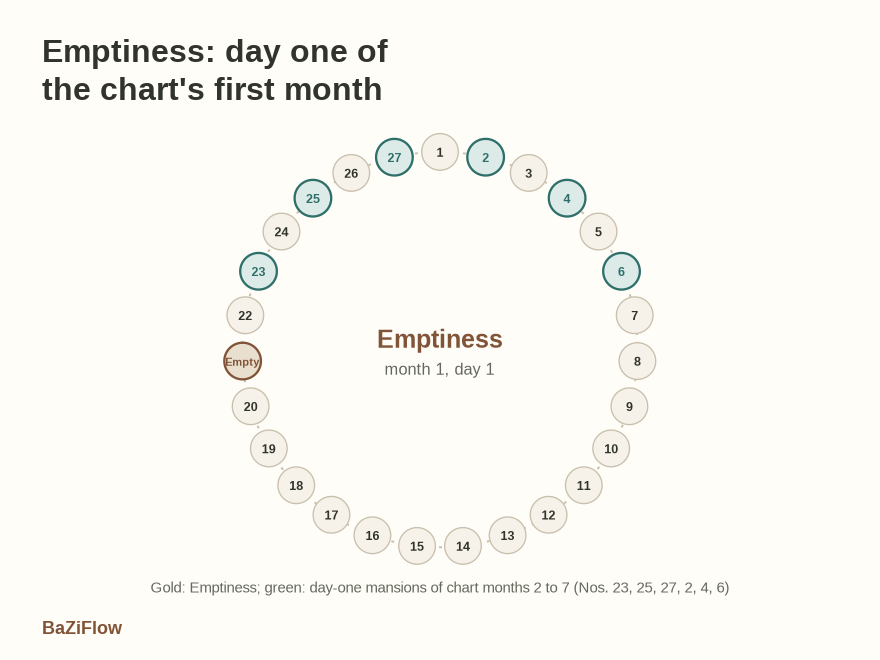
Position sketch: the twenty-seven names are spaced evenly in their order, with Hairy Head as No. 1; green marks the day-one mansions of chart months 2 to 7, and even spacing is typography, not sky width.
The colors point at something else, Jingfeng’s calendar in the sutra. The Tang month chart near the start of the first fascicle gives every day of every month a mansion, and the cell for day 1 of month 1 holds Emptiness. In the picture Emptiness is gold, and green marks the mansions that open months 2 to 7: Encampment, Legs, Stomach, Net, Three Stars and Ghost (室, 奎, 胃, 毕, 参, 鬼), one every second place.
The Emptiness picture: four stars like a myrobalan, two in the note
The entry for Emptiness begins:
Emptiness has four stars, shaped like a myrobalan. Its deity is Suo-po (娑婆). Its clan name is Po-si-jia-ye (婆私迦耶).
Three terms in the Emptiness picture
- Myrobalan
- A fruit used in medicine; the book compares the shape of the four stars to it.
- Four stars and two
- The note says Chinese astronomy gives Emptiness two stars and the post of chief minister, two fewer than the picture, the reverse of Tail and Girl, where the note has more.
- Suo-po (娑婆)
- The deity name in the picture, a transcription from Sanskrit that the book does not explain.
The picture of Chariot gives five stars against four in the note, also more than the note, and is taken up on the page for Chariot; Emptiness is another such case.
The sutra's month 1 against the site's month 12
The first row of the Tang month chart in the first fascicle holds the day-one mansion of each of twelve months:
Day 1: Emptiness, Encampment, Legs, Stomach, Net, Three Stars, Ghost, Star, Wings, Horn, Root, Heart.
Take months 1 to 7 and set them against the starting mansions of months 12 to 6 on the site table:
Enlarge diagram · scroll sideways to read
Seven columns without a miss show that, for the first seven months, the two tables start from one sequence slipped by a month: the sutra's month 1 is the site's month 12. At month 8 the link breaks: chart month 8 opens on Star and site month 7 on Extended Net, and from there each goes its own way, since the chart runs a ring of twenty-eight and moves its starting mansion on two places a month, while the site runs twenty-seven and moves it two or three. That is why the sutra's day 1 of month 1 is Emptiness and the site's day 1 of month 1 is Encampment; how to read two tables with different starts side by side is laid out in why the calculation methods differ.
An extra Ox day
In the seven aligned months the dates of the Emptiness days follow a rule too: for a matched pair of months the chart's Emptiness day always comes one day after the site's. Take the sutra's month 1 and the site's month 12:
Enlarge diagram · scroll sideways to read
Both sequences start at Emptiness and both reach Dipper on day 26; the chart then puts Ox after Dipper, which shifts Girl and Emptiness one day later each. The chart's Emptiness days for months 2 to 7 are days 27, 25, 23, 21, 19 and 17, and for the matching site months 1 to 6 they are days 26, 24, 22, 20, 18 and 16, one day apart in every pair.
Emptiness cut in half by the house table
In the twelve-house table Emptiness holds four feet: two in the Makara house and two in the Vase house (瓶宫). A line in the middle of the table reads:
The six places above all belong to the Sun share; the six below all belong to the Moon share.
The last house of the Sun share is the Makara house and the first of the Moon share is the Vase house, so their boundary runs through the middle of Emptiness:
Enlarge diagram · scroll sideways to read
More than one mansion is cut by house lines in the table, but the boundary between the Sun share and the Moon share falls at the start of Star on one side and straight through Emptiness on the other. The Sun share begins with the whole four feet of Star and ends at the two feet of Emptiness, which makes Emptiness the mansion that this line cuts. Girl comes just before Emptiness on the ring (Girl) and Rooftop just after (Rooftop).
Questions readers ask next
Why do the sutra's month 1 and the site's month 12 both begin with Emptiness?
The month chart runs twenty-eight mansions and its starting mansion advances two places each month, beginning at Emptiness in the first column; the site table runs twenty-seven and starts month 12 at Emptiness. Set the first seven columns side by side and the sutra's months 1 to 7 match the site's months 12 to 6 exactly, as if one sequence had slipped by a month, until month 8 where the unequal ring lengths pull them apart.
The picture gives Emptiness four stars; why does the note give two?
The picture is the star chart that came with the sutra and says four; the annotator added, from Chinese astronomy, a line that says two. Emptiness is one of the few mansions where the picture has more than the note, and the book does not explain the difference. Say which layer a star count comes from.
Do the Sun and Moon shares make Emptiness two mansions?
No. By the feet in the fascicle 1 house table, Emptiness holds four, two in the Makara house and two in the Vase house, which are the last house of the Sun share and the first of the Moon share. That is how the table divides feet among houses, and the mansion itself stays one.
Was this article helpful?
Sources & references
Continue reading
Girl (女), Mansion No. 20: Third-Row Head, Two Meanings of "Girl", Twenty-Seven Views ↗
Rooftop (危): Two Meanings of One Character in the 27-Mansion System ↗