

The Moon: the road between two towers
Content version · · Sources & references
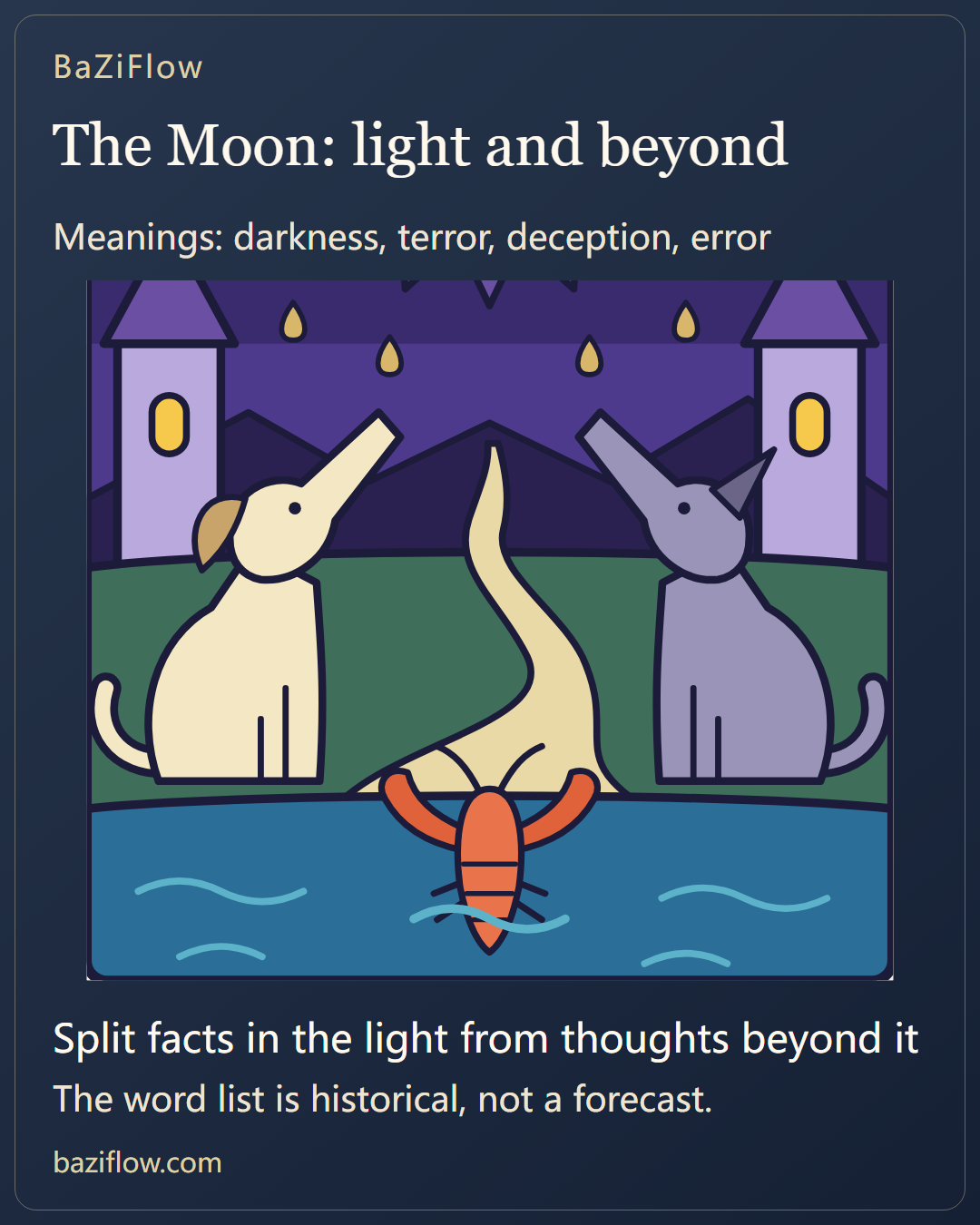
The Moon shows a road between two towers, a dog and a wolf howling at the moon, and a crayfish crawling from the water. Separate the picture, the word list and Waite’s reflected-light gloss, then plan a night outing.
The short version7 min read
The Moon shows a path between two towers with a dog and a wolf howling at the moon, and something climbing out of the water. Waite says the light here is a reflected one.
- The picture: the moon above two towers with a face in profile and many rays; a path running between the towers; a dog and a wolf howling at the moon; a crustacean climbing out of the water.
- Waite’s reading: the moonlight is the reflected light of the intellect, the path an issue into the unknown, the dog and wolf the fears of the natural mind, and what climbs from the deeps a nameless tendency.
- The list runs from hidden enemies to error, with occult forces among them; reversed, it speaks of instability and silence, with deception only turned down a notch.
Read first
The road between the towers: moon, dog and wolf, what is in the water
Waite’s description rests on a few points. The distinction between this card and some conventional types is that the moon is increasing on what is called the side of mercy, to the right of the observer; it has sixteen chief and sixteen secondary rays; and the path between the towers is “the issue into the unknown”. He adds that the card represents the life of the imagination apart from the life of the spirit.
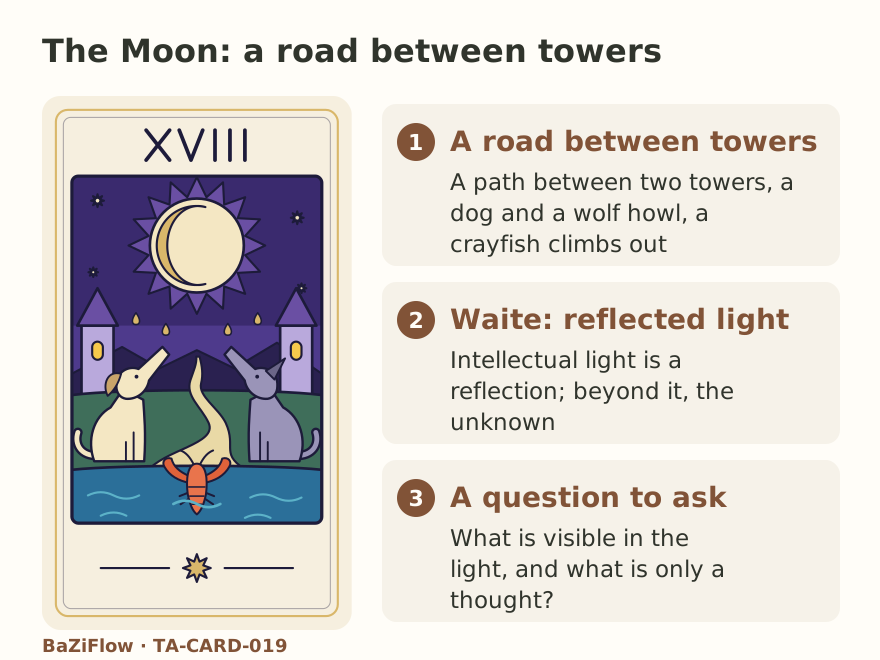
The Moon as BaZiFlow drew it: towers and a path.
Looking at the Rider-Waite-Smith card, you can see XVIII at the top; a yellow full moon with a face in profile, rays of alternating length and many yellow drops below it; a grey tower on each side with hills beyond; a red-brown dog at the left and a pale yellow wolf at the right, each looking up and howling; a pale path between the two beasts leading up between the towers; and, in the water at the bottom, a dark red crustacean climbing toward the shore.
Enlarge diagram · scroll sideways to read
Eight words in three groups by subject: others, surroundings, inside
Waite’s divinatory meanings are: hidden enemies, danger, calumny, darkness, terror, deception, occult forces, error.
Hidden enemies, danger, calumny, darkness, terror, deception, occult forces, error.
You can read the eight words by first asking whose matter each is. Enemies, calumny and deception are done by others; danger, darkness and occult forces belong to the surroundings; terror and error land inside oneself. The grouping is added here for reading; Waite prints a single run of words.
Enlarge diagram · scroll sideways to read
Moonlight, dog and wolf, what climbs out: Waite reads them as something inside
In Part II Waite reads the whole picture as an inner landscape. The moonlight is intellectual light, a reflection, with the unknown mystery beyond it. It illuminates our animal nature, types of which are drawn below: the dog, the wolf and “that which comes up out of the deeps”, a nameless and hideous tendency lower than the savage beast. It strives to attain manifestation, symbolized by crawling from the abyss of water to the land, but as a rule it sinks back whence it came.
Enlarge diagram · scroll sideways to read
His last passage is the “message”: the face of the mind directs a calm gaze upon the unrest below, the dew of thought falls, and the words are “Peace, be still”; it may be that a calm will come upon the animal nature, while the abyss beneath ceases from giving up a form.
Moon, beasts, the thing in the water: Waite’s reading of each
- Moon
- The reflected light of the intellect, with an unknown mystery behind it that it cannot show forth. Waite also gives its waxing side (the right of the observer, “the side of mercy”) and its rays (sixteen chief, sixteen secondary).
- Dog and wolf
- “The fears of the natural mind” in the presence of the place of exit, when “there is only reflected light to guide it”. Waite does not say what dog and wolf stand for separately.
- What climbs from the water
- He gives it no name, calling it a “nameless and hideous tendency” lower than the savage beast; it wants to appear but usually sinks back. “Crustacean” is what the picture shows, not Waite’s word.
Peace, be still.
All of this is Waite’s inner reading, in which the picture becomes a landscape within a person. The practice below borrows only one line of it: the light is reflected, so separate what the light reaches from what it does not.
How to read it: before a night walk, write the light and what lies beyond it apart
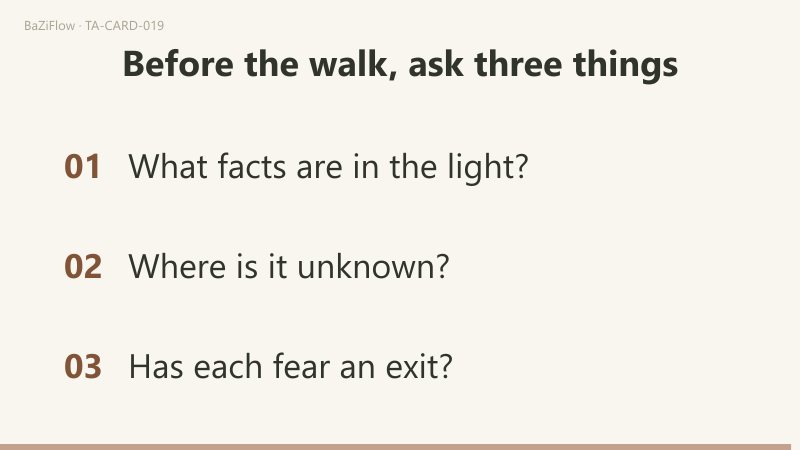
Take the line “only reflected light to guide it” and lay a Friday night out against it. Four friends plan a walk around a lake at the edge of town to see the night view, and none of them has walked the road at night.
Write what the moonlight reaches
Write only what can be checked: how long the whole walk is, which stretch has street lamps, when the last bus home leaves. This is the part the light can reach; list it item by item.
Write what it does not reach
An unwalked stretch, a change in the night’s weather. Label these “unknown”, not “dangerous”; the two words carry different weight, and the wrong one turns something unknown into a known bad thing.
Give every thought an exit
The dog and wolf stand at the place of exit. Write down the worries that come up one by one and give each a check or a fallback, then see how big each one still looks.
Enlarge diagram · scroll sideways to read
What is in the light, and what is beyond
In the light
- About 3 km in all
- Last bus at 22:40
Beyond it
- An unwalked stretch of bank
- Whether fog will rise
Exits for the worries
- Walk it by day first
- Go in a group, bring a torch
Reversed and neighboring cards: unsteady, inconstant, silent, and other cards that write about light
The reversed line reads quickly: instability, inconstancy, silence, plus lesser degrees of deception and error.
Instability, inconstancy, silence, lesser degrees of deception and error.
Enlarge diagram · scroll sideways to read
Three neighboring cards, and how each writes about light
The crescent at her feet, “borrowed light”
Waite says her light is borrowed, and that she is the Moon fed on the Supernal Mother’s milk. Her list holds silence next to secrets, mystery and a future not yet revealed.
The next card: direct light
In that entry Waite sets the sun’s light opposite the reflected kind. Its words point at goodness in daily life, where the Moon’s circle hiding and not seeing clearly.
The card before: another reading at night
That entry begins with loss and keeps hope as a second reading inside the same line. Also a night card, but this one holds two readings that point opposite ways.
Questions readers ask next
Does the Moon simply mean someone is deceiving you?
The list does have hidden enemies, calumny and deception, but the same line also has darkness, terror, occult forces and error, several of which sit on your own side. In Part II Waite reads the dog and wolf as “the fears of the natural mind”. Start by asking whether the matter is outside or in your head.
What does the Moon mean reversed?
Waite’s reversed line is short and mostly about condition: unsteady, inconstant, quiet. The deception and error of the upright list are still there, only turned down a notch.
What about the rays and the falling drops on the Moon card?
Waite gives only a few details: the moon is increasing on the side of mercy, to the right of the observer; it has sixteen chief and sixteen secondary rays; and “the dew of thought falls”. He does not go through the drops one by one.
Was this article helpful?
Sources & references
Continue reading
The High Priestess: seated between two pillars, her scroll half covered ↗
The Sun: a child on a white horse with a red banner, and the light Waite calls direct ↗