

Coming of Age: the capping cell
Content version · · Sources & references
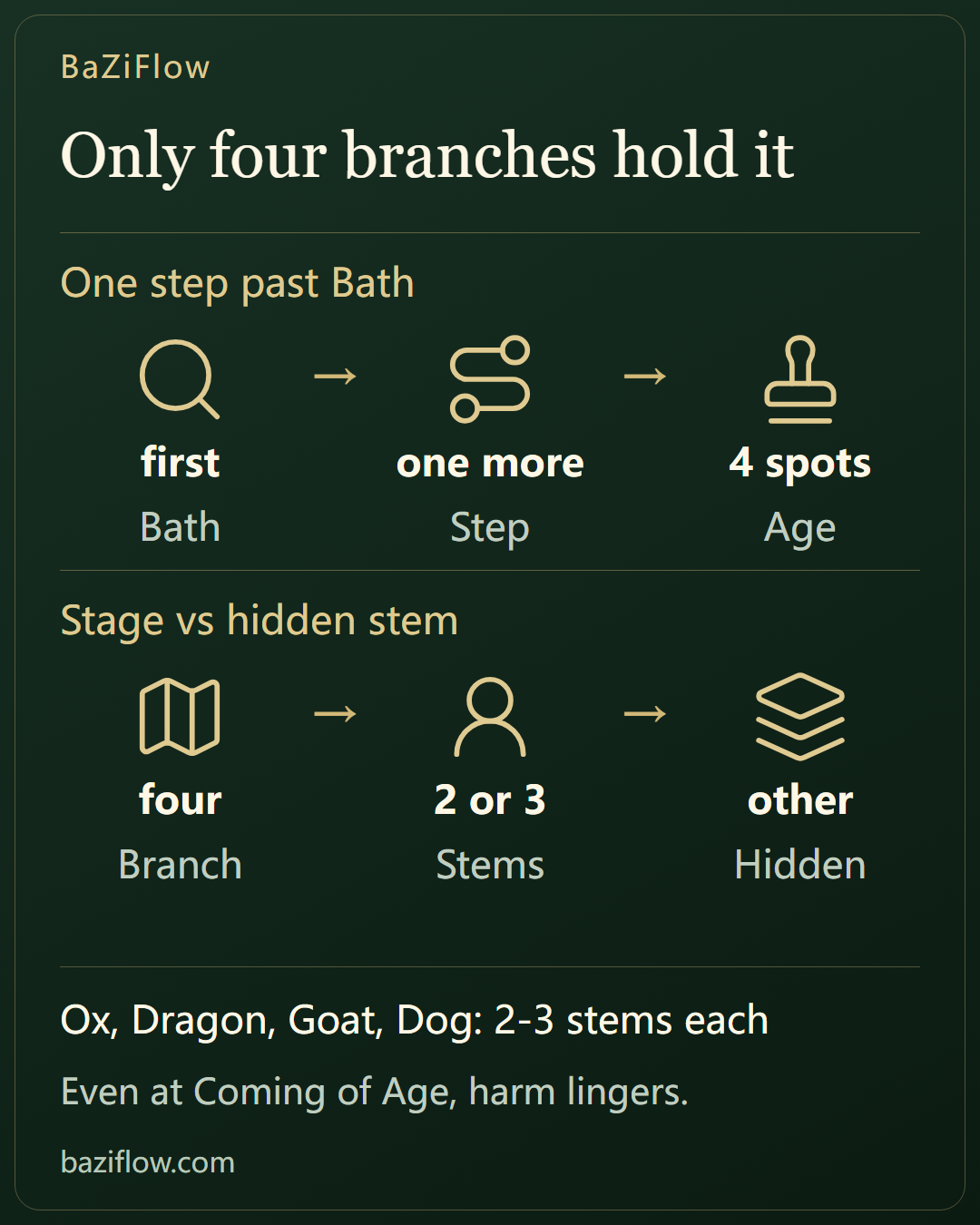
Coming of Age is the third cell of the twelve life stages; all ten Day Masters land on Ox, Dragon, Goat and Dog. A reverse table, stage versus hidden stems, three books and a five-year handover window explain it.
The short version7 min read
Coming of Age is the third cell of the twelve life stages, taking the image of a young man capped and sashed as an adult. All ten Day Masters land on the four storehouse branches, Ox, Dragon, Goat and Dog, with two or three on each.
- The position comes from one more step after Bath, forward for Yang stems and back for Yin stems; ten Day Masters, two or three at a time, use only the four branches Ox, Dragon, Goat and Dog.
- To learn what a branch contains, use the hidden-stems table; the Coming of Age table cannot tell you. Six of the ten Day Masters are also hidden in their own Coming of Age branch, and four are not.
- One book lists Coming of Age among the lucky meetings, another says "things stay middling", a third says "some misfortune still lingers": the first two grade the stages of a Luck Pillar, coarsely or finely, and the third is about the handover.
Read first
Twelve Life Stages and Void Branches: Two Tables, Two References ↗
Strong and weak Day Masters: references, relationship directions and evidence ↗
Coming of Age: the day the cap goes on and the sash is tied
In the old rite of capping (冠礼), a young man reaching adulthood had a cap put on his head and a sash tied at his waist, and from then on appeared in an adult's dress. The third cell of the twelve life stages is named after that moment: Coming of Age (冠带), literally "cap and sash".
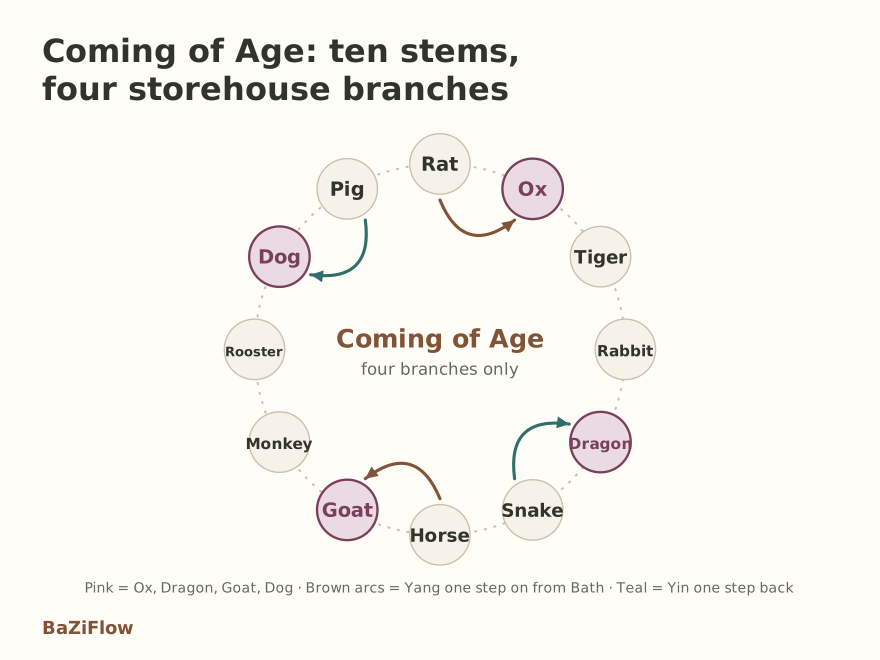
Position sketch: the positions come from the site engine's twelve-stage table; the arcs show only the last step for four Day Masters, and the rest work the same way.
The Sanming Tiyao (三命提要), quoted in juan 2 of the Sanming Tonghui (三命通会), writes it like this:
Coming of Age: things gradually come into flower and beauty, like a person fully dressed in cap and robe.
Things are slowly coming into flower, like a person with cap and robe in order. Compared with the "softness and fragility" of Bath, this cell is a step on: the form has grown, but not yet to the cell of taking office and running a household, which is the next one, Establishment (临官).
One more step from Bath, onto Ox, Dragon, Goat and Dog
The look-up continues the first two cells: a Yang stem counts forward to the third cell from Growth, and a Yin stem counts back to the third. The arcs in the figure draw four examples: Yang Wood steps forward from Rat to Ox and Yang Metal from Horse to Goat; Yin Wood steps back from Snake to Dragon and Yin Metal from Pig to Dog.
It is easier to look up in reverse: start with the branch and ask which Day Masters have Coming of Age there.
Enlarge diagram · scroll sideways to read
Take Goat: Yin Fire, Yin Earth and Yang Metal all have Coming of Age here. Yang Metal steps forward from Horse; Yin Fire and Yin Earth step back from Monkey. Three Day Masters stand on one Goat, each having come by its own route and direction.
One Dragon, two tables: the stage and the hidden stems
Dragon, Dog, Ox and Goat are the four storehouses of Earth, and each stores several stems. By the site's hidden-stems table, Dragon holds Yang Earth with Yin Wood and Yin Water, Dog holds Yang Earth with Yin Metal and Yin Fire, Ox holds Yin Earth first and then Yin Water and Yin Metal, and Goat holds Yin Earth with Yin Fire and Yin Wood. Coming of Age is the stage a Day Master is in on this branch; the hidden stems say what the branch contains. The two tables answer separately.
Enlarge diagram · scroll sideways to read
Check the ten Day Masters one by one and it is plain: Yin Wood, Yang Earth, Yin Fire, Yin Earth, Yin Metal and Yin Water happen to find themselves hidden in their own Coming of Age branch, while Yang Wood, Yang Fire, Yang Metal and Yang Water do not. So hidden stems cannot verify a stage, and a stage position cannot tell you what the branch holds.
Three texts, three tones
Is Coming of Age good or not? Open three passages and the tone is not the same:
Enlarge diagram · scroll sideways to read
The tones differ, but nobody is wrong. The first two both describe a Luck Pillar reaching each stage. The Yuanhai Ziping, in an "alternative method" in its section on Luck Pillars, has only two sides, lucky and unlucky; Coming of Age is on the lucky side, followed at once by "if void, unlucky". Juan 2 of the Sanming Tonghui grades more finely, with separate words for Growth, Establishment and Peak, Decline and Weakening, Death and Severance, and the ruin stages, and puts Coming of Age with Conception, Storage and Taking Shape in the "things stay middling" band. The third, from Luluzi, speaks only of the moment a Luck Pillar changes. Before quoting a verdict on Coming of Age, check which passage it comes from and what that passage was asking.
Just arrived at Coming of Age: why "some misfortune lingers"
The last passage deserves a slow read. The line from Luluzi (珞琭子) is:
Even when the year meets Coming of Age, some misfortune still lingers.
A commentator named Wang explains it as a matter of handover: luck has just left a place of sudden ruin like Bath and moved on to Coming of Age, and one should not take it at once for good fortune, because the tail of the previous step's decline is still there. The book goes on: "that is why luck has the saying of five years before and after". It does not spell out how the five years are counted; in context it means that around the change, the previous step's momentum has not yet run out.
Enlarge diagram · scroll sideways to read
This is one reading in the book, a reminder not to treat the year of change as a clean cut. For how Luck Pillars are derived, see how Luck Pillars are derived.
Two more to try
The Day Master is Yin Fire. Which branch holds Coming of Age?
Yin Fire has Growth at Rooster; two steps back give Monkey for Bath and Goat for Coming of Age.
On the Dog branch, which Day Masters have Coming of Age?
Yin Metal and Yang Water. Yin Metal steps back one from Pig and Yang Water steps forward one from Rooster; both land on Dog.
The cell before is Bath and the next is Establishment; the whole table of twelve is laid out in the twelve life stages and void branches.
Questions readers ask next
Yang Metal has Coming of Age at Goat. Why do Yin Fire and Yin Earth sit there too?
Yang Metal has its Bath on Horse and steps forward to Goat; Yin Fire and Yin Earth have their Bath on Monkey and step back to Goat. Three Day Masters stand on one Goat with different routes and directions, so a shared branch does not mean a shared path.
The Sanming Tonghui says the young should run Coming of Age. Is it good only for the young?
That is juan 2 matching Luck Pillars to age: around ten, a youth should run Conception, Nurture, Growth, Bath and Coming of Age; at thirty and forty, the strong stages; at fifty and sixty, only Decline, ruin, Death and Severance, and the reverse is called "a lifetime of luck against you". It is about pairing luck with age; a Coming of Age position in a chart only says where the Day Stem sits on that branch and reveals no age.
Why do the books say different things about it?
The first two both describe a Luck Pillar reaching each stage: one has only lucky and unlucky, with Coming of Age on the lucky side; the other grades more finely and puts it in the "things stay middling" band. The third covers only the moment of changeover. Identify the passage before arguing about its mood.
Was this article helpful?
Sources & references
Continue reading
Bath (沐浴): One Step After Growth, and Why It Is Also Called Ruin and the Salt Pool ↗
Establishment (临官): Eight Branches, Each One Stem's Emolument, and What the Books Say ↗
What is Na Yin in BaZi? Why Jia-Zi Gold in the Sea does not replace Yang Wood ↗