

Seven of Wands: one staff on the height
Content version · · Sources & references
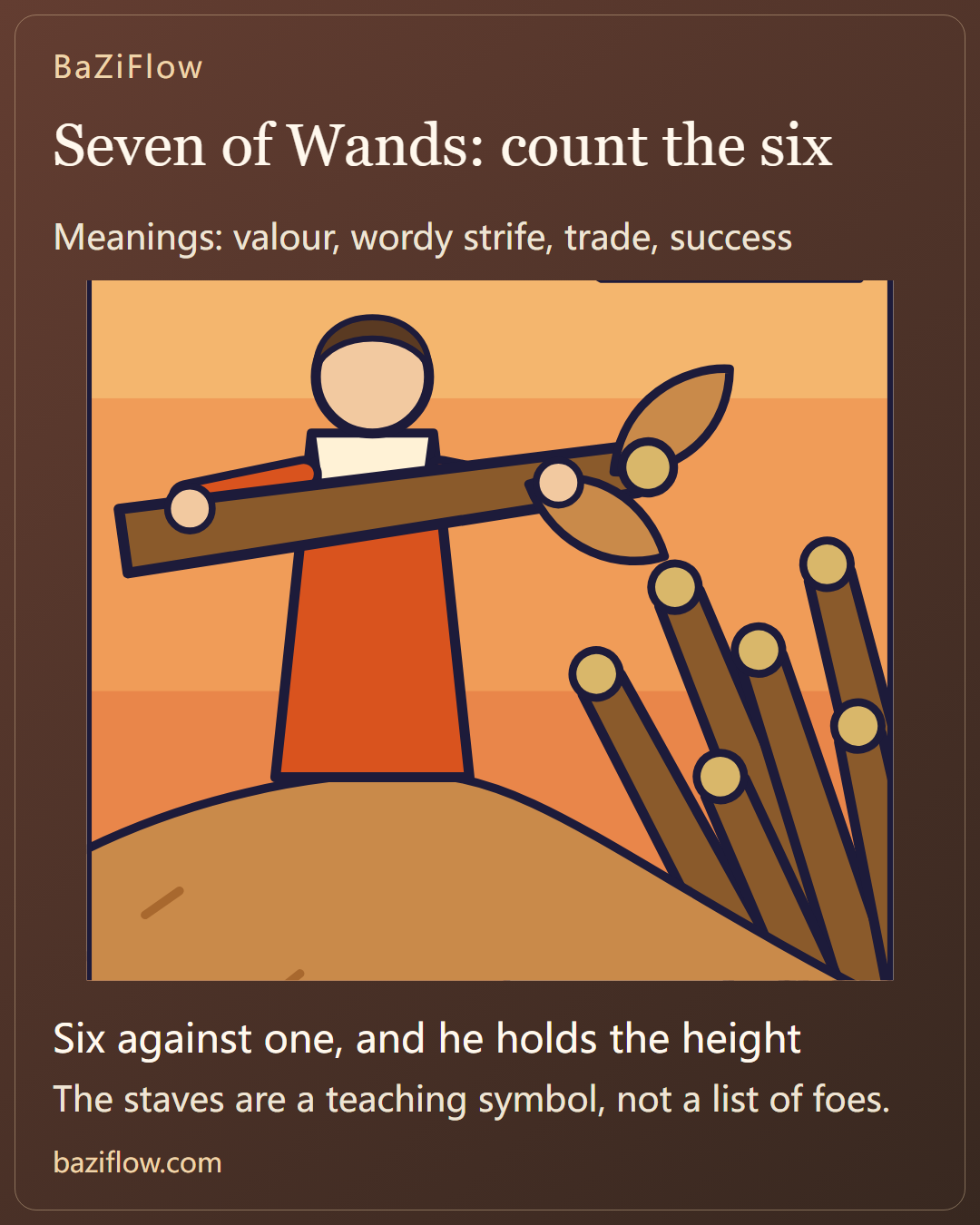
The Seven of Wands shows one figure on craggy high ground swinging a staff while six staves rise toward him. Read Waite's "six against one" and "vantage position", then practice counting six messages that arrive at once.
The short version7 min read
The Seven of Wands puts one person on high ground and six staves below him. Waite says "on the surface" it is six against one, then adds that he holds the vantage position. So count how many matters are coming, then look at where he stands.
- The number on the card is six against one, but Waite limits it with "on the surface" and at once says the man holds the vantage position.
- The meanings come in layers: valour, argument, rivalry in trade, and success because he is on top.
- Reversed, the card brings perplexity, anxiety and a warning against dithering; its one extra line, "a dark child", is period wording for looks and links to nothing else.
Read first
Start with the picture: one figure on a rise, six staves from below
Waite's description is one sentence: a young man on a craggy eminence brandishing a staff, with six other staves raised towards him from below.
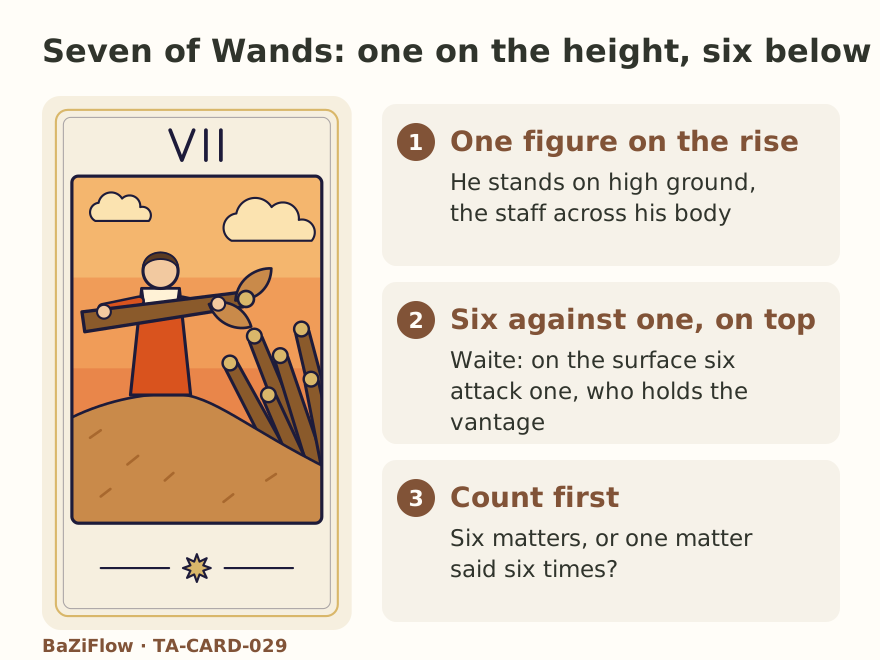
Seven of Wands: one above, staves below
In the Rider-Waite-Smith picture the young man wears green and stands on a green hilltop, gripping the staff in both hands and holding it slanted across his body. The staves below stand upright with small leaves on their heads, split between left and right. The picture holds three things from top to bottom: one person, the one staff in his hands, and the six staves below.
Enlarge diagram · scroll sideways to read
What Waite lists: valour, wordy strife and "unable to reach him"
Waite gives this card layers rather than a string of equal words. On the surface it is valour: six attack one, who holds the vantage position. On the intellectual plane it is discussion and wordy strife. In business it is negotiations, war of trade, barter and competition. He closes by saying it is also a card of success, because the combatant is on the top and his enemies may be unable to reach him.
It is a card of valour, for, on the surface, six are attacking one, who has, however, the vantage position. On the intellectual plane, it signifies discussion, wordy strife; in business—negotiations, war of trade, barter, competition. It is further a card of success, for the combatant is on the top and his enemies may be unable to reach him.
Enlarge diagram · scroll sideways to read
Height, staff and six staves: what each rests on
Three details deserve separating: the ground, the one staff in hand and the six staves raised from below. Waite writes "the vantage position" straight into his meanings and gives no further symbolism for the rest.
Where the height, the staff and the six staves come from
- Craggy eminence
- Waite puts the young man on a "craggy eminence" and says he holds the vantage position. That high ground gives a wide view and is hard to approach is general knowledge.
- The one staff
- Waite writes that he brandishes "a staff" and explains nothing more. Teaching reads it as "the one thing you will not give up", which is a borrowing.
- Six staves below
- Waite says they are "raised towards him", without saying whose they are or whether all are attacking. The number six appears in his meanings only in the line "six are attacking one".
Enlarge diagram · scroll sideways to read
Reading the six staves as "six separate views" and the staff in hand as "the one thing you keep" are modern teaching analogies. They bring the picture down to real counts and choices; the original goes no further than "six against one" and "the vantage position".
How to read it: count the six, check the footing, grip one
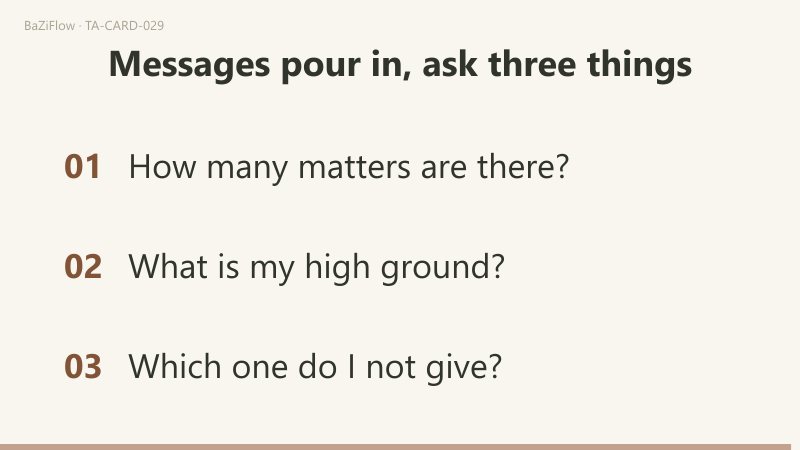
The easy slip with the Seven of Wands is to read "many people around me" as "I am being attacked". The picture offers three things to count: how many staves are below, where he stands, and how many he holds. Carried into everyday matters they become three questions:
Count: are the six one matter or six?
The six staves all point at one person, yet they are six. Write each message down and count them, and you may find that three of the six are saying the same thing.
Footing: what is your high ground?
Waite says he holds the vantage position. In teaching the rise is read as "what you already have and the other side may not", such as stock on hand or a stated dispatch time.
Grip one: which matter will you not give?
He holds a single staff. Before replying, choose from the six the one matter where the answer is "not this", such as selling below cost; the others can be talked over.
An example: a handmade candle shop gets six messages in one day, all saying the shop next door is better value. Write them down one by one and sort them:
Enlarge diagram · scroll sideways to read
Once sorted, the reply no longer has to say "we are good value too" six times: say the price floor once for price, the free-shipping threshold once for shipping, and stock on hand with the dispatch time once for the freebie. The high ground can now be written down as well: the candles are in stock and can ship the same day.
After taking stock of the footing
Standing firm
- Six counted into three matters
- A high ground you can write down
Not holding
- Giving a little on every one
- Treating each message as a foe
Do first
- Write the one you will not give
- Set limits on the others
Reversed and neighboring cards: perplexity, indecision and "a dark child"
Waite's reversed words are perplexity, embarrassments and anxiety, and he adds that it is also a caution against indecision. The main entry ends there, with no account of how indecision relates to the six against one, or of what not being indecisive would look like. The additional meanings hold only "a dark child", period wording for a person's looks that links to neither the picture nor the main list; cite it as such.
Enlarge diagram · scroll sideways to read
Three more cards of staves and opposition, and where each puts the topic
A crowd with staves, as if in sport
Waite describes a posse of youths brandishing staves as if in sport or strife, calls it mimic warfare, and also the competition of the search after riches. Here it is many against many, not six against one.
The card before: a wreath above the crowd
A mounted figure raises a wreathed staff while people on foot follow. Several staves again, but the list speaks of triumph, news and hope, with no standoff.
One leaning on a staff, a palisade behind
Waite writes a figure leaning on his staff with an expectant look, as if awaiting an enemy, and eight staves behind him like a palisade. The list is strength in opposition, with delay and suspension.
Questions readers ask next
Does the Seven of Wands mean I am under attack?
The picture is six against one, but Waite says only "on the surface". He follows at once with the vantage position and enemies who may be unable to reach the man. The card carries two facts, many and high, and reading only the first skews it.
What does the Seven of Wands mean reversed?
Waite gives perplexity, embarrassments and anxiety, with the remark that it is also a caution against indecision. The main entry stops there, and the additional list has no reversed line for this card.
Is the Seven of Wands a card for business questions?
Waite writes business into it himself: negotiations, war of trade, barter, competition. In his text the brandished staff lands mainly on talk and trade. The list gives no prices or figures, so the specific reply comes from the items you write down.
Was this article helpful?
Sources & references
Continue reading
Five of Wands: five staves cross at one point, and Waite himself says "sport or strife" ↗