

Karma–Womb: the thirds of the ring
Content version · · Sources & references
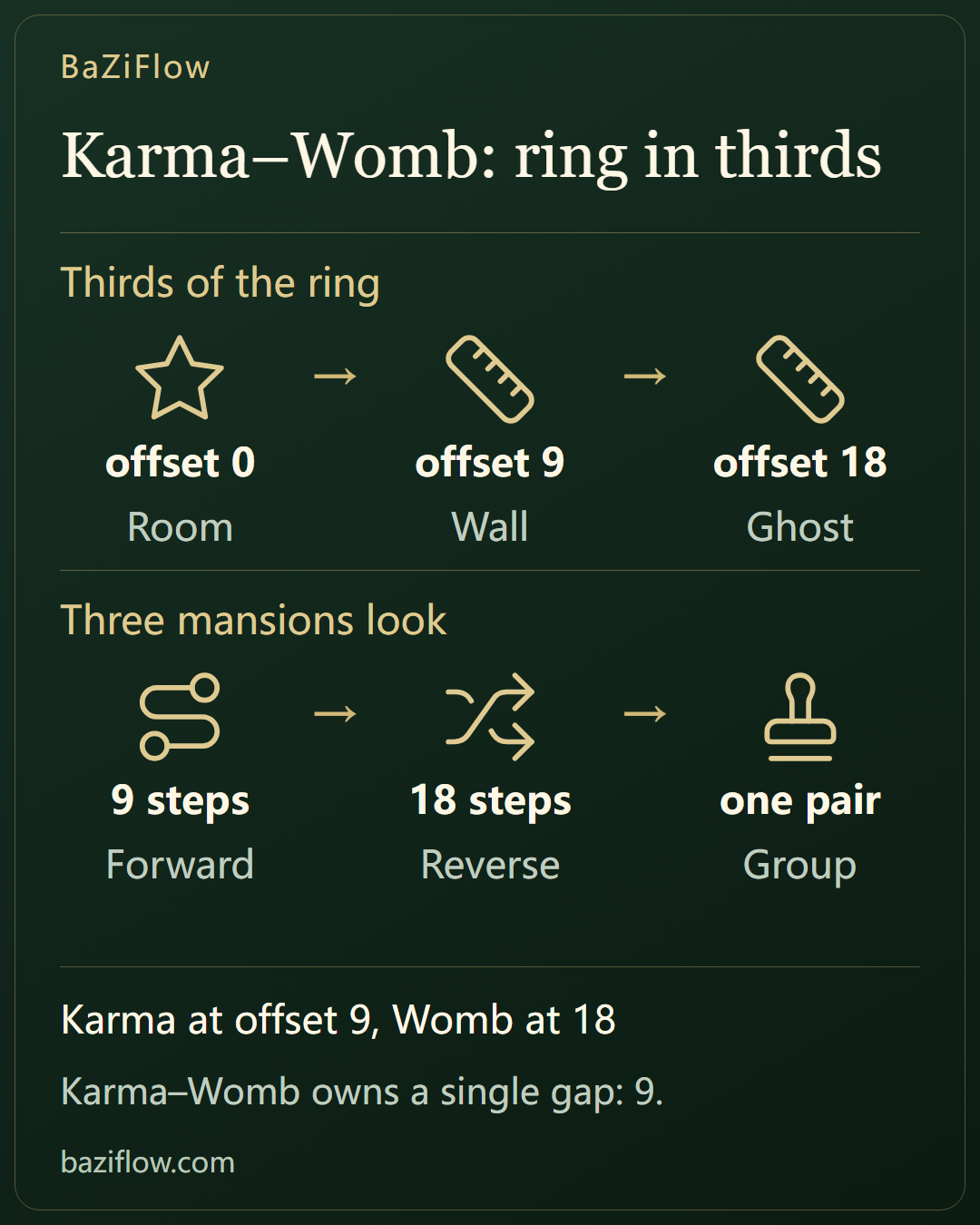
Karma and Womb sit at places 10 and 19 of the three-nine count and cut the ring of 27 into thirds, nine steps each way. A ring, a three-mansion table, the row structure and the book's two statements on Karma days.
The short version5 min read
Because 27 is three times 9, Karma at place 10 and Womb at place 19 cut the ring of 27 mansions into three equal arcs, and whichever way you count, the two mansions are 9 steps apart.
- 27 is three times 9, so the three row heads Fate, Karma and Womb sit nine steps apart: from any one, the next head is Karma and the previous head is Womb.
- Karma–Womb has exactly one short gap, 9. Of the gaps 1 to 13, the other twelve go three each to Prosper–Kin, Friend–Decline, Ease–Break and Peril–Attain.
- In the table Karma and Womb are a pair, but the book's verdicts pair Womb with Fate and list Karma alone; chapter 3 calls a Karma day auspicious, the second fascicle says neither good nor bad deeds are completed.
Read first
The thirds of the ring
Karma (業) is place 10 and Womb (胎) place 19; 27 is exactly three times 9, so the three row heads Fate, Karma and Womb cut the whole circle into three arcs of exactly nine steps.
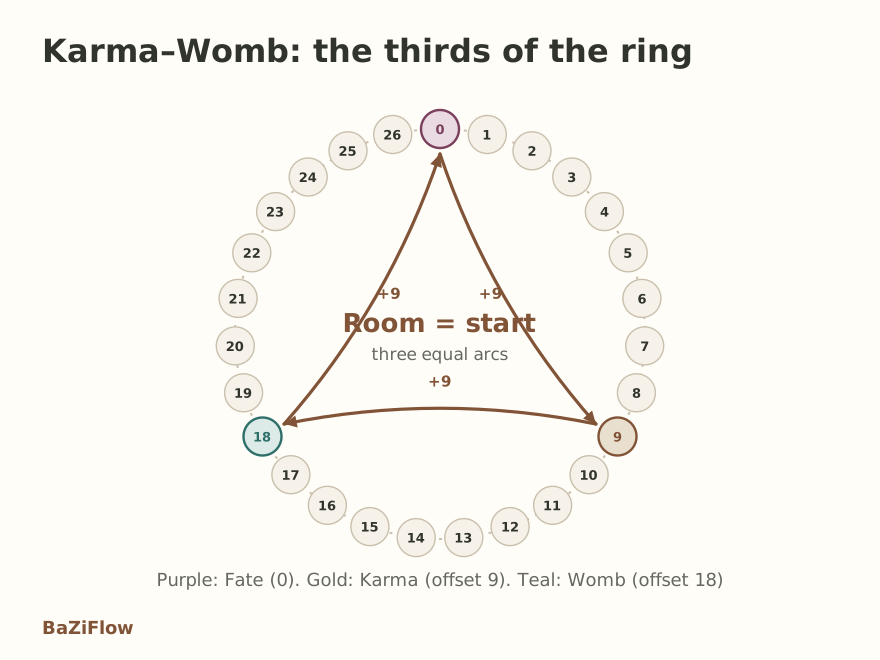
Sketch: the ring of 27 mansions starting at Room, with the start at offset 0 (place 1 if the start is counted); the three arcs each take nine steps and join the three row heads.
The picture starts at Room (房): purple is Fate (offset 0), gold is Karma (offset 9, which lands on Wall) and teal is Womb (offset 18, which lands on Ghost). Each arc takes nine steps, and three of them bring you back to the start.
Enlarge diagram · scroll sideways to read
Three mansions looking at one another: the next is Karma, the previous is Womb
Put Room, Wall and Ghost together and each is 9 or 18 steps from the other two. When they look at one another, the answers form a rotating table:
Enlarge diagram · scroll sideways to read
Going round Room, Wall, Ghost and back to Room, every mansion sees the next as Karma and the previous as Womb; reverse the direction and Karma and Womb swap. Karma–Womb has a direction just as Prosper–Kin does, but each direction has only one landing place (9 and 18), so every mansion has exactly one Karma and one Womb.
Second nine and third nine: Karma and Womb each head a row
The name "three-nine" comes from Karma and Womb heading a row each. After writing out the first nine, headed by Fate, the sutra goes on:
Next take the Karma mansion as the head, and the nine after it follow the earlier pattern, making the second nine. Then take the Womb mansion as the head, and the nine after follow the earlier pattern. The three-nine method thus goes round all 27 mansions; this is all kept secret.
Enlarge diagram · scroll sideways to read
So place 10 is called Karma because counting reaches the head of the second row, and place 19 is called Womb because counting reaches the head of the third. The rule of position is where the names come from.
Paired in the table, separated in the book
In the table Karma and Womb are mirror images of each other. In the verdicts the sutra gives, though, Womb is always put with Fate and Karma appears alone.
Enlarge diagram · scroll sideways to read
Even on a Karma day the two passages differ. Chapter 3 says:
On days when the Karma mansion is on duty, whatever one does is auspicious.
The three-nine passage (三必秘要法) in the second fascicle says:
On a Karma-mansion day, deeds good or bad alike do not come to completion; it is very weak.
Both sentences stand in the same book. This site does not rule between them and asks for one thing: when quoting a Karma-day statement, name the fascicle and passage first.
Two small checks
Checking Karma–Womb takes one number: how many steps apart the two mansions are, 9 or 18, and who is counting.
Two Karma–Womb checks
Net looks at Chariot, and Net looks at Girl: what are they?
Net is place 2 and Chariot place 11, nine apart: Karma. Net is place 2 and Girl place 20, eighteen apart: Womb. In reverse, Chariot sees Net as Womb and Girl sees Net as Karma.
Extended Net, Winnowing Basket and Stomach: what do they call one another?
Extended Net is place 9, Winnowing Basket place 18 and Stomach place 27, each neighbor nine apart. Extended Net sees Winnowing Basket as Karma, Winnowing Basket sees Stomach as Karma, and Stomach sees Extended Net as Karma; in the reverse direction all three are Womb.
In the table the Karma and Womb heads are flanked by Prosper–Kin; the next group in this series is Friend–Decline. Why there are exactly six groups is explained in the six relationship types, and whether a gap of 9 counts as near, middle or far depends on the chosen convention, discussed in near, middle and far distances.
Questions readers ask next
Is Karma meant for the past life and Womb for the next?
In the passages quoted here Karma and Womb are only names for place 10 and place 19, decided by who is counting, and no past or future life is mentioned. Explanations that add such ideas belong to later interpretation and need their own source; they are not part of the table itself.
Why does Karma–Womb have one gap when the other groups have three?
Offsets 9 and 18 reverse into each other and both give gap 9; 27 minus 9 is 18, which is Karma–Womb itself, so nothing spills into another group. The other four groups each have six offsets that pair off in reverse, so each owns three gaps.
Is Karma–Womb near, middle or far?
The convention chosen in the distance article of this series sets Karma–Womb aside as unbanded, like Fate. That is how one convention treats it and another may differ, so this series gives only the gap, 9, and does not assign a band.
Was this article helpful?
Sources & references
Continue reading
Prosper–Kin (栄親): six landing offsets and how they pair up ↗
Friend–Decline (友衰): why the indexes add up to 9, and how the book groups the two names ↗