

What birth information does a Zi Wei chart need, and where does each item go?
Content version · · Sources & references
Match the fields of a chart-casting form to the placement steps of Zi Wei Dou Shu Quan Shu: lunar year, month, day, double-hour, sex and birthplace each drive a different step, and each error moves something different.
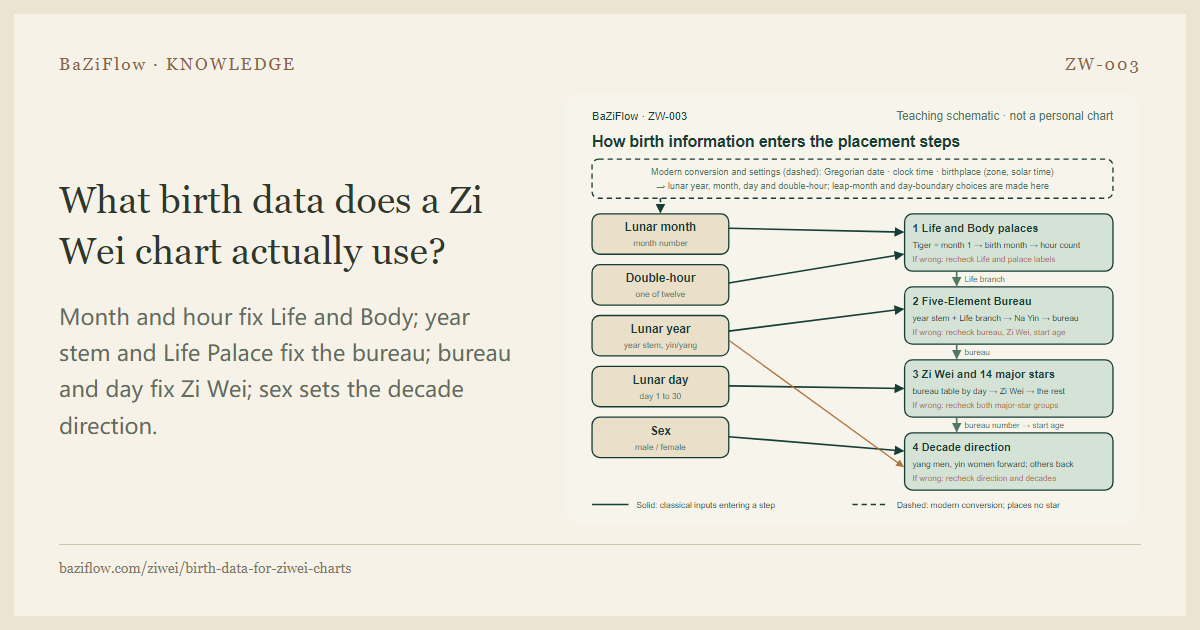
Month and hour fix Life and Body; year stem and Life Palace fix the bureau; bureau and day fix Zi Wei; sex sets the decade direction.
Read first
What is Zi Wei Dou Shu? A first guide to palaces and stars ↗
Read the form, then read the recipe
A chart-casting app asks for a calendar date, a clock time, a sex and a birthplace, and then a row of switches: solar-time correction, leap-month handling, the day boundary at the Zi hour. The opening of the second volume of Zi Wei Dou Shu Quan Shu, the compendium most schools cite, uses only four items: the year, month, day and double-hour of birth, all in the Chinese lunisolar calendar. The form is longer than the recipe because modern readers hold Gregorian dates and clock times; the software converts them first and hands the ambiguities of that conversion to the switches.
This article asks one question: which placement step consumes each input, and what moves when that input is wrong. For the vocabulary of palaces and stars, start with what Zi Wei Dou Shu is; for the hand-counting of the Life and Body palaces, see Life and Body palaces.
Four inputs, four routes
Following the order of volume two, placement falls into four steps, each fed by a specific input.
| Input | Step it enters | If this item is wrong |
|---|---|---|
| Lunar month + double-hour | Life Palace (命宫) and Body Palace (身宫): start the first month at the Tiger branch, count forward to the birth month, then treat that box as the Zi hour and count backward to the birth hour for Life, forward for Body | The Life Palace may change; if it does, the palace labels must be reassigned |
| Year stem + Life Palace branch | The Life Palace stem comes from the year stem (volume two's table: a Yang Wood or Yin Earth year starts at Yang Fire Tiger, and so on); the Na Yin (纳音) of that stem-branch pair gives the Five-Element Bureau (五行局): Water 2, Wood 3, Metal 4, Earth 5 or Fire 6 | The bureau may change; recalculate the Zi Wei position and the starting age of decade periods |
| Bureau + lunar day | Look up the day in that bureau's table to find the branch of Zi Wei (紫微), then place the other thirteen major stars by the placement verse | Zi Wei may change position; recheck both major-star groups. Different birth dates can also yield the same major-star layout |
| Yin or yang year stem + sex | Volume two's decade rule: yang-year men and yin-year women run forward, yin-year men and yang-year women run backward | The decade direction reverses if the changed polarity/sex combination switches the forward/backward condition |
Two facts in the table are easy to miss. The lunar day appears only in the third step: it does not decide the Life Palace, yet it decides Zi Wei, so a one-day error can relocate every major star. And the year stem is used twice: once to derive the Life Palace stem, once, through its yin or yang quality, to set the decade direction together with sex. The year stem also drives the birth-year transformations and stars such as Lu Cun; those belong to the articles on auxiliary stars and transformations.
The worked example inside volume two
The end of the Life-and-Body section gives an example that strings the first three steps together. A person born in a Yang Wood (甲) year has the Life Palace at the Tiger. Yang Wood and Yin Earth years begin at Yang Fire Tiger, so the Life Palace pair is Yang Fire Tiger (丙寅). The Na Yin song reads "Yang Fire Tiger and Yin Fire Rabbit: fire in the furnace," so the bureau is Fire 6. Born on the first day of the lunar month, the Fire 6 table starts Zi Wei at the Rooster. The text adds that a slip here "misses by a hair and ends a thousand miles away," which is exactly the chain dependence this article is about.
Change one condition to feel the sensitivity. Keep the Life Palace at the Tiger but make the year Yin Wood (乙): those years begin at Yang Earth Tiger (戊寅), whose Na Yin is "earth on the city wall," so the bureau becomes Earth 5. For the same first-day birth, the Earth 5 table puts Zi Wei at the Horse. Month, day, hour and Life Palace are unchanged; Zi Wei has jumped from the Rooster to the Horse. The table below lists the first-day starting branch for each bureau together with the starting age named in the bureau verses; both can be checked against volume two.
| Bureau | Starting age in the verse | Zi Wei for a first-day birth |
|---|---|---|
| Water 2 | age 2 | Ox |
| Wood 3 | age 3 | Dragon |
| Metal 4 | age 4 | Pig |
| Earth 5 | age 5 (table only) | Horse |
| Fire 6 | age 6 | Rooster |
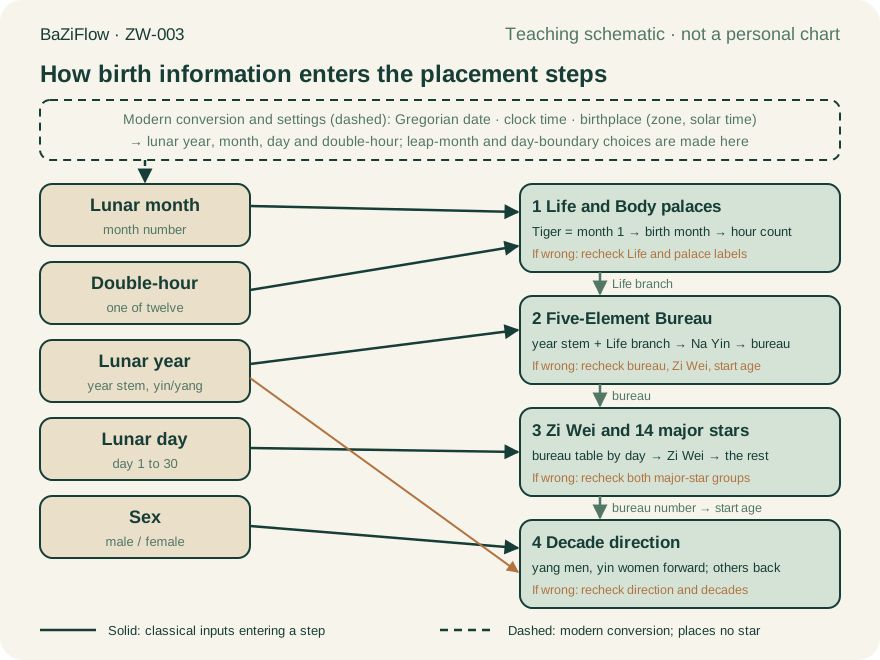
Original BaZiFlow teaching diagram; it maps inputs to placement steps and is not a personal chart.
Sex sets a direction; birthplace is a setting
In the classical method, sex does one thing: combined with the yin or yang quality of the year stem, it decides whether the decade periods (大限) run forward or backward. Volume two words the rule as starting "from the palace before Life" for yang men and yin women, running forward, and "from the palace after Life" for yin men and yang women, running backward. Modern teaching usually places the first decade in the Life Palace itself, starting at the age given by the bureau number, and then proceeds in the same direction; whether the first decade sits in Life or in the neighbouring palace is a difference between editions and schools worth noticing in older books. The direction rule is the same in both: swap the sex input on one natal chart and the decades walk the other way, so every palace is overlaid in a different decade of life.
Birthplace does not appear in the compendium. It enters modern casting because clock time has to be converted: first the local standard time of the birthplace's time zone, then an optional correction to apparent solar time, and only then the judgment of which double-hour and which day the birth belongs to. Birthplace therefore places no star directly; it acts only through "which hour and which day this moment counts as." Whether to apply the solar-time correction varies by school and by software. The difference between time zones and apparent solar time is explained in true solar time, time zones and daylight saving.
Limits and common misreadings
- A Gregorian date cannot stand in for the lunar month and day. Life placement uses the lunar month number and Zi Wei placement uses the lunar day; both must be converted first. The form accepts a Gregorian date for convenience, not because the method does.
- "If the hour is uncertain, just pick one" freezes the Life Palace, the Body Palace and every hour-placed star on an unverified assumption. Keeping candidate charts and noting which structures change with the hour is safer; see verifying birth time and records.
- Sex affects only the decade direction. It moves no star on the natal chart, so if two charts differ only in decade direction, check the sex or the year stem first.
- Near the end of a lunar year the year stem itself can change with a day or year boundary, carrying the bureau and the transformations with it. Those boundary cases are the subject of the next article.
Once each input is tied to its step, the effects of leap-month attribution, the Zi hour and the day boundary are just extra branches on the same diagram: why leap months, double-hours and day boundaries change the chart.