

Seal of Office: one branch per day stem
Content version · · Sources & references
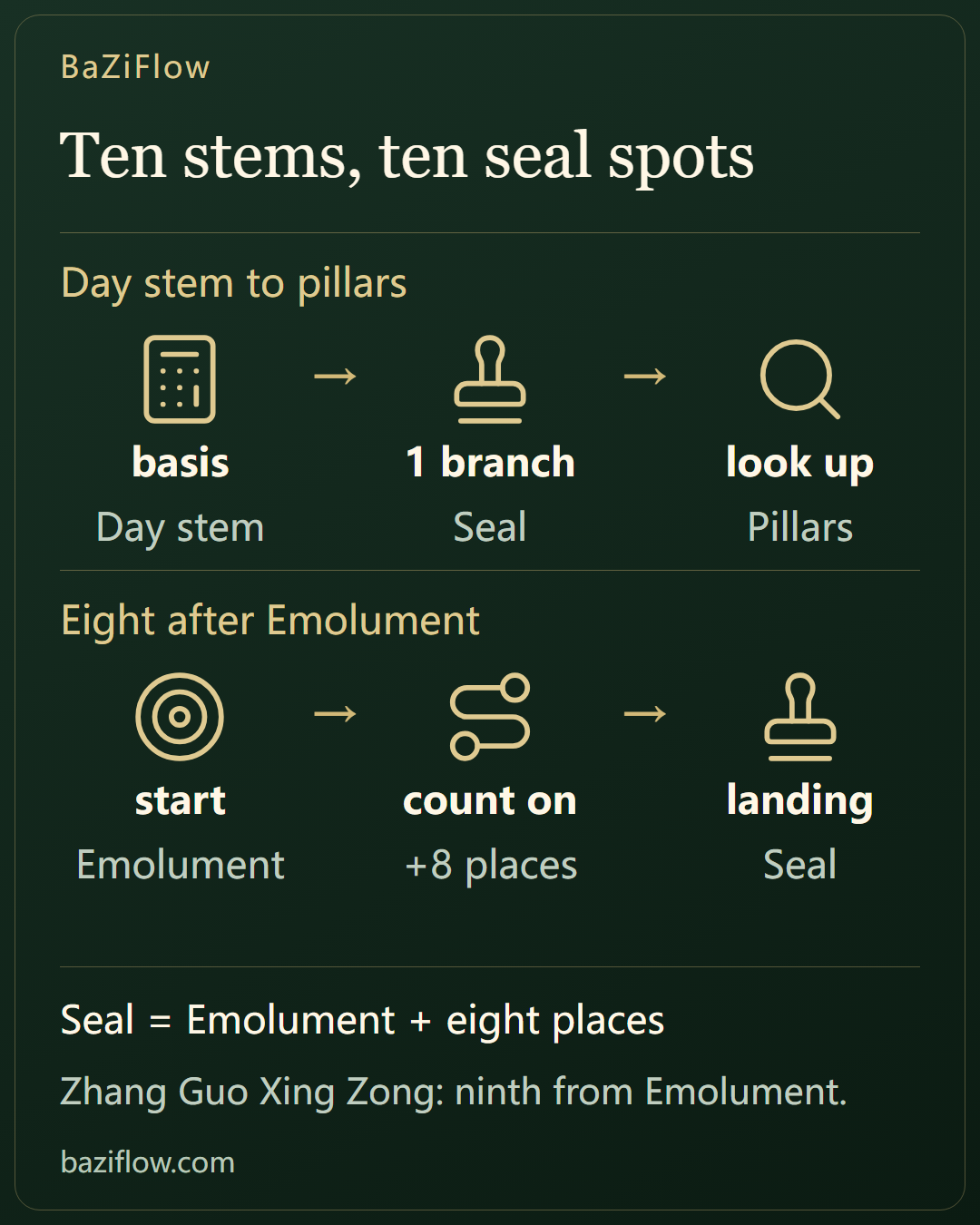
The Seal of Office is a ten-row look-up keyed to the day stem; the branch it returns is searched in all four pillars, day pillar included. A table, two charts, an arithmetic pattern, a look-alike classic table.
The short version9 min read
The Seal of Office (国印贵人) is a ten-row look-up: the day stem returns one branch, which is then searched in the year, month, day and hour pillars, the day pillar's own branch included.
- Rows are day stems and the answer is one branch. All four pillars are checked, and the pillar that shows that branch is where the Seal of Office sits.
- The table follows a pattern: eight places after the Emolument branch is the Seal, and it faces the same stem's Golden Carriage. The Zhang Guo Xing Zong states it as "the ninth place ahead of Emolument", counting the Emolument itself.
- The name comes from the star-and-fate book Zhang Guo Xing Zong, which counts from the year stem; the site uses the day stem. The "Heavenly Seal noble" of Sanming Tonghui juan 3 is a different table that agrees on only two stems.
Read first
Symbolic Stars in BaZi: Check the Reference and Rule Before the Meaning ↗
One day stem, one spot, four pillars to check
In one sentence: the Seal of Office (国印贵人) is a ten-row look-up. Rows are day stems and the answer is a single branch; that branch is searched among the branches of the year, month, day and hour pillars, and the pillar that shows it is where the Seal sits.
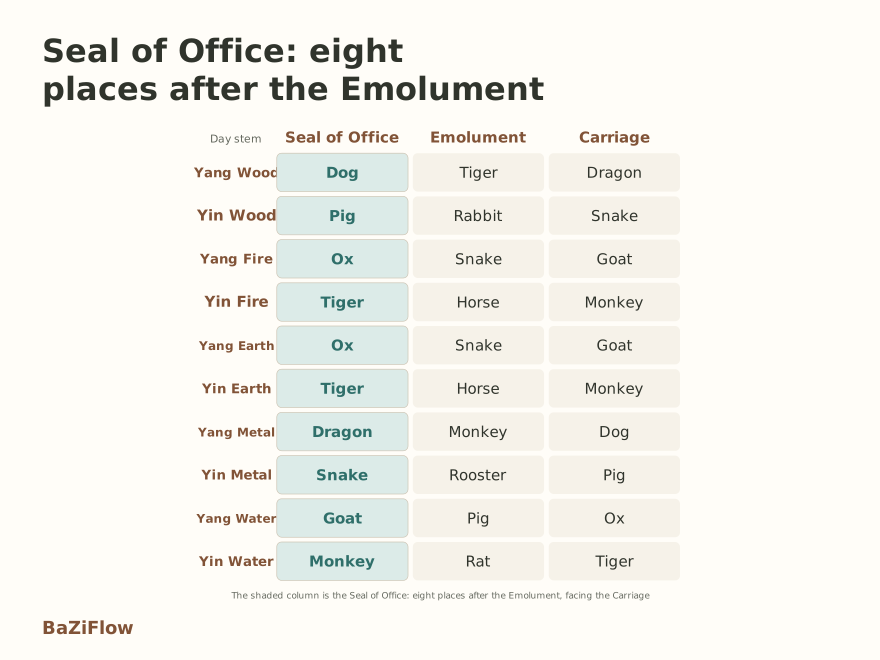
Comparison sketch: the Seal of Office, Emolument and Golden Carriage columns all come from the site engine's look-up tables; the last two columns are there to check where the Seal sits.
The first column is the answer: a Yang Wood day master has the Seal on Dog, a Yin Fire day master has it on Tiger. The other two columns give the same stem's Emolument and Golden Carriage branches. They are shown here because the third section uses them to test the pattern of the table.
A Yin Fire day hit twice, a Yang Wood Dog day that hits itself
Enlarge diagram · scroll sideways to read
In chart one the year and hour pillars each show a Tiger, so there are two hits; the same branch twice is not merged. In chart two the day master is Yang Wood, the Seal is on Dog, and the day pillar happens to be Yang Wood Dog (甲戌): the day master's own branch is the answer.
Only four day pillars can do this: Yang Wood Dog, Yin Wood Pig (乙亥), Yang Metal Dragon (庚辰) and Yin Metal Snake (辛巳). The reason is how pillars are put together, since a stem and a branch must have the same yin or yang. For the other six stems the Seal branch (Ox for Yang Fire, Tiger for Yin Fire, Ox for Yang Earth, Tiger for Yin Earth, Goat for Yang Water, Monkey for Yin Water) has the opposite polarity to the stem and cannot form that stem's own day pillar.
How the table is built: eight places after the Emolument
The site's table comes without a rhyme, but a book of star-and-fate astrology states the rule (see the next section). Set beside the same stem's Emolument and Golden Carriage, it shows several regularities that can be checked cell by cell.
Enlarge diagram · scroll sideways to read
- The Seal stands eight places after the Emolument. For Yang Wood the Emolument is on Tiger; counting on gives Rabbit, Dragon, Snake, Horse, Goat, Monkey, Rooster, and the eighth place is Dog. For Yin Wood the Emolument is on Rabbit and eight places on is Pig. All ten rows fit.
- The Seal faces the Golden Carriage. Yang Wood's Carriage is on Dragon, which clashes with Dog; Yin Wood's is on Snake, which clashes with Pig. All ten rows fit.
- The Seal and the Emolument sit in one Three Harmony group: Tiger and Dog of Yang Wood both belong to Tiger-Horse-Dog, Rabbit and Pig of Yin Wood to Pig-Rabbit-Goat.
- On the twelve life stages, the Seal of a yang stem falls on Nurture and that of a yin stem on Death.
The Emolument is covered in Emolument Star and the Carriage in Golden Carriage.
The source is a star-and-fate book; the look-alike "Heavenly Seal" is another table
The name does not turn up anywhere in the twelve juan of the Sanming Tonghui (三命通会). It appears in the literature of five-star astrology: juan 568 of the art section of the Gujin Tushu Jicheng (古今图书集成) reprints the Zhang Guo Xing Zong (张果星宗), whose entry on Emolument, the blades, the Tang Tally and the Seal of Office says:
The eighth place ahead of Emolument is called the Tang Tally; the ninth is named the palace of the Seal of Office. When the body or life palace meets it, eminent rank is conferred; if it falls into emptiness or a weak palace, poverty follows.
The entry then goes stem by stem: Yang Wood has Emolument on Tiger, the Flying Blade or Tang Tally on Rooster and the Seal on Dog; Yin Wood has Emolument on Rabbit and the Seal on Pig; then Ox for Yang Fire and Yang Earth, Tiger for Yin Fire and Yin Earth, Dragon for Yang Metal, Snake for Yin Metal, Goat for Yang Water and Monkey for Yin Water. All ten cells match the site. "Eighth ahead" counts the Emolument itself as the first place, which is why the Tang Tally lands on the Flying Blade and the Seal eight places after the Emolument; juan 1 of the Xingxue Dacheng (星学大成) also has the line "the Seal of Office is the ninth place ahead of Emolument". Note that this group of stars in the book is "all counted from the year stem" and read against the body and life palaces; the site applies the same table to the day stem and searches the four branches, which is the site's own convention.
The other near name is the Heavenly Seal noble that juan 3 of the Sanming Tonghui lists in its section on the Tai Chi noble:
"There is the Heavenly Seal noble: ... Yin Wood meets the Pig, the same; Yin Fire the Rooster and Yang Earth the Monkey; Yang Fire the Dog and Yin Earth the Goat's palace; Yang Metal and Yin Metal have the Horse and the Snake; Yin Water the Rabbit and Yang Water the Dragon. This is called the Heavenly Seal noble: honor and rank, and an imperial investiture."
Read as a ten-stem table and set beside the site's Seal of Office, it looks like this:
Enlarge diagram · scroll sideways to read
Two of nine rows agree, no more. The Heavenly Seal list has a pattern of its own: from Yin Wood Pig (乙亥) on, each step forward in the stems takes one step back in the branches, all the way to Yin Water Rabbit (癸卯). The two tables are built differently and meet in two places, so readings of the Heavenly Seal cannot simply be carried over to the Seal of Office.
The site's description and where it belongs in a chart
The site describes the Seal of Office in one line: a place of standing and responsibility, suited to roles that carry a clear title and can be vouched for. That is a modern summary. The Zhang Guo Xing Zong says only that meeting the Seal brings eminent rank and that emptiness or a weak palace turns it to poverty; the site's line points the same way but is not a translation of it.
Enlarge diagram · scroll sideways to read
Confirm the basis is the day stem
The year, month and hour stems take no part. Whatever the day master is, that is the row to read.
Then check the four pillars
Read year, month, day and hour in turn, the day pillar included. Each appearance of the branch is one hit.
Finally return to the whole chart
A hit only says that a pillar stands on this position. Its weight and meaning depend on how that pillar relates to the rest of the chart; see where shensha belong in a reading.
Two exercises
Yang Water day master, branches Horse, Goat, Tiger, Monkey: which pillar has the Seal?
The Seal of Yang Water is Goat, and the month pillar's branch is Goat, so it sits on the month pillar.
Yin Wood day master, branches Pig, Rat, Rabbit, Horse: which pillar has the Seal?
The Seal of Yin Wood is Pig, and the year pillar's branch is Pig. It sits on the year pillar, and the other three pillars show no Pig.
To carry on with another look-up of the same kind, the next article is Academy Star, whose spot is taken from the day stem's own Growth position.
Questions readers ask next
Does the day pillar's own branch count for the Seal of Office?
Yes. Stars keyed to the day branch skip the day pillar, but the Seal does not. Four day pillars hit themselves: Yang Wood Dog, Yin Wood Pig, Yang Metal Dragon and Yin Metal Snake.
Is the Seal of Office the same star as the "Heavenly Seal noble" in the old books?
The site does not say how they relate. Read as a ten-stem table, the juan 3 list matches the site only for Yin Wood (Pig) and Yin Metal (Snake), so the two are kept apart and neither borrows the other's readings.
Does a Seal on the year pillar mean something different from one on the hour pillar?
The look-up only answers whether it is present and on which pillar, with no ranking of strength. What a pillar position means has to come from the whole chart; see the article on where shensha belong in a reading.
Was this article helpful?
Sources & references
Continue reading
Golden Carriage (金舆): Two Branches Ahead of Emolument, Yin Stems Included ↗
Academy Star (学堂): The Day Stem's Own Growth Spot, and How the Sanming Tonghui Reads It ↗