

Bath: one step after Growth
Content version · · Sources & references
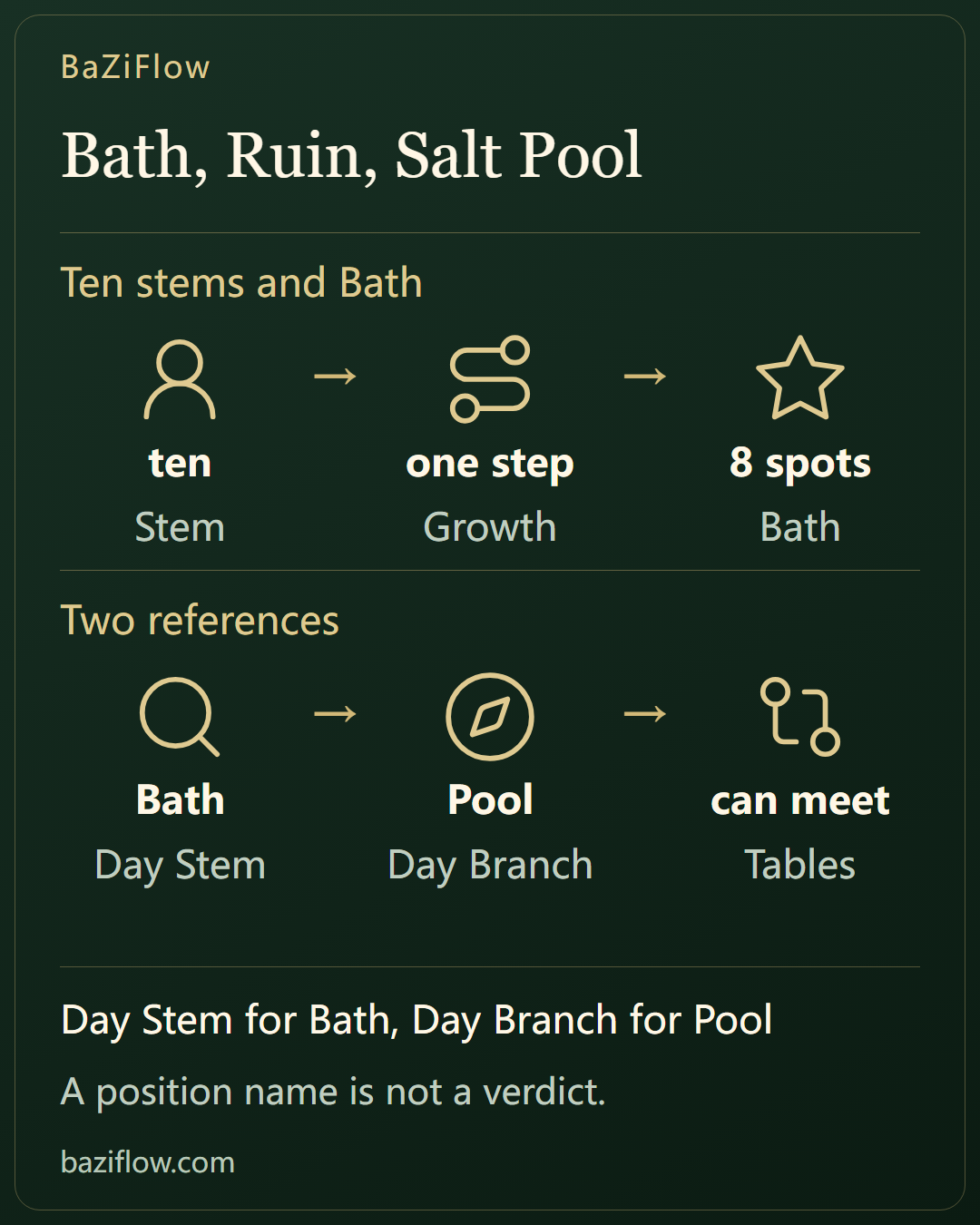
Bath is the second cell of the twelve life stages. A map of the ten stems, the one-step-after-Growth rule and a Salt Pool comparison table show which table each of the three names, Bath, Ruin and Salt Pool, is read from.
The short version8 min read
Bath is the second cell of the twelve life stages table, one step after Growth: the Yang stems land on Rat, Rabbit, Horse and Rooster, the Yin stems on Snake, Monkey, Pig and Tiger. The book also calls this cell Ruin and the Salt Pool, and the three names belong to different references.
- Bath is simply the cell after Growth. Yang stems step forward and Yin stems step back, so the two groups of positions have traded places with those of Growth.
- The book calls the cell Ruin, Salt Pool and Peach Blossom. Checked against the site engine, a Yang stem's Bath coincides with the Salt Pool of its own element's three-harmony group, while a Yin stem's does not.
- The Sanming Tonghui's verdicts on the Salt Pool and on luck periods are written in heavy words. They are the book's reading of that star and of luck; Bath in the twelve stages is only a position, and any quotation should say which table it comes from.
Read first
Twelve Life Stages and Void Branches: Two Tables, Two References ↗
Strong and weak Day Masters: references, relationship directions and evidence ↗
Bath: the washing on the third day
Picture a newborn on its third day, when the family gives it its first wash. The second cell of the twelve life stages takes exactly that scene: it comes right after Growth (长生) and is called Bath (沐浴).
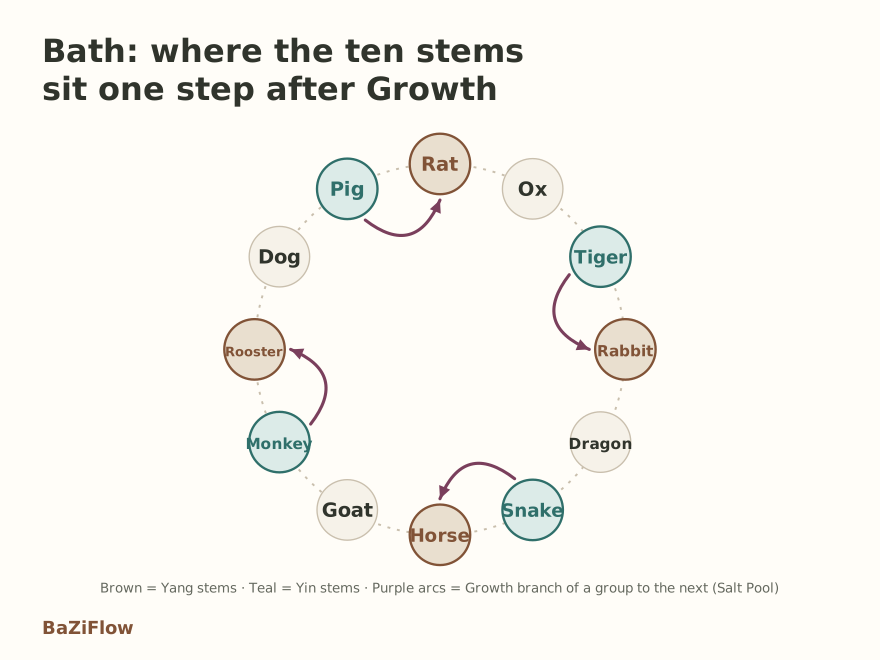
Position sketch: the positions come from the site engine's twelve-stage table and the Salt Pool follows the three-harmony rule in juan 2 of the Sanming Tonghui; the two coincide for Yang stems and not for Yin stems.
Read the ring by branch this time. The four branches at the compass points, Rat, Rabbit, Horse and Rooster, hold only Yang stems (Yang Wood; Yang Fire with Yang Earth; Yang Metal; Yang Water). The four branches at the corners, Snake, Monkey, Pig and Tiger, hold only Yin stems (Yin Wood; Yin Fire with Yin Earth; Yin Metal; Yin Water). Eight branches house ten Day Masters.
The Sanming Tonghui (三命通会) copies the image for this cell from an older text, the Sanming Tiyao (三命提要), in its second juan:
Bath, also called Ruin: when things have only just begun to live their bodies are soft and easily harmed, as a person is bathed on the third day after birth, almost to the point of exhaustion.
The image is concrete: something newly born is soft and easily hurt, like a baby given its first bath on the third day. Because of that fragility the book gives the cell a second name, Ruin (败).
The cell after Growth: Yang steps forward, Yin steps back
There is no separate table to memorize for Bath. Look up Growth first, then take one step in each stem's own direction. Take the Water pair as an example:
Enlarge diagram · scroll sideways to read
Yang Water has its Growth at Monkey, and one step forward along the branch order is Rooster, so its Bath is Rooster. Yin Water has its Growth at Rabbit, and one step back is Tiger, so its Bath is Tiger. Going through all ten Day Masters gives Yang Wood at Rat, Yin Wood at Snake, Yang Fire at Rabbit, Yin Fire at Monkey, Yang Earth at Rabbit, Yin Earth at Monkey, Yang Metal at Horse, Yin Metal at Pig, Yang Water at Rooster and Yin Water at Tiger, which is the site engine's table.
One place, three names: Bath, Ruin, Salt Pool
Besides Bath and Ruin, the book also calls this cell the Salt Pool (咸池). Juan 2 first quotes the Huainanzi (淮南子) for the origin of the name:
The sun rises from the Fusang tree and sets into the Salt Pool; so the place of Bath among the elements is called the Salt Pool, taking the meaning of the sun going in.
The sun climbs out of the Fusang tree and goes down into the Salt Pool; the Bath cell stands for the place where the sun sets, so it is also called the Salt Pool. The book then gives a second way to find it, counting by three-harmony group: Tiger-Horse-Dog meets Rabbit, Snake-Rooster-Ox meets Horse, Monkey-Rat-Dragon meets Rooster, and Pig-Rabbit-Goat meets Rat. It calls this "the second position after Growth, the palace of Bath", also named the Ruin Spirit (败神) and Peach Blossom Sha (桃花煞). The site engine calls the place Peach Blossom and looks it up from the Day Branch. Put the two tables side by side and you can see where they overlap:
Enlarge diagram · scroll sideways to read
Read the table across: the Bath of a Yang stem falls exactly on the Salt Pool of its own element's three-harmony group. The book says "the place of Bath among the elements is called the Salt Pool"; checked against the site's two tables, that holds for Yang stems, while the Bath of a Yin stem sits in the other group and does not coincide with the Salt Pool. So whether Bath and the Salt Pool can be equated depends on whether the stem is Yang or Yin.
The heavy words in the book: which table do they speak of?
The Sanming Tonghui spends a long passage on the Salt Pool, in very heavy words that touch conduct, money and illness, and it also has verdicts for luck periods that reach the Ruin stage. Those words are about the Symbolic Star called the Salt Pool and about the book's reading of luck periods; they are one book's view. Bath in the twelve-stage table is only a position. The two are looked up differently:
Enlarge diagram · scroll sideways to read
In a chart with a Yang Wood Day Master and a Tiger Day Branch, Bath is on Rat and Peach Blossom is on Rabbit, two different places. In a chart with a Yang Fire Day Master and a Horse Day Branch, Bath and Peach Blossom are both on Rabbit and meet there. So when a Rabbit turns up, ask which table it came from.
Yang Fire Day Master, Horse Day Branch, a Rabbit in the chart
You can write
- Rabbit is the Bath of Yang Fire (twelve stages, reference: Day Stem)
- Rabbit is the Peach Blossom of Horse (Symbolic Star, reference: Day Branch)
You cannot derive directly
- The chain "Rabbit is Bath, Bath is Ruin, so there is something wrong with character"
Add to make it clear
- Which table gave this Rabbit
- When quoting the book's verdicts, give title, juan and which Symbolic Star it is speaking of
Bath a third way: the Na Yin of Ding Mao
The word Bath has a third reference in the book: the Na Yin element. The Na Yin of Bing Yin (丙寅) and Ding Mao (丁卯) is Fire in the Furnace; Fire has its Growth at Tiger, and one step forward puts Bath on Rabbit. Juan 1 of the Sanming Tonghui, quoting the Wuxing Yaolun (五行要论), uses this word when it speaks of Ding Mao:
Ding Mao is fire at Bath, holding the breath of thunder stirring and wind rising.
Enlarge diagram · scroll sideways to read
By now the same Rabbit can be reached from three references:
One branch, three references
Bath of a Yang Fire Day Master
Twelve stages table, reference: the Day Stem. Rabbit.
Peach Blossom of a Horse Day Branch
Symbolic Star table, reference: the three-harmony group of the Day Branch. Rabbit.
The Na Yin Fire of the whole Ding Mao pillar
Na Yin element, reference: the Growth of the Na Yin. Bath is on Rabbit as well.
That three references happen to give one branch is just why you need to ask before reading whose Rabbit it is and which table produced it. The cell before this one is Growth and the next is Coming of Age; for how Na Yin names are chosen see Fire in the Furnace, and for where Symbolic Stars sit in a chart see Symbolic Stars in BaZi.
Questions readers ask next
Does Bath mean there is Peach Blossom in the chart, or something wrong with character?
Bath in the twelve stages is the stage name of a Day Stem when it reaches a branch. Peach Blossom, the Salt Pool, is a separate Symbolic Star looked up from the Day Branch, and it coincides with Bath only for Yang stems. The two tables differ, so the book's heavy words about the Salt Pool cannot be carried over to the stage name.
Both are Bath, so why is Yang Wood at Rat and Yin Wood at Snake?
Yang Wood has its Growth at Pig and takes one step forward to Rat; Yin Wood has its Growth at Horse and takes one step back to Snake. The starting points and the directions both differ, so the landing places differ too.
The book calls Ding Mao "fire at Bath". Is that the Bath of a Yin Fire Day Master?
Not directly. "Fire at Bath" is counted with the Na Yin Fire of the whole Ding Mao pillar: Fire has its Growth at Tiger, and the next cell, Rabbit, is Bath. A Yin Fire Day Master is a Yin stem and runs in reverse through the twelve stages, so its Bath is Monkey. One looks up the Na Yin element, the other the Day Stem, and each table gives its own branch.
Was this article helpful?
Sources & references
Continue reading
What is Na Yin in BaZi? Why Jia-Zi Gold in the Sea does not replace Yang Wood ↗