

The Hierophant: keys at the feet
Content version · · Sources & references
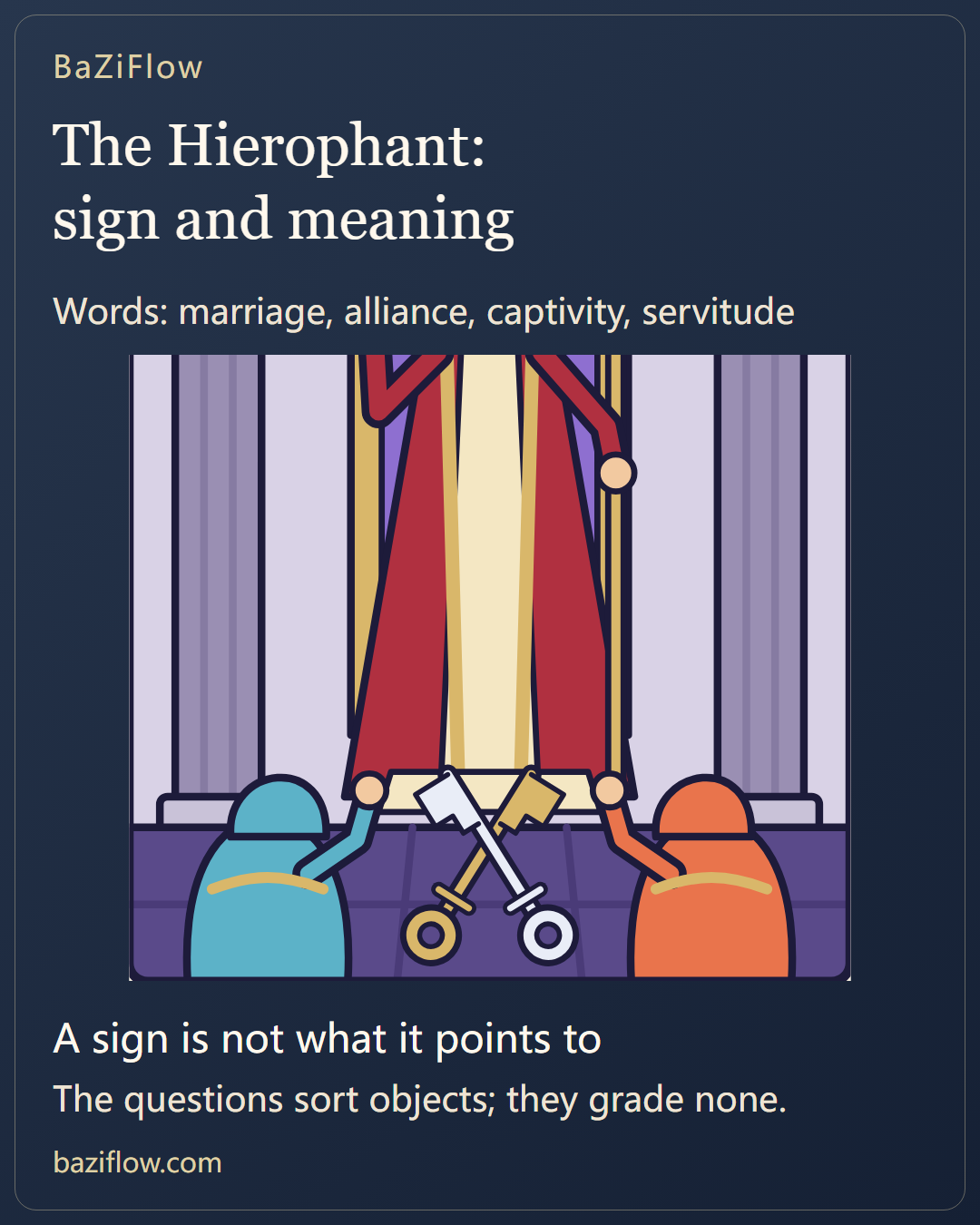
The Hierophant sits between two pillars, a hand raised, crossed keys and two kneelers at his feet. Separate Waite's picture, word list and symbols, then use "sign and thing signified" to sort an old drawer before a move.
The short version8 min read
The Hierophant has two levels: above, a figure raises a hand; below, two figures kneel with a pair of keys at their center. Waite spends more words on what the card is not.
- Waite's picture: a triple crown, a seat between two pillars (not the High Priestess's Temple); a triple-cross sceptre in the left hand, a sign dividing manifest from concealed doctrine in the right; crossed keys and two kneeling ministers below.
- The main entry is a group of bonds (marriage, alliance, and captivity, servitude); the other account turns to mercy, goodness, inspiration; yet Part II says flatly that he is not inspiration, so the two places should be quoted apart.
- The practice separates a sign from what it points to, then keeps one key for each kind, applied to a drawer of old things before moving.
Read first
Start with the picture: a sign above the seat, keys below it
Waite opens the Hierophant with crown and pillars. He wears the triple crown and is seated between two pillars, but they are not those of the Temple which is guarded by the High Priestess. In his left hand he holds a sceptre terminating in the triple cross, and with his right hand he gives the well-known ecclesiastical sign which is called that of esotericism, distinguishing between the manifest and concealed part of doctrine. At his feet are the crossed keys, and two priestly ministers in albs kneel before him. He adds that the figure has usually been called the Pope, a particular application of the more general office that he symbolizes.
The Hierophant: BaZiFlow's card with three prompts
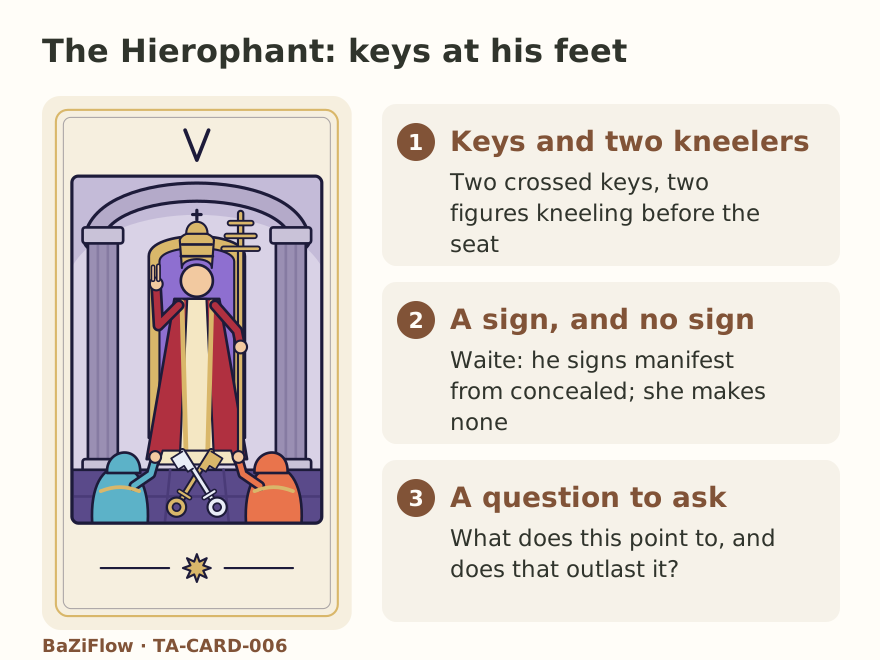
Check the Rider-Waite-Smith card and most of it is there: the Roman numeral V at the top and grey pillars at the sides; a figure in a tall tiered crown and a red robe, a long white band with crosses hanging at his chest; one hand raised in a gesture and the other holding the triple-cross staff; a pair of crossed golden keys at his feet, and two figures with tonsured heads, seen from behind, kneeling at either side in patterned vestments. The picture falls into three places: crown and hand on the seat, staff and pillars at the side, keys and kneelers below.
Enlarge diagram · scroll sideways to read
What Waite lists: a group of bonds, and mercy and inspiration by another account
The Hierophant's divinatory meaning reads: marriage, alliance, captivity, servitude; by another account, mercy and goodness; inspiration; the man to whom the Querent has recourse. Reversed: society, good understanding, concord, over-kindness, weakness.
Marriage, alliance, captivity, servitude; by another account, mercy and goodness; inspiration; the man to whom the Querent has recourse. Reversed: Society, good understanding, concord, over-kindness, weakness.
Enlarge diagram · scroll sideways to read
The main line reads as a group of bonds: marriage and alliance bind together, captivity and servitude are being bound, and both ends sit on the same line. The "other account" turns toward giving, while the reversed column leans toward loosening: society, accord, concord, and then, with over-kindness and weakness, loosening too far. That grouping is this article's summary, and Waite does not divide them this way.
One more pair to set side by side: in Part II Waite says plainly that the Hierophant is not inspiration, yet the "other account" in Part III lists inspiration. One passage defines the symbol, the other lists divinatory terms, so say which one you are quoting.
Triple crown, gesture and keys: the line Waite draws
Waite's Part II on the Hierophant is mostly about drawing a boundary. He complains that the card's meanings have suffered woeful admixture from nearly all hands, quotes a commentator, Grand Orient, who "says truly" that the Hierophant is the power of the keys, exoteric orthodox doctrine and the outer side of the life that leads to the doctrine, and corrects another commentator: he is certainly not the prince of occult doctrine. He is rather the summa of theology when it has passed into the utmost rigidity of expression, yet he symbolizes all things righteous and sacred on the manifest side, the channel of grace belonging to the world of institution as distinct from that of Nature, and the leader of salvation for the human race at large.
Three groups of symbols and where each comes from
- Triple crown and triple-cross staff
- Waite writes a triple crown and a sceptre ending in the triple cross, and says "Pope" is only a particular application of the more general office he symbolizes. That the triple crown belongs to the papacy is common knowledge.
- The raised hand
- Waite calls it the well-known ecclesiastical sign, that of esotericism, distinguishing the manifest and concealed parts of doctrine. In the same sentence he remarks that the High Priestess, by contrast, gives no sign.
- Crossed keys and two kneelers
- Waite writes the keys at his feet and two ministers kneeling before him; the phrase "power of the keys" appears when he quotes Grand Orient. Crossed keys on papal emblems are common knowledge; what the keys stand for here he does not explain.
Enlarge diagram · scroll sideways to read
Reading the keys as "ways in" and the kneeling figures as "those who receive a tradition" is a metaphor modern teaching has lent the picture; it is not in Waite's text, so give its origin when you use it.
How to read it: a sign and what it points to, then one key
Waite leaves a warning in the Hierophant entry: the pontiff may forget the significance of his symbolic state and act as if he contained within his proper measures all that his sign signifies. That sentence is already a practice form: a sign is not the thing it points to. Before a move, with one drawer of old things, it works like this.
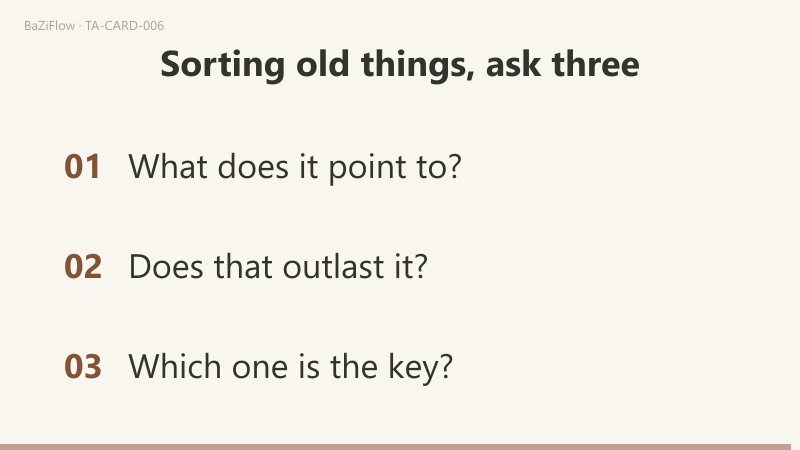
This is a sign: what does it point to?
Write item by item whom it points to, and which stretch of life or which event. If you cannot write what it points to, it is probably just taking up room.
Does what it points to outlast it?
Do not assume that giving it away means losing the memory. Try keeping the pointed-to thing another way: a photograph, a few written lines, a phone call.
For each kind, which one is the key?
The keys lie crossed at his feet. In teaching the image is borrowed: keep for each kind of object the one that best "opens" that memory. This is a borrowing, not Waite's sentence.
An example: before a move, sort the bottom drawer of a desk, asking all three questions of three old things:
Enlarge diagram · scroll sideways to read
After the drawer is done
Can be done
- Write what each one points to
- Keep one key per kind
Cannot be settled
- Whether you will regret it
- Whether family wants it
Do next
- Photograph first, then dispose
- Put what stays into one box
Reversed and neighboring cards: concord and weakness, and three cards on "seat" and "key"
The Hierophant's reversed words follow straight after the upright ones in the same entry:
Society, good understanding, concord, over-kindness, weakness.
The first three words lean harmonious and the last two lean excessive, so say first which half a reading draws on.
Neighboring cards and how each places a "seat"
The power of this world
The card before. Waite calls the Emperor the power of this world and the Hierophant the ruling power of external religion; both sit on a seat, but the Emperor's weight is on execution and realization, the Hierophant's on a recognized order.
The inward other end
Waite sets the two as a pair: the Hierophant is the ruling power of external religion, the High Priestess the prevailing genius of the esoteric, withdrawn power; one signs outward, the other does not.
Another kind of "marriage"
The next card. Waite writes the Lovers as the card of human love; its list is attraction, love, beauty, trials overcome. The Hierophant's list also holds marriage and alliance, but they fall on bonds and structure.
Enlarge diagram · scroll sideways to read
Questions readers ask next
Is the Hierophant simply the "tradition" or "authority" card?
That is a later summary. Waite's list opens with marriage, alliance, captivity, servitude, and only "by another account" mercy, goodness, inspiration. In Part II he calls him the ruling power of external religion and the head of the recognized hierarchy, while insisting that he is not philosophy, not inspiration, not religion itself.
What does the Hierophant mean reversed?
Waite's reversed words are society, good understanding, concord, over-kindness, weakness. The first three lean harmonious and the last two lean excessive. Phrases like "rebelling against tradition" come from later methods, so say whose rules you use.
What do the keys at his feet stand for?
Waite writes only that crossed keys lie at his feet, and quotes a commentator calling the Hierophant the power of the keys, without further explanation. Crossed keys are a familiar element of papal emblems; reading them as "ways in" is a teaching borrowing.
Was this article helpful?
Sources & references
Continue reading
The High Priestess: seated between two pillars, her scroll half covered ↗