

Calamity Sha: one spot past the Robbery Sha
Content version · · Sources & references
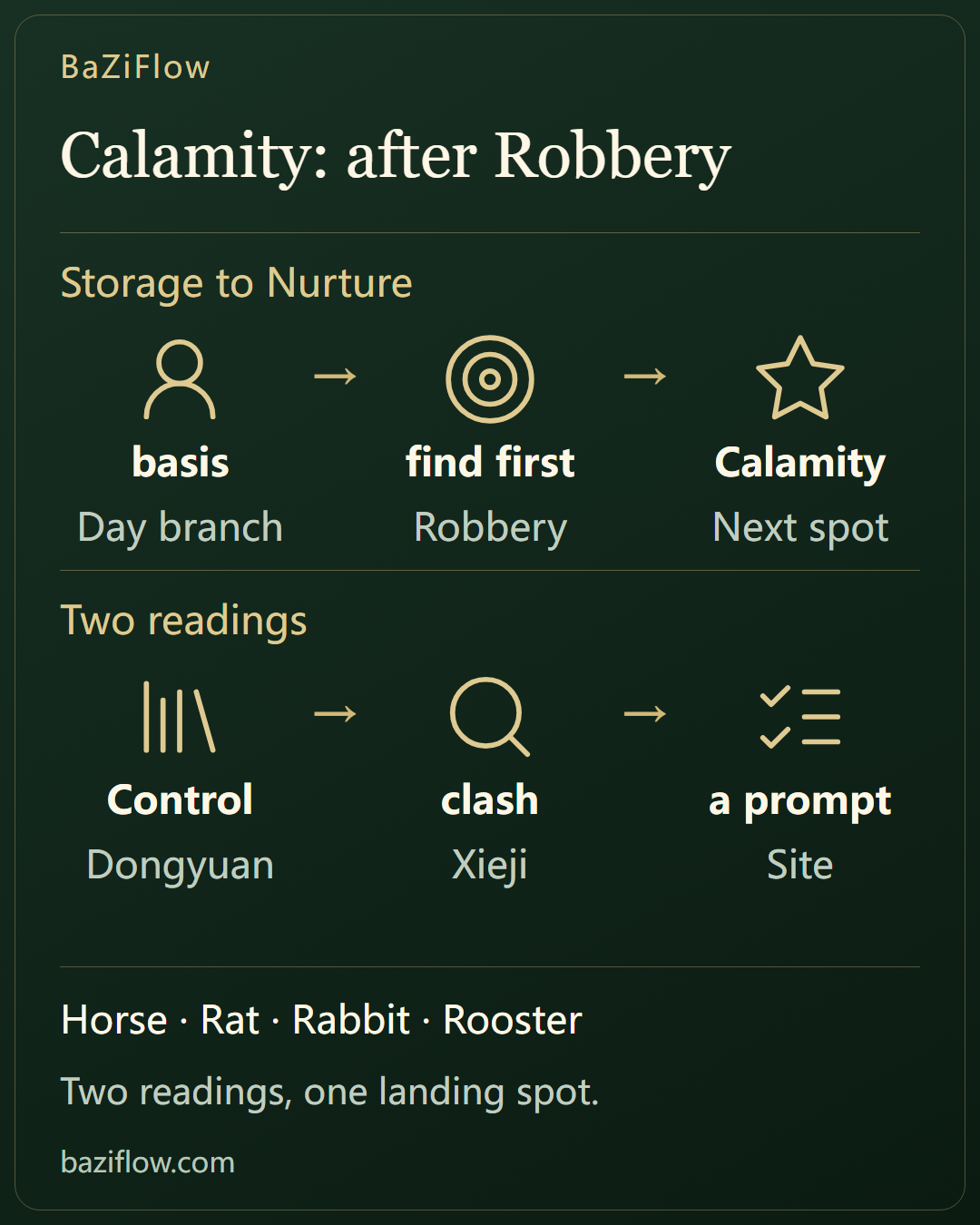
The Calamity Sha starts from the day branch and sits one spot after the Robbery Sha in its Three Harmony group, at Conception and across from the General Star: Rat, Horse, Rabbit or Rooster. Table, ring, two readings.
The short version7 min read
The basis of the Calamity Sha is the day branch: it sits right after the Robbery Sha of the same group, which is the Conception spot of the twelve stages, always one of Rat, Horse, Rabbit and Rooster, and it is looked for in the year, month and hour pillars.
- Monkey-Rat-Dragon gives Horse, Tiger-Horse-Dog gives Rat, Snake-Rooster-Ox gives Rabbit, Pig-Rabbit-Goat gives Rooster. It is also the clash of the same group's General Star, so all four landing spots are cardinal branches.
- The Dongyuan Jing says the Calamity "arises from Control" and fixes it at the Conception of the group's element; the editors of the Xieji Bianfang Shu reject that road and say it is the clash of the central branch of the group.
- The two readings explain one landing spot, and the site's table fits both. The book's "illness and misfortune" is a direction taboo, which the site rewrites as a prompt about outside pressure.
Read first
Symbolic Stars in BaZi: Check the Reference and Rule Before the Meaning ↗
One more step past the Robbery Sha
The Calamity Sha (灾煞) is located through its neighbor: find the Robbery Sha of the same group first and take one more step; the place where you land is the Calamity Sha.
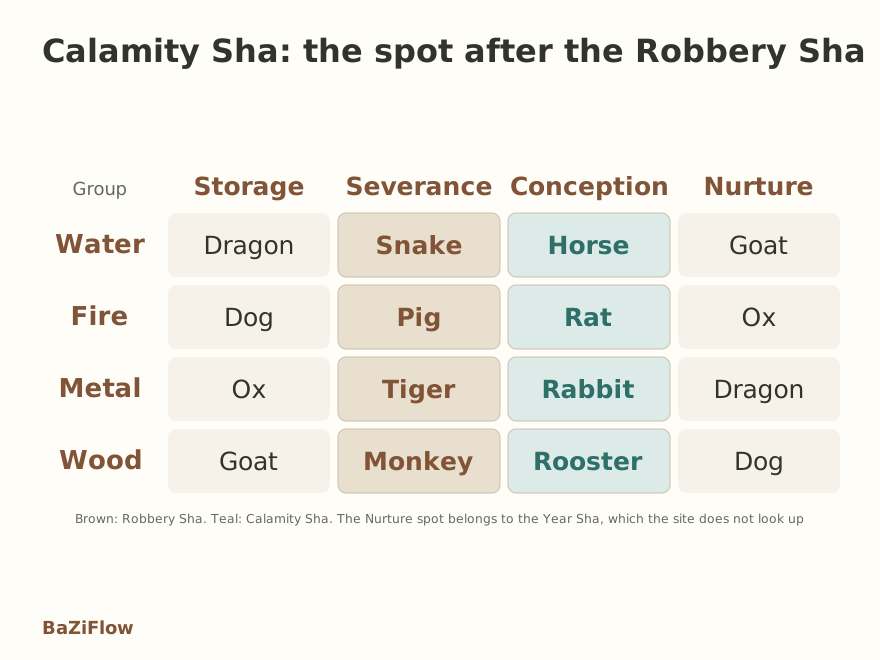
Table: Storage, Severance, Conception and Nurture are checked against the twelve-stage table, the Robbery Sha and Calamity Sha spots come from the site engine, and the Nurture column belongs to the Year Sha of the Xieji Bianfang Shu, which the site does not look up.
The four columns are four neighbors in a row: Storage, Severance, Conception and Nurture. The Robbery Sha stands at Severance, the Calamity Sha at the Conception spot right behind it, and the Nurture spot after that is the Year Sha in the Xieji Bianfang Shu (协纪辨方书), which the site does not look up. The result: Horse for the Water group, Rat for Fire, Rabbit for Metal, Rooster for Wood, all four being Rat, Horse, Rabbit or Rooster.
One road: it arises from Control, and sits at Conception
The Xieji Bianfang Shu (协纪辨方书), the Qing court's almanac for choosing dates, discusses the Calamity Sha in the same passage as the Robbery Sha (juan 3). It opens with the Shenshu Jing (神枢经) on the position:
The Calamity Sha is the place of the yin qi of the five elements, and it stands one spot ahead of the Robbery Sha.
"One spot ahead" means the next branch in the usual order, which agrees with the rule above. The book then quotes Cao Zhengui (曹震圭) and the Dongyuan Jing (洞源经) for the reason:
The Calamity Sha is the Conception god of the five elements of a Three Harmony group. The Dongyuan Jing says: the Robbery Sha arises from Severance and the Calamity Sha arises from Control.
The quotation goes on with examples. In a year of the Monkey-Rat-Dragon Water group, Water is cut off at Snake, so the Robbery Sha is Snake; the next spot, Conception, is Horse, and because Water and the Fire of Horse control one another, the Calamity Sha is Horse. Metal works the same way: it is cut off at Tiger, so the Robbery Sha is Tiger; Conception is Rabbit, and Metal and the Wood of Rabbit control one another, so the Calamity Sha is Rabbit. The other two groups also involve control, but it runs the other way: the Fire group's Conception spot is Rat, whose Water controls Fire, and the Wood group's is Rooster, whose Metal controls Wood.
Enlarge diagram · scroll sideways to read
The other road: across from the middle of the group
The editors of the Xieji Bianfang Shu do not accept that road. Their remark takes the Fire group as the example and changes the angle:
The Three Harmony group is Fire, and Horse stands in the middle. Horse is the place where the power of Fire is full to the brim, and to be clashed there is bound to bring calamity. Rat is the clash of the cardinal branch, and so it is called the Calamity Sha.
In other words, of the three branches of the Fire group Horse stands in the middle, where Fire is strongest; directly facing it is Rat, which is where the Calamity Sha stands, and a clash on the fullest point brings calamity. The editors also say outright what they think of the earlier road:
As for Cao Zhengui's theory of Severance, Conception and Nurture, it does not fit the principle.
On this road the Calamity Sha is no longer the "Conception spot"; it is the clash of the General Star (将星). The middle of each group, where the General Star stands, is one of Rat, Horse, Rabbit and Rooster, and the Calamity Sha stands straight across from it. Draw the General Star and the Calamity Sha of all four groups on one circle and only four branches are used, clashing in pairs.
Enlarge diagram · scroll sideways to read
The editors favor "face it, do not sit on it": the directions of the three shas are what the Grand Duke dislikes and must not occupy. Both roads lead to the same table, so the site's look-up is unaffected; only the explanation differs.
Putting it on two real charts
Only branches matter here. First chart: a Rabbit day branch, which sits in the Wood group of Pig, Rabbit and Goat; that group's Robbery Sha is Monkey, so the Calamity Sha is the Rooster after it. Second chart: a Dog day branch, in the Fire group of Tiger, Horse and Dog; its Robbery Sha is Pig, so its Calamity Sha is Rat.
Enlarge diagram · scroll sideways to read
In the first chart a single pillar lights up, the year. In the second, Rat sits in both the year and the hour pillar, so two pillars light up, while the Horse in the month pillar happens to be the General Star of the same group, standing across from Rat. On such a chart the two stars face each other over the circle, and the site marks both, with the day branch printed as the basis of each.
Where the word "calamity" comes from
The "calamity" in the name travels two different roads, one in the books and one on the site, so it helps to ask which road a sentence is on.
In the books: a direction to avoid
The Shenshu Jing files the Calamity Sha among the direction gods of "illness and misfortune", and in a given year that direction is not a good one to build in. This is date-selection usage, tied to the Grand Duke of each year and not to anyone's birth.
The landing spot: two origins
The two roads in the sections above, one fixing it at Conception and one at the clash of the central branch, describe how a single landing spot comes about. They explain the position and judge no outcome.
On the site: one line of caution
The site's wording is "a position of outside pressure, with accidents and being on the receiving end; a prompt to leave a buffer, not a forecast of disaster". With this position in hand, the useful move is to think about which matters deserve some extra slack.
Next to it: the Robbery Sha one spot earlier, the General Star in the middle of the same group, and the Death God that comes next in the series. The stage it lands on has its own page, Conception, and the weight of any Symbolic Star within a whole chart is discussed in where Symbolic Stars belong in a reading.
Questions readers ask next
The Calamity Sha and the General Star use the same branches. Why are they named differently?
Both land on Rat, Horse, Rabbit and Rooster, but inside one group they play different roles: the General Star sits in the middle and the Calamity Sha is its clash. With a day branch in Tiger-Horse-Dog, Horse is the General Star and Rat is the Calamity Sha.
My day branch is Rat and my year pillar has Horse. Is that Horse a Calamity Sha?
Yes. A Rat day branch belongs to Monkey-Rat-Dragon, whose Calamity Sha is Horse, so the year pillar is hit. The same Horse is the General Star in a chart whose day branch is in Tiger-Horse-Dog, which is why the group comes first and the name second.
Is the Calamity Sha a forecast of disaster?
The site describes it as a position of outside pressure and suggests keeping some slack. The book's "illness and misfortune" comes from direction taboos and concerns which way a building faces. A position cannot say what is going to happen.
Was this article helpful?
Sources & references
Continue reading
Robbery Sha (劫煞): the Severance Spot of the Day Branch's Three Harmony Group ↗
Death God (亡神): the Establishment Spot of a Group, Opposite the Robbery Sha ↗