

Classics and modern explanations
Content version · · Sources & references
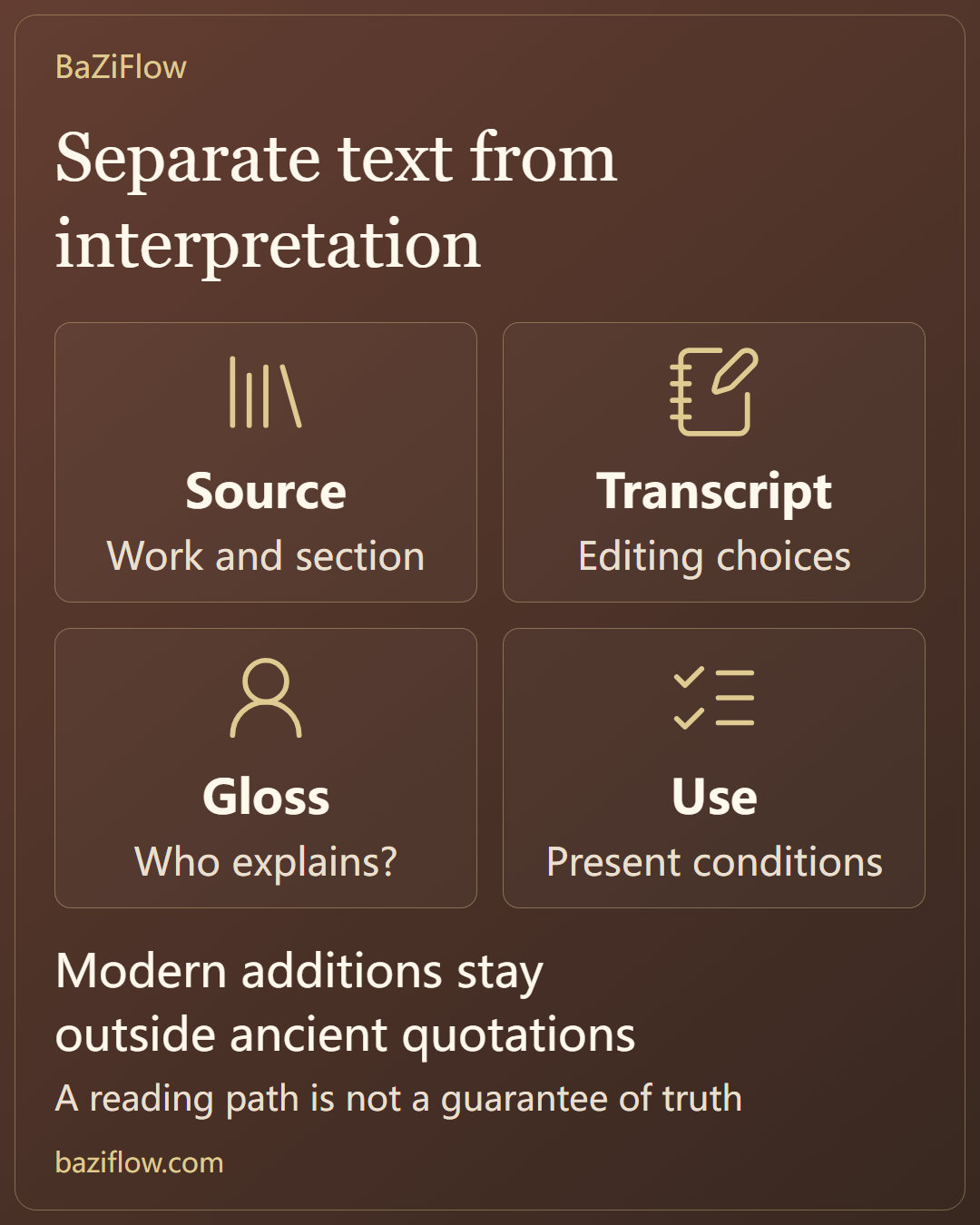
Audit a claim backwards through application, interpretation, transcription and source. Keep editions, translators and historical values visible rather than treating a book title as proof.
The short version6 min read
A classical citation beside modern advice may support only one part of it. Identify the original writer, transcription, commentary and present application before deciding how far the citation reaches.
- Record the actual work, section, passage and version or transcription used.
- A method citation and a historical value judgment require different contextual checks.
- Translation and analogy can help, but their added meanings belong to the modern author rather than inside a direct quotation.
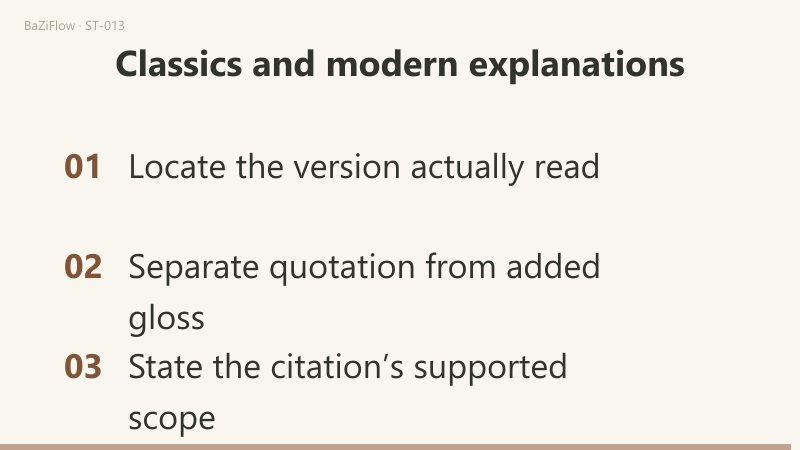
Read first
Combination, clash and star in BaZi, Ziwei and astrology: different rules ↗
Start with the modern claim and ask what the citation supports
An article may cite an old book beside a present-day recommendation. The citation might support a traditional procedure, a symbolic association or a historical opinion. It does not automatically support the recommendation in its full modern context. Ask which part of the sentence is actually found in the cited passage and which part the current author added.
This backwards audit is often more useful than treating a familiar title as a seal of authority. A contemporary interpretation can be thoughtful and useful while still being an interpretation. Its author should remain visible and responsible for the new connections being made.
| Part of the argument | Question for the citation |
|---|---|
| A traditional procedure | Does the specified passage describe this procedure? |
| A modern translation of a term | Who chose the wording and explained its limits? |
| A contemporary application | Which assumptions were added for the new setting? |
Procedure
- Citation question
- Does this passage describe it?
Translation
- Citation question
- Who chose the wording?
Application
- Citation question
- Which conditions were added?
Separate source, transcript, gloss and application
- Direct quotation
- The source writer’s wording with a retrievable location.
- Paraphrase
- The current writer’s explanation, identified as such.
A method belongs to an author and a version
Open Waite's manual at the section headed An Ancient Celtic Method of Divination (III.7). The positional instructions there let a reader identify which procedure a later article is borrowing. That is the proper reach of the citation: an identifiable procedure in an identifiable work. A modern spread with different position definitions requires its own attribution. Historical classifications of people on the same page remain historical material, not categories this article endorses.
The distinction matters when an explanation changes from “Waite describes this method” to “tarot has always required this.” The second claim has a much wider scope. A source for the first does not establish the second. Keep the book, section and method together rather than allowing a particular example to stand for an entire tradition.
Historical value judgments require another kind of care. The discussion of male and female charts in Zi Wei Dou Shu Quan Shu, volume 3, reflects social roles and evaluations in the text. A reader can study those statements as historical material without importing their hierarchy or disparaging judgments into present-day assessments of people.
In both examples the passage can be accurately located, yet the questions asked of it differ. One concerns the version of a procedure; the other also concerns historical values. Neither deserves an unqualified label of timeless wisdom or a blanket dismissal of every other procedure in the book.
Waite III.7
- A particular spread and roles
Ziwei volume 3 passage
- Historical social evaluations
Identify the document you actually read
A website may provide a transcription, editorial punctuation, headings and a modern commentary on the same page. Those layers need not share an author. Record the work, volume or section, passage and the edition or transcription used where it is identifiable. Do not claim to have checked an original page image if you have only read an electronic transcript.
Two pages with the same title can differ in wording, punctuation or arrangement. That observation calls for version checking; it does not by itself establish that one is fraudulent. An unresolved textual difference can remain unresolved while the citation accurately identifies the material used.
If only a modern summary was accessible, cite it as a summary. If a link was unavailable, do not replace the missing inspection with a well-known title and imply that the passage was read. A smaller, honestly described source base is more useful than an impressive but untraceable bibliography.
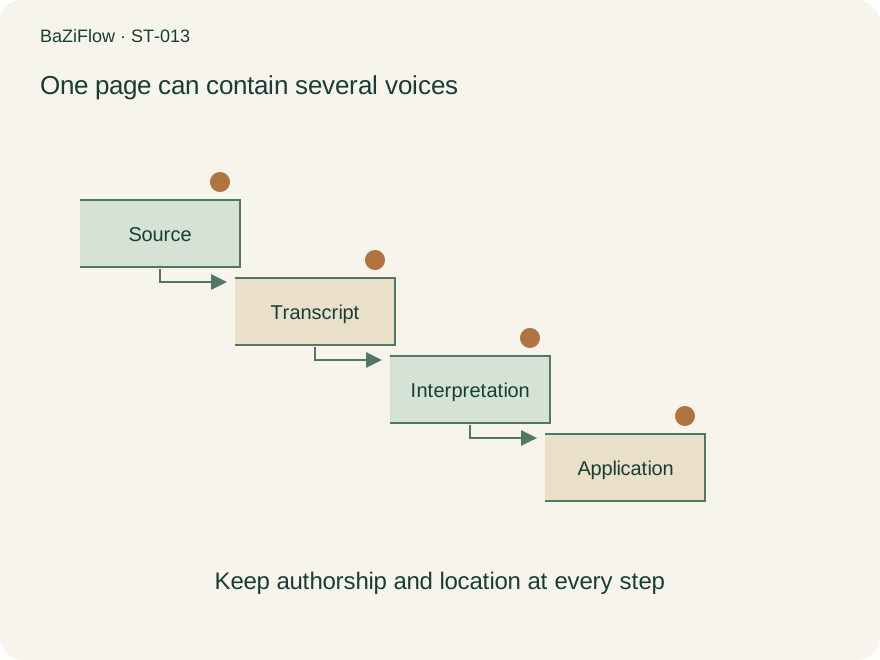
Original BaZiFlow source-layer diagram. Vertical order is not a ranking of eras or reliability.
The arrows show a reading path, not a chain of guaranteed truth. A claim should be traceable back through the relevant layers, with additions identified at each transition.
Source
Original writer
Transcript
Editor
Interpretation
Commentator
Application
Modern author
Translation and analogy make choices
Moving an old term for office, household or resources into a modern workplace involves analogy. The author should explain what relationship is being preserved and where the comparison stops. The old text did not literally describe every institution or employment arrangement now in use.
Translation can also narrow or broaden a term. A familiar everyday word may carry implications absent from the technical source. Sometimes retaining a term with a short definition is clearer than making it appear fully equivalent to a modern category. A translator's explanatory addition should not be placed inside quotation marks as though it were the original author's wording.
Where evidence supports competing readings, identify their bases or leave the point open. Do not invent certainty to smooth the prose, but do not treat unlimited personal association as a textual interpretation either. Each reading should show what in the passage constrains it.
Workplace analogy
- Who supplies the addition?
- Contemporary interpreter
Term definition in translation
- Who supplies the addition?
- Translator or annotator
Direct source wording
- Who supplies the addition?
- Quoted author
A good note states both support and limits
Keep a short passage location, a paraphrase in your own words and the claim it supports. Separate direct quotation from interpretation. Add unresolved vocabulary or version questions rather than silently resolving them through guesswork. Copying an entire page without explaining its relevance does not create a better note.
If a later edition changes the analysis, record the revision and why it was made. That makes it possible to distinguish a deeper understanding from a mistaken earlier citation. The goal is a record another reader can follow, not a display of how many classical titles have been collected.
Finally, the existence of a statement in a historical source establishes that the source contains it; it does not establish the statement's predictive truth. Facts, symbols, inferences and advice develops that separation. Building a learning log offers a place to retain the source, your interpretation and the questions still open.
Waite describes a spread
- Supports
- That method’s attribution
- Does not establish alone
- Every tarot spread must use it
A judgment appears in a text
- Supports
- Presence in the document
- Does not establish alone
- Predictive truth
Fix the supported proposition
Record that Waite III.7 presents a particular spread and positional roles.
Inspect the enlarged claim
All tarot must use those positions adds a universal scope not established by that citation.
Restore the attribution
Keep the author and method together; give a modern alternative its own source rather than merging the versions.
Questions readers ask next
Is a book title enough for attribution?
Retain the section, passage and version or transcript actually read. An electronic transcription should not be described as an inspected original image.
May an explanation use a modern analogy?
Yes, if it identifies the author, the relation preserved and the limits of the comparison. It is not a literal definition supplied by the original text.
Does a documented judgment become proven?
Documentation establishes the passage’s presence. Historical practice, social evaluation and prediction require different questions and evidence.
Was this article helpful?
Sources & references
Continue reading
Facts, Symbols, Inferences and Advice Have Different Jobs ↗
A Learning Log Should Change Your Next Attempt ↗
Personalization Needs a Reason That Changes with the Input ↗