

Nine of Cups
Content version · · Sources & references
Explore Waite’s materially satisfied figure and the limits of apparent security. Keep enjoyment, other people’s responses, and future arrangements distinct.
The short version6 min read
A figure has enjoyed a feast, with abundant cups still arranged behind him. This front-and-back relation gives the Nine its contentment. Enjoyment can be recognized fully while the scene’s apparent security remains an impression, not a seal on every future event.
- The figure has already enjoyed something and abundance remains behind him; this relation matters more than a count of objects.
- Dinner can be both satisfying and demanding, so changing preparation need not withdraw the good experience already lived.
- Waite’s reversal includes truth, loyalty and liberty alongside varying imperfections, rather than only greed or a failed wish.
Read first
Notice the qualification in the picture of security
On the RWS card, a man in a red cap sits on a bench with arms folded and a satisfied look. Behind him a curved counter is draped in blue cloth, and nine cups stand along it.
Waite describes a well-fed, contented figure with abundant cups of wine arranged on an arched counter behind him. The future appears assured within the scene. That appearance is a feature of the description, not a demonstrated fact about a reader's future.
He also specifies that the picture presents the material side and allows other aspects of interpretation. Read together, these qualifications prevent the Nine of Cups from becoming an unrestricted promise that every wish will be granted. An image of having enough and enjoying it need not claim that uncertainty has disappeared.
The main entry includes concord, contentment, physical well-being, victory, success, advantage, and satisfaction. These are historical divinatory terms. They are not a medical assessment, a financial forecast, or evidence that a particular undertaking will succeed.
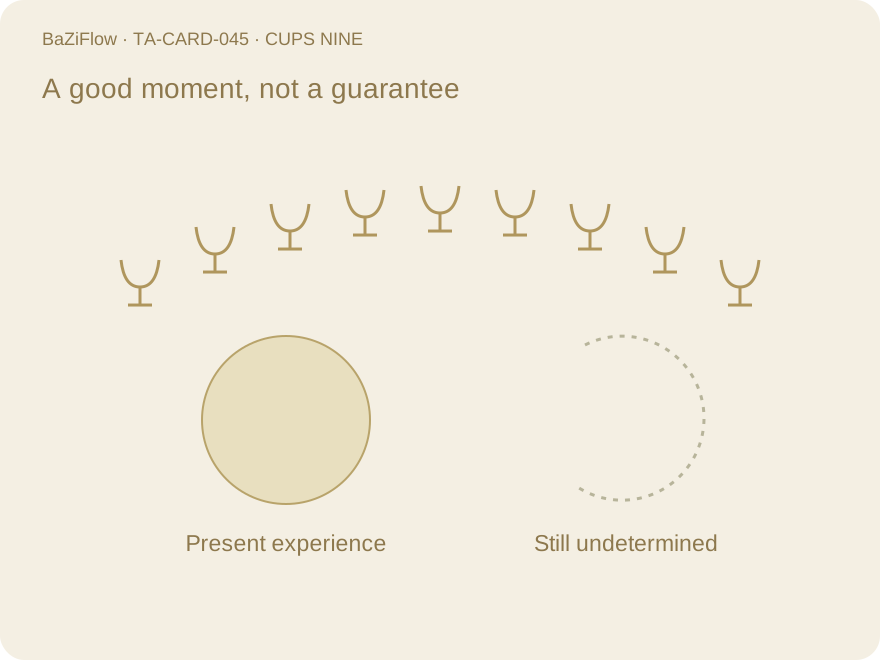
An original BaZiFlow diagram of the scope of satisfaction. Closed and open arcs mark what is known, not a happiness score, wealth total, or guarantee.
Locate the satisfaction in something that happened
Suppose you prepared dinner for friends. The food suited the occasion, conversation felt relaxed, and you enjoyed the evening. It is reasonable to record that enjoyment without proving that every later gathering will be equally successful.
Specificity makes the positive account more useful. Perhaps the best part was having time to talk, rather than producing an elaborate meal. Perhaps a guest praised one dessert. Neither fact needs to be enlarged into a statement that every arrangement pleased everyone.
| Experience or response | What does not automatically follow |
|---|---|
| I enjoyed this evening's conversation | Every guest felt exactly the same way |
| A friend praised the dessert | They endorsed every part of the occasion |
| Someone suggested another dinner | A date and division of work are already agreed |
A pleasant suggestion can remain a pleasant suggestion. Turning it into a scheduled commitment requires another exchange. This distinction does not diminish the atmosphere; it protects that atmosphere from being used to assign obligations nobody accepted.
The nine cups identify the card. Below them, a complete circle represents the experience that can presently be described. The open arc beside it leaves room for matters not yet established. Neither shape measures happiness, represents ninety percent completion, or counts units of wealth.
For the dinner example, the completed circle might contain the relaxed conversation you experienced. The open arc might concern whether and how people want to meet again. Hope belongs there without having to masquerade as a confirmed arrangement.
Permission has its own scope, too. Agreeing to a group photograph does not automatically authorize a public story about someone's relationships. Enjoyment does not remove the need to ask what can be shared. The card's positive associations do not provide that permission on anybody's behalf.
Dinner experience
Same host
- Conversation enjoyed
- Can be true
- Preparation tiring
- Can also be true
An invented example: both experiences may coexist without a combined score.
Let enjoyment coexist with effort
The person who cooked may feel both satisfied and tired. Those experiences can coexist without one disproving the other. Asking others to bring food next time or reducing the number of dishes can follow from the work involved, rather than from a judgment that the first evening was unsuccessful.
Similarly, a cheerful photograph is not a complete report of everyone's private life. You can describe your own experience and quote feedback within the permission given. You cannot use an attractive image, or a positive card, to supply another person's unspoken emotional state.
A record that separates effort, experience, and feedback offers something to learn from. A record that says everything is perfect leaves no room for a small adjustment without making the whole positive account seem false. The smaller, more precise account can be both warmer and more durable.
Keep
- Time to talk
Adjust
- One less demanding dish
Discuss anew
- Next date and shared work
Reversal adds source complexity, not a compulsory failure
Waite's reversed entry includes truth, loyalty, and liberty, alongside varying readings of mistakes and imperfections. It is not limited to greed, disappointment, or the collapse of a wish. That variety is worth preserving instead of forcing every reversal into a negative mirror image.
The supplementary chapter records older military and business good omens. They remain historical claims here, not advice to take a financial risk or assurance of victory. A list of favorable words cannot establish the relevant present-day conditions.
Compare the Eight of Cups, which can examine changing involvement, with this attention to an enjoyable experience. Their numbering does not require a universal story in which leaving always produces happiness. State the convention you use in the upright and reversed methods guide.
For a later review, preserve a few concrete details: what felt relaxed, which feedback was actually given, and what preparation you would change. If another dinner feels different, inspect its different circumstances. There is no need to erase the first evening's satisfaction or defend it as a prophecy. A good moment can matter on its own terms.
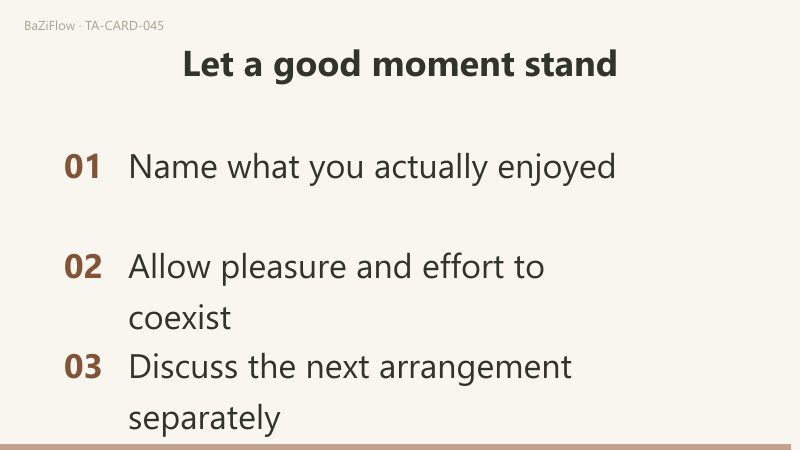
Choose one detail to savor
Name a taste or relaxed conversation without supplying everyone’s feelings.
Keep what helped it happen
For example, enough time and a manageable number of dishes.
Let a new invitation take shape
Discuss invitations, replies and shared work for the next occasion.
Questions readers ask next
Can the Nine of Cups be read as a wish guaranteed to come true?
No. Waite describes contentment and a future that seems assured within the picture. That is a visual impression. The card can frame existing pleasure or sufficiency without proving a particular wish, income or relationship outcome.
Is being satisfied and tired at the same time a contradiction?
No. Conversation may be satisfying while preparing dinner takes effort. The experiences concern different aspects and can both be described. Fewer dishes or more shared preparation next time does not make this evening’s pleasure false.
Does reversal make the earlier happiness entirely false?
Waite gives no such single rule. He includes truth, loyalty and liberty while also recording variable readings of mistakes and imperfections. Actual experience can identify an adjustment without forcing every good aspect into its opposite.
Was this article helpful?
Sources & references
Continue reading
Eight of Cups: describe the change before deciding what departure means ↗