

Solitude Star: one before the direction group
Content version · · Sources & references
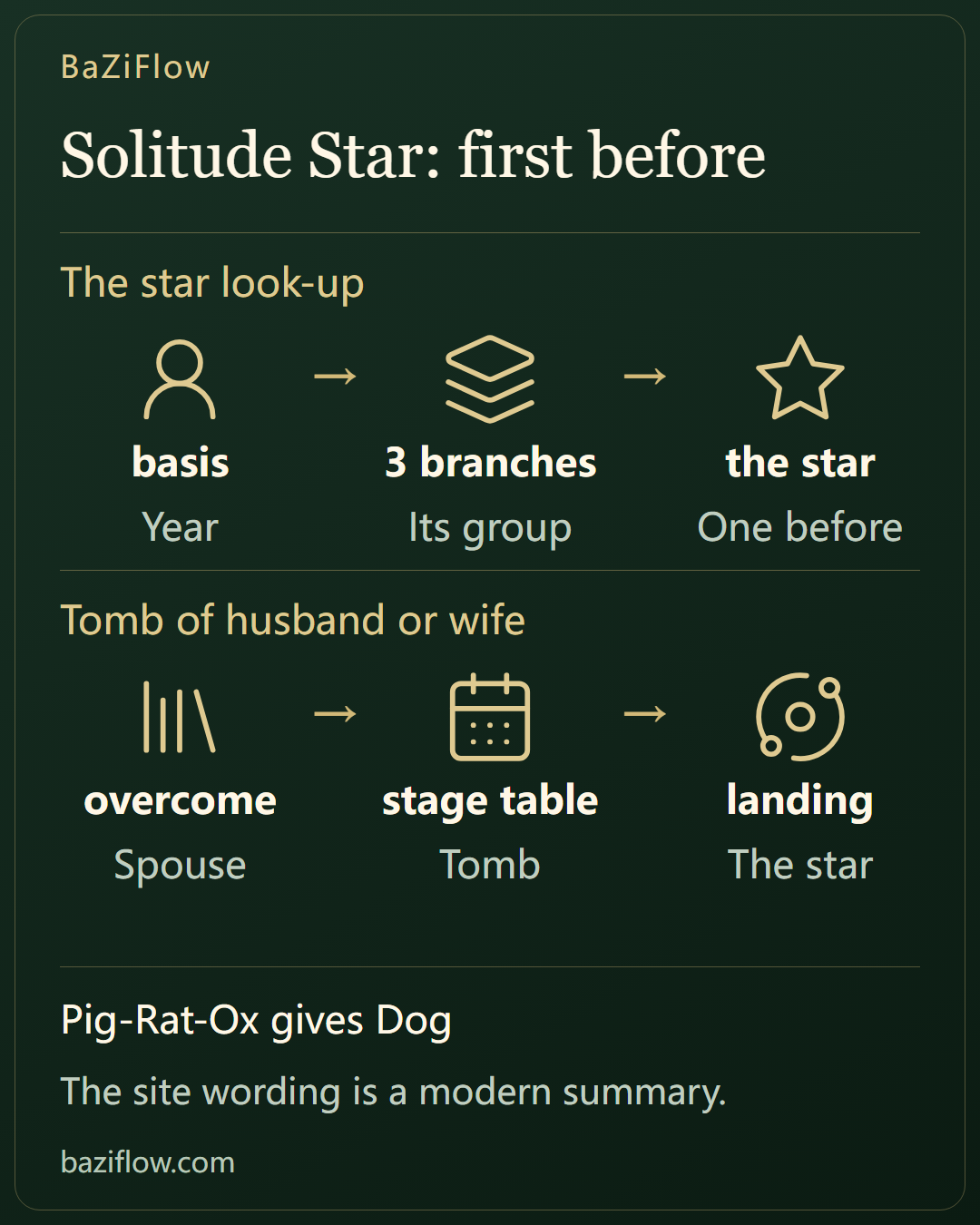
The Solitude Star takes the branch before the year branch's direction group: always Ox, Dragon, Goat or Dog. A ring, the tomb of a husband or wife, two charts, and the condition that a single one is not counted.
The short version7 min read
The basis of the Solitude Star is the year branch: decide which direction group it belongs to, take the first branch before that group, always one of Ox, Dragon, Goat or Dog, and look for it in the month, day and hour pillars.
- Pig, Rat and Ox give Dog; Tiger, Rabbit and Dragon give Ox; Snake, Horse and Goat give Dragon; Monkey, Rooster and Dog give Goat. The four landing spots are exactly the four Storage branches, and the year pillar itself is skipped.
- The Sanming Tonghui, quoting Sanche, pictures it as the tomb of a husband or wife: Fire's tomb is Dog in the north, Wood's is Goat in the west, Water's is Dragon in the south, Metal's is Ox in the east, each matching the site table.
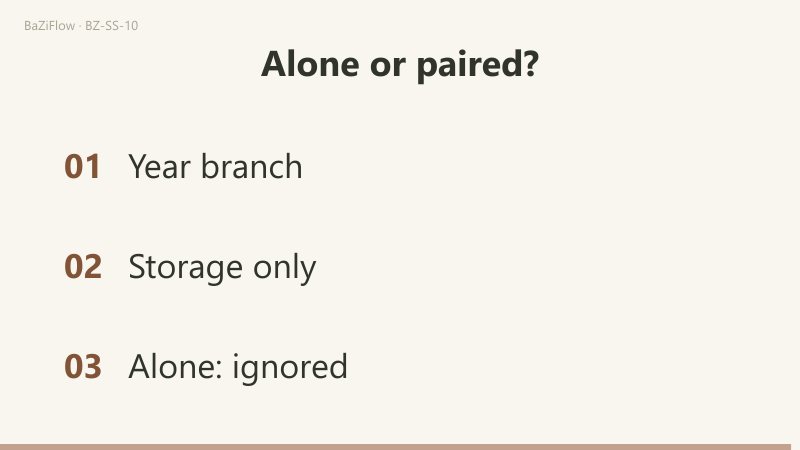
- The book says the two stars fear being met doubly or piled up and that a single one is not counted; the Xieji bianfang, a date-selection text, mentions the pair too and leaves it out as roundabout and unrealistic.
Read first
Symbolic Stars in BaZi: Check the Reference and Rule Before the Meaning ↗
One before the group, on the four Storage branches
The Solitude Star (寡宿) is the Loneliness Star's partner and begins at the same place, the year branch. They part ways in direction: the Loneliness Star goes to the branch after the group, the Solitude Star steps back to the one before it.
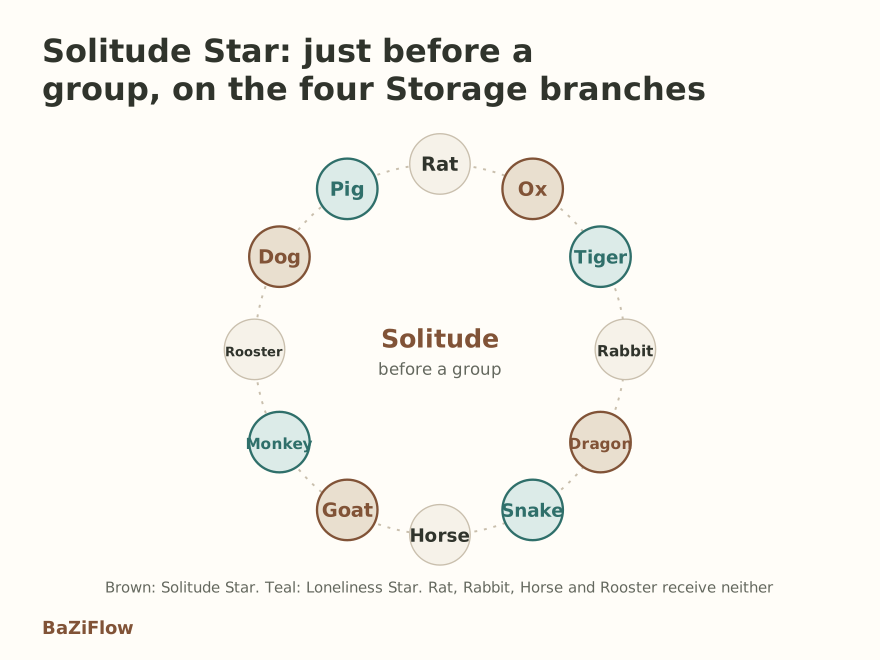
Sketch: four landing spots each for the Solitude Star and the Loneliness Star, from the site engine; the brown branches are the four Storage branches and the teal ones are the first branches of the four seasons.
On the ring, the brown Ox, Dragon, Goat and Dog are the Solitude Star and the teal Tiger, Snake, Monkey and Pig are the Loneliness Star, four branches each; Rat, Rabbit, Horse and Rooster receive neither. The pairing runs: Pig-Rat-Ox gives Dog, Tiger-Rabbit-Dragon gives Ox, Snake-Horse-Goat gives Dragon, Monkey-Rooster-Dog gives Goat. Whether it matches is read off the three pillars other than the year.
Why the book picks a tomb: of the husband or of the wife
The Sanming Tonghui (三命通会), quoting Sanche (三车), pictures the Solitude Star as the "tomb" of a spouse. Pig-Rat-Ox is northern Water, Water overcomes Fire, Fire is Water's wife, and in the twelve life stages Fire is entombed at Dog, so Dog is the Solitude Star. The book gives a similar set for the other three directions and then sums up in one line:
So the Loneliness Star takes the mother cut off, and the Solitude Star takes the tomb of the husband or the wife; the meaning is especially close.
Enlarge diagram · scroll sideways to read
North and west take the wife (Water overcomes Fire, Metal overcomes Wood), and south and east take the husband (Fire is overcome by Water, Wood by Metal). In the twelve life stages Fire is entombed at Dog, Wood at Goat, Water at Dragon and Metal at Ox, and the four cells match the site's Solitude Star table one by one. What the Storage stage means in itself is in the article on Storage.
Two charts looked up: a lone star and a pair
Enlarge diagram · scroll sideways to read
In chart one the east group's star is Ox, which sits in the day pillar, and no other lonely or solitary star shows up. In chart two a Rat year branch belongs to the north, so Dog is the Solitude Star and Tiger the Loneliness Star; the month holds the Tiger and the hour the Dog, one each. What separates the two charts is the point of the next section: the book reads "a single one" and "a lonely and a solitary together" differently.
The book's condition: a single one is not counted
A gloss in juan 11 says how this pair has to appear before it counts:
The two shas, Loneliness and Solitude, fear being met doubly or piling up; a single one is not counted. With an Officer and a Resource star above, even a monk or Daoist is noble.
By this line the two stars deserve a careful reading only when met doubly or piled up, and a single one does not count; an Officer or Resource star above changes the reading again. The three cases can be set side by side:
Three cases in the book
A single one is not counted
A chart with only the Loneliness Star or only the Solitude Star is not read as lonely or solitary by the book. The site still marks the one that is there, and leaves the reading to the whole chart.
Both together, or repeated
A Loneliness and a Solitude Star in one chart, or one of them showing twice, is what the book takes seriously. Chart two of the last section, one of each, belongs here.
With an Officer or a Resource star
The same line says that with them even a monk or Daoist is noble, and that without them such a person is only an ordinary monk or Daoist. What the conditions are has to be judged against the whole chart.
Why a calendar text drops the pair, and how the site's line was written
The same names turn up in texts on choosing auspicious days. In the appendix of juan 35, the Xieji bianfang (协纪辨方书), the imperial calendar compendium, has this sentence:
Loneliness and Solitude take the place ahead of the season's command as lonely and the place behind it as solitary; they are drawn out of the Qimen method of isolated and void branches. Though they have a rationale, they are roundabout and do not fit the facts, so the present Observatory texts do not use them.
Read literally, "ahead of the command is lonely, behind it is solitary" is the same positional relationship the Sanming Tonghui spells out in juan 3: for the winter group Pig-Rat-Ox, one step forward reaches Tiger, the lonely one, and one step back reaches Dog, the solitary one. This text is about choosing days: the names have a rationale, but it is roundabout and unrealistic, so the current Observatory texts do not adopt them. It speaks of date selection, not of birth charts, yet it shows how far apart the treatment of one set of names can be in different books.
One note on wording: the book's "ahead" means counting forward; when this article says the Solitude Star sits "before" a group, it means the branch that comes just before the group in order. The words point in opposite directions but name the same Dog.
Enlarge diagram · scroll sideways to read
The previous star is the Loneliness Star, and the next, which goes back to the day stem as its basis, is the Emolument Star.
Questions readers ask next
The Solitude Star and the Canopy Star land on the same four branches. Are they one star?
The set of landing spots is the same, but the method is not. The Solitude Star looks at the direction group of the year branch and takes the branch before it; the Canopy Star looks at the Three Harmony group of the day branch and takes the last branch of it. A Rat day branch has Dragon as its Canopy Star while a Rat year branch has Dog as its Solitude Star, so one branch can bear different names depending on the basis.
If my chart has only one Solitude Star, does it not count?
The site marks it as soon as it matches. The book speaks of something else: the Sanming Tonghui says the two stars "fear being met doubly or piled up, and a single one is not counted", meaning that one alone is not read as lonely or solitary. That is a condition for reading, not for looking up, so the site's marking and the book's "not counted" do not contradict each other.
Does the Solitude Star only matter for women's charts?
The site looks it up from the year branch whatever the gender, and every chart is treated alike. Some passages of the book are written separately for men's and women's charts, which is the book's own reading; the site wording does not divide by gender and is much milder, so the two are different things.
Was this article helpful?
Sources & references
Continue reading
Loneliness Star (孤辰): One Branch Past the Year Branch's Direction Group ↗
Emolument Star (禄神): The Day Stem's Own Post, and Why It Never Sits on a Storehouse ↗