

View Gate: the Fire of Li Nine in two gate lists
Content version · · Sources & references
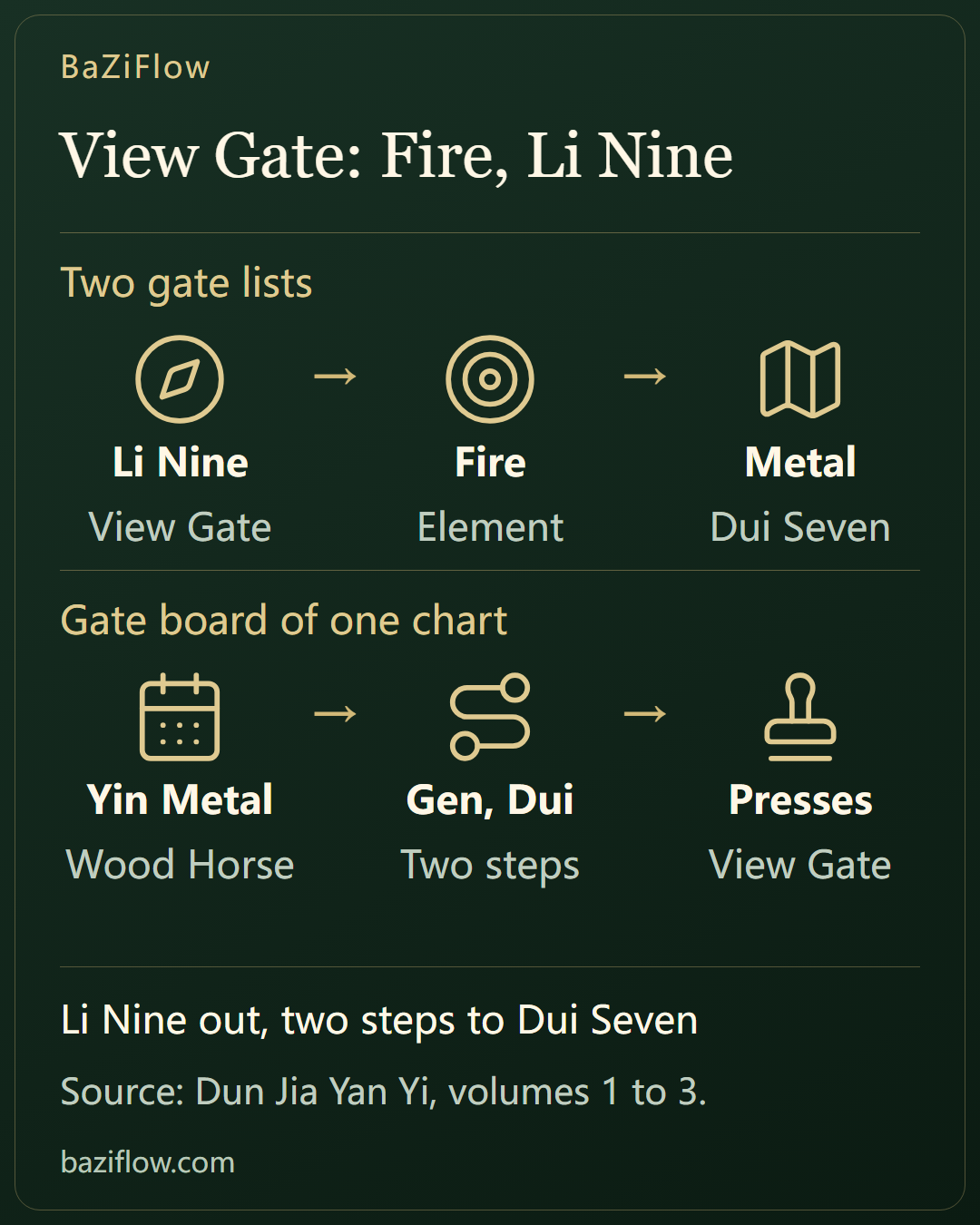
The View Gate starts in Li Nine and belongs to Fire. Dun Jia Yan Yi lists it among auspicious gates in one passage, not in another; we follow it through Heaven Feint, one worked chart and an element check.
The short version11 min read
Whether the View Gate counts as auspicious gets two answers in Dun Jia Yan Yi: the verse names only Open, Rest and Life, while the pressure examples put the View Gate in the auspicious row. This article sets the passages on the Fire gate of Li Nine side by side and works one example chart from the book.
- The View Gate starts in Li Nine and belongs to Fire. Which palace it occupies in a given chart is settled by the setup and the cycle head.
- The poem says “all affairs go as wished” for only the Open, Rest and Life gates, yet the pressure examples in volume 2 put the View Gate in the auspicious row. Both lists sit in one book.
- In the Yin Metal Ox day, Yang Fire Monkey hour chart the View Gate is the duty gate and steps back two palaces from Li Nine to Dui Seven: Fire on a Metal palace. Another chart in the book says outright that the View Gate there is pressed and not auspicious.
Read first
Li Nine, Fire, the south: where the View Gate starts
Start with the position: the View Gate (景门) is the gate whose home is Li Nine (离九). Li Nine is the southernmost of the nine palaces and belongs to Fire.
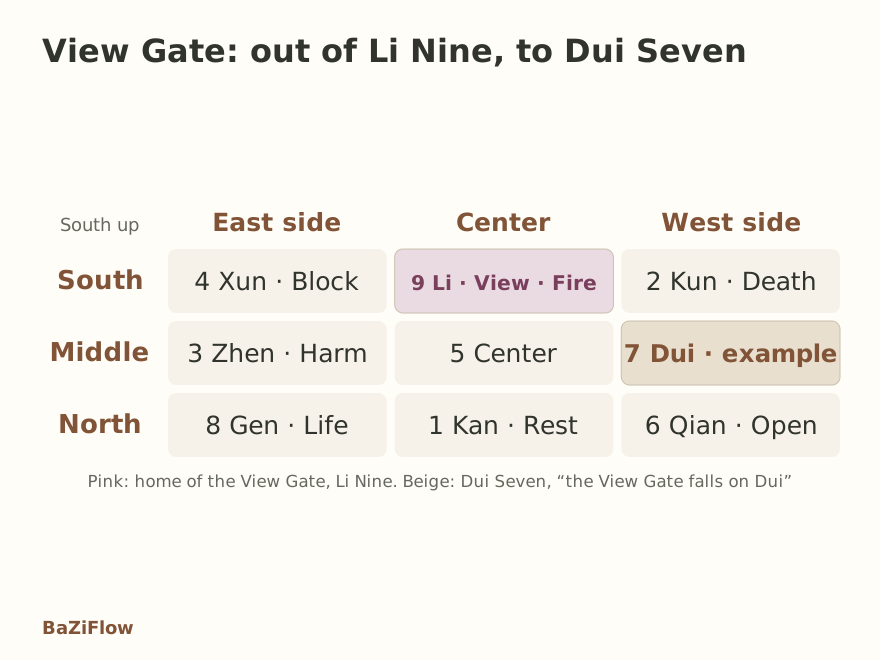
Nine-palace base grid with south at the top and east on the left; directions and elements follow the usual assignments. Pink marks the View Gate’s home, Li Nine, and beige marks Dui Seven, where the Yin Metal Ox day, Yang Fire Monkey hour chart places it. They are different boxes.
South is at the top of this grid, which puts Li Nine in the middle of the top row, facing Kan One across the center; 9 + 1 = 10. The Shuo Gua (说卦), chapter 5, says of Li:
Li is brightness: all things see one another in it. It is the trigram of the south.
“Brightness”, “seeing one another” and “the south” match the position in the picture, and Fire is the usual element assignment for the palace. What the View Gate takes from this box is mainly its direction and element. The Ming-era Dun Jia Yan Yi (遁甲演义) never explains the character for “view” (景) itself, and this article does not guess at it.
Two lists of auspicious gates, and the View Gate is in only one
“Which gates are auspicious?” is not answered in one sentence in Dun Jia Yan Yi. Volume 1 carries the Yan Bo Diao Sou fu (烟波钓叟赋), a verse on the eight gates, and it opens by naming three of them, Open, Rest and Life, with the promise that meeting them means “every affair goes as one wishes”. Only these three are named. Volume 2, in its section on gate and palace pressure, gives another set of examples. For an auspicious gate under pressure it lists the Open Gate in palace three, the Rest Gate in palace nine, the Life Gate in palace one and the View Gate in palace seven; for an ominous gate under pressure it lists the Harm and Block gates in palaces two and eight, the Death Gate in palace one, and the Shock Gate in palaces three and four. That set puts the View Gate in the auspicious row.
Enlarge diagram · scroll sideways to read
This site checked all eleven of these placements against the elements: View Fire in Metal, Rest Water in Fire, Life Earth in Water, Open Metal in Wood, Harm and Block Wood in Earth, Death Earth in Water, Shock Metal in Wood. Without exception the gate restrains its palace: that is the direction the book means by “pressure”.
So “is the View Gate auspicious?” has no single answer in the book; naming the passage you rely on stands up better than a flat verdict.
“View, to submit a letter and break a formation”, and Heaven Feint
The verse gives the View Gate this line:
At View, submit letters and break formations.
Submitting a letter means delivering written papers; breaking a formation means breaking an enemy line. Both belong to old court and military settings; the verse says nothing about exams or filings.
Volume 2, in its section on the three ruses and five feints (三诈五假), gives the gate another place: each of the five feints hangs on one gate, and the View Gate carries Heaven Feint (天假).
If the View Gate joins Yin Wood, Yang Fire or Yin Fire and lies on Nine Heaven, it is called Heaven Feint: Yin Wood is “Majestic Virtue”, Yang Fire “Majestic Force”, and Yin Fire is called Great Yin, the spirit of the three wonders. It suits stating one’s case and paying a visit to ask for something.
In short: the View Gate joins one of the three wonders, Yin Wood (乙), Yang Fire (丙) or Yin Fire (丁), on the palace of Nine Heaven (九天); that is Heaven Feint, which the book suits to stating a case and calling to ask a favour.
Enlarge diagram · scroll sideways to read
Two things read straight off the five rows: the View Gate is the only one joined to the three wonders, and the View and Shock gates both lie on Nine Heaven while the other three lie on Nine Earth (九地). Nine Heaven belongs to the spirit layer; see Nine Heaven.
A worked chart: Yin Metal Ox day, Yang Fire Monkey hour, the View Gate from Li Nine to Dui Seven
Volume 3 demonstrates chart setup with two charts from the 25th year of the Wanli reign. One of them, the “Yin-mode chart for a time after the Summer Solstice”, is the Yin Metal Ox (辛丑) day, Yang Fire Monkey (丙申) hour: middle ju after the Summer Solstice, Yin mode, ju three. This is how it sets the duty gate:
The Yang Fire Monkey hour of the Yang Wood Horse cycle: take the Ying star as duty star, add it to Kun, counting backward. Yang Wood Horse is originally in Li, so the View Gate is the duty gate; count back: Yang Wood Horse in Li, Yin Wood Goat in Gen, Yang Fire Monkey in Dui, and the View Gate falls on Dui.
Three steps are packed into this. First, find the cycle: Yang Fire Monkey belongs to the Yang Wood Horse (甲午) cycle, which runs Yang Wood Horse, Yin Wood Goat, Yang Fire Monkey. Second, find the cycle head’s palace: in Yin-mode ju three the Yang Earth instrument (戊) starts in Zhen Three and the instruments run backward, so Yang Earth is on 3, Yin Earth on 2, Yang Metal on 1, Yin Metal on 9. Yang Wood Horse hides under Yin Metal (辛), Yin Metal is on Li Nine, and the gate at home in Li Nine is the View Gate, so the View Gate is the duty gate. Third, walk: Yang Fire Monkey is the third double-hour in its cycle, which means two steps; in Yin mode the count runs backward, from Li Nine through Gen Eight to Dui Seven, and the View Gate lands on Dui Seven.
Enlarge diagram · scroll sideways to read
The other seven gates turn with it; this site recomputed the whole board with a script:
Enlarge diagram · scroll sideways to read
The book’s verdict on the chart: “Li, Dui and Kan get a wonder but no gate; Gen, Zhen and Xun get a gate but no wonder; it is no time to act.” Gen, Zhen and Xun hold the Open, Rest and Life gates, and Li, Dui and Kan hold the Harm, View and Shock gates, which fits the verdict’s “gate” and “no gate”.
The other chart in volume 3 (Yang Water Monkey day, Yang Fire Horse hour, middle ju after Minor Fullness, Yang mode, ju two) has the same gate board, and there the book states the View Gate’s verdict outright:
Yin Fire reaches Dui: Fire flourishes, Metal is dead. The View Gate is added to the Dui palace, pressed and not auspicious.
The View Gate is Fire and Dui is Metal: Fire restrains Metal, a gate over its palace, the direction of section two.
The View Gate in all eight palaces: element by element
Pressure has a direction. The View Gate is Fire, and in the eight outer palaces only five relations can occur. The pressure section opens with a verse saying that a palace restraining its gate is not “pressing”, and only a gate restraining its palace is; it then names the other two relations:
The gate restraining the palace is the master of pressing. … The gate producing the palace is “harmony”; the palace producing the gate is “righteousness”.
Checked palace by palace against the View Gate:
Enlarge diagram · scroll sideways to read
Qian Six and Dui Seven are Metal, and the View Gate restrains them, so they are “pressed”. Kan One is Water, and Water restrains Fire, so here the palace restrains the gate, which the verse calls “not pressed”. The same View Gate gets a different name in a different palace. A further sentence in the same section applies “ominous pressing” and “auspicious pressing” to the two directions in a way that conflicts with the verse; pending a better edition, this article follows the verse and the examples and draws no verdict from them.
Four terms, one sentence each
- Home
- The palace each gate starts from; for the View Gate, Li Nine.
- Cycle head
- The first of a group of ten double-hours, such as Yang Wood Horse; it decides which gate is on duty.
- Duty gate
- The gate on duty. It starts from the cycle head’s palace and moves one stop per double-hour.
- Gate pressure (门迫)
- A gate restraining its palace, such as the View Gate (Fire) on Dui Seven (Metal).
In the order of the gates’ homes the next gate after the View Gate is the Death Gate; for the full calculation of palace, cycle head and duty gate, see duty chief and duty door.
Questions readers ask next
Is the View Gate an auspicious gate or not?
It depends on which passage you cite. The poem’s “all affairs go as wished” names only Open, Rest and Life; the pressure examples treat Open, Rest, Life and View as the four auspicious gates. The book never reconciles them, so a note should say which passage it follows.
Does “View, to submit a letter” mean the View Gate suits exams or filing papers?
The line names two jobs, submitting a letter and breaking a formation, in the setting of old court paperwork and military affairs. Nothing in it points to the outcome of a modern exam or application; for that you would need other evidence on the chart itself.
Does the View Gate on Dui always count as “pressed”?
The gate-over-palace pair holds: Fire restrains Metal. But the book judges its charts from several layers together, and the pressure is just one of them, so it cannot stand in for a verdict on the whole chart.
Was this article helpful?
Sources & references
Continue reading
Block Gate: Xun Four Wood Gate, Pushed to Kun Two in a Wanli 25 Example Chart ↗
Death Gate: the Earth of Kun Two and How Dun Jia Yan Yi Limits What It Governs ↗