

Five of Swords: the holder and the two who leave
Content version · · Sources & references
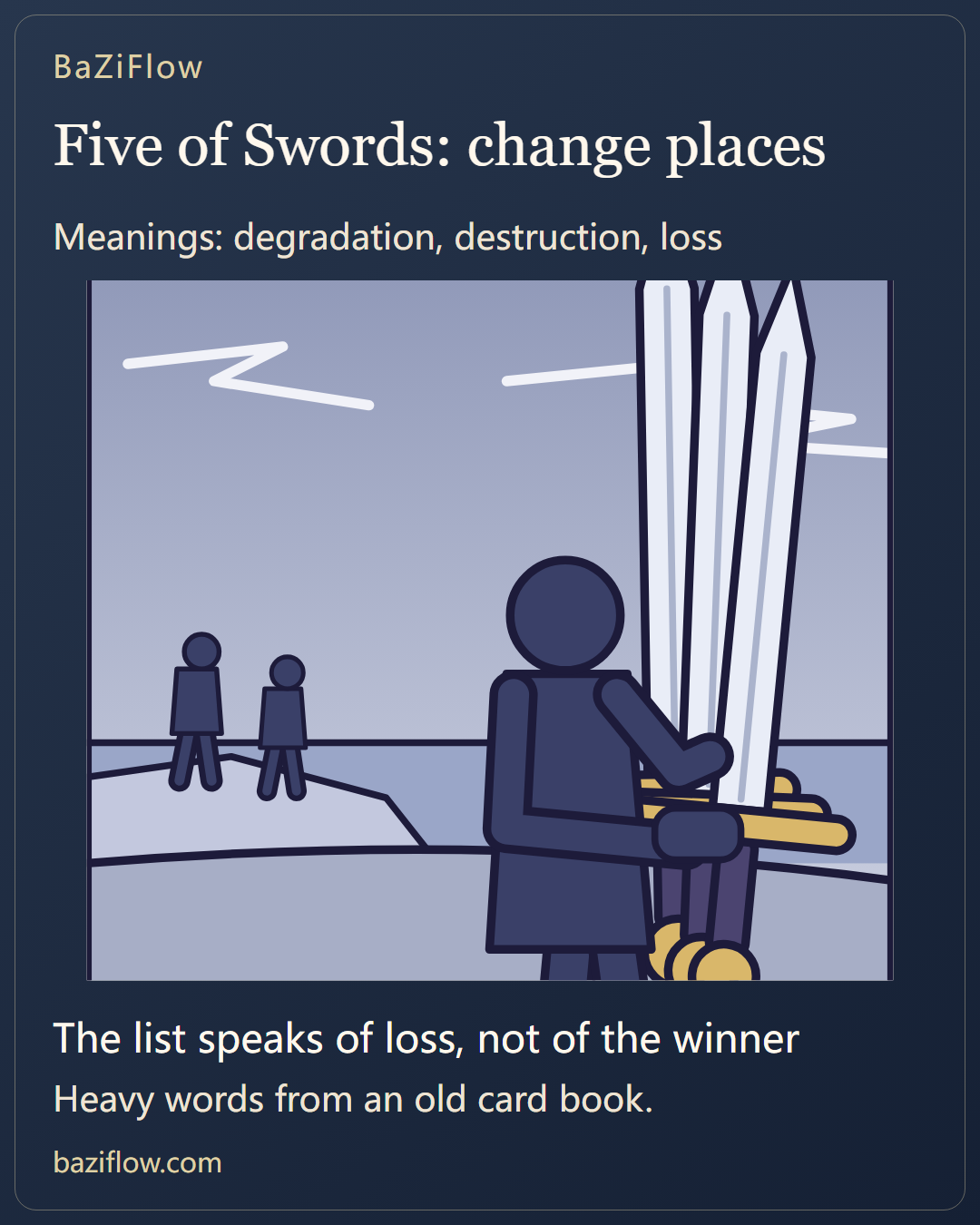
The Five of Swords shows one figure holding swords while two walk away and their blades lie on the ground. See which words Waite lists, then take a shared-notes dispute from three positions.
The short version6 min read
The figure at the front of the Five of Swords holds the swords, yet Waite's list lands entirely on loss: degradation, destruction, revocation, infamy, dishonor, loss.
- A disdainful man watches two dejected figures retreat; their swords lie on the ground, he carries two on his shoulder and holds a third, and he is the master in possession of the field.
- None of the six upright words says what that master gains. The reversed card gives the same words and adds burial and obsequies.
- Other readers' notes are short and grim, one for each orientation, and are best taken as period phrasing.
Read first
Start with the picture: three swords in one pair of hands, two on the ground
Waite puts the card this way: a disdainful man looks after two retreating and dejected figures. Their swords lie upon the ground. He carries two others on his left shoulder, and a third sword is in his right hand, point to earth. He is the master in possession of the field.
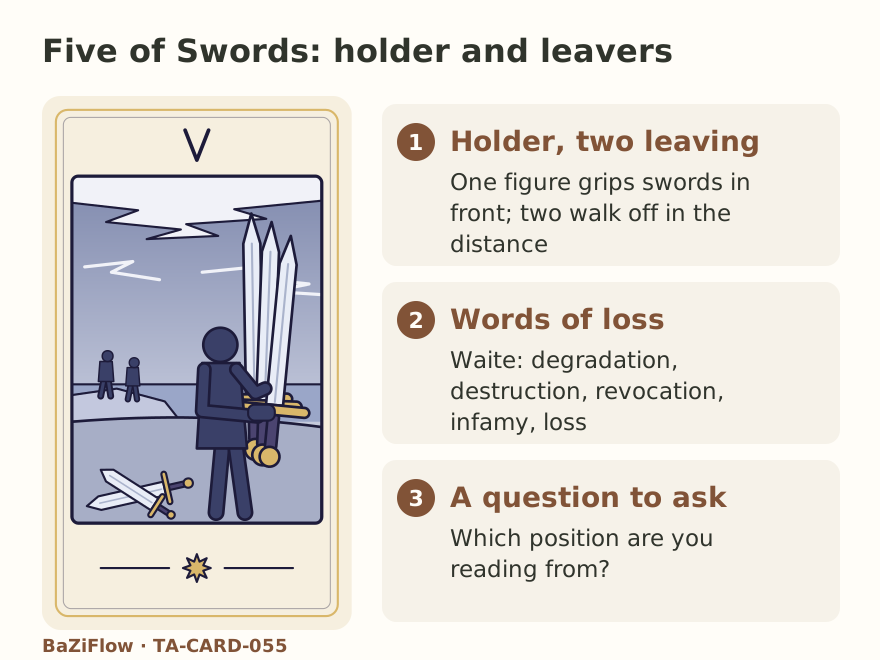
BaZiFlow original Five of Swords with three labels
In the RWS drawing the man fills the foreground, looking back over his shoulder. Two small figures turn their backs on him and walk toward the sea; the clouds are torn into strips, and the two fallen swords lie at the lower left of the card, in front of the two who walk away. Count the five swords: three are with the man, and the two on the ground are the ones the departing pair left behind. From front to back the picture has three parts:
Enlarge diagram · scroll sideways to read
What Waite lists: degradation, destruction, revocation, and no word for gain
Waite's divinatory meanings are: degradation, destruction, revocation, infamy, dishonour, loss, "with the variants and analogues of these". He does not go further.
Degradation, destruction, revocation, infamy, dishonour, loss, with the variants and analogues of these.
Enlarge diagram · scroll sideways to read
All six words sit on the side of being taken, lowered or destroyed, and none says what the master of the field gains. The front of the picture belongs to the swordholder while the list gives consequences: the position and the words do not line up, and that is the first gap you meet when reading this card.
Disdain, dejection, a point to earth: Waite's adjectives and later additions
Waite uses a few feeling-laden words when describing the picture. Taken apart, they describe the look of the figures:
Three details, each with its source
- Disdainful
- Waite's word for the swordholder's manner. It describes a figure in the picture, and is not a remark about the person who draws the card.
- Dejected
- Said of the two who retreat. It describes a posture and gives no information about what they really think.
- Point to earth
- The third sword in the right hand has its tip toward the ground. Waite gives only the posture, with no meaning attached.
Enlarge diagram · scroll sideways to read
"Holding as keeping the field" and "fallen swords as things set down" are readers' additions. The next section puts them to work. Both come from the structure of the picture, so when you use them, say the reading is yours.
How to read it: one picture from three positions, in a dispute over shared notes
The card carries three positions ready-made: the one holding swords, the two who leave, and the swords on the ground. The way to read it is to stand in each in turn and write one factual sentence:
Stand with the holder: what does he actually have
He holds three; the other two are not in his hands. Write what he actually holds, then separate "the field is his" from "the things are his": keeping the field does not make everything on it his.
Stand with the two who leave: what did they leave behind
The swords lie on the ground and the people walk away. Write what they left. "Dejected" is Waite's word for their look and not their thoughts; if you want those, ask.
Stand with the fallen swords: can they be picked up
The list has destruction, revocation and loss. What fell may have been destroyed, taken back, or only set aside, and each calls for a different response.
An example: a study group writes a course literature review together, with five reading-note tables. The member in charge merges three of them into the master table; the other two belong to two members and were not merged, and those two stop replying in the chat. Write it from the three positions:
Enlarge diagram · scroll sideways to read
After the change of position, what can be said
Can read
- One fact for each position
- What fell is still on the field
Cannot read
- The holder is surely in the right
- The leavers are surely the losers
Next step
- Ask what the two think
- Judge the two drafts again
Reversed, additional meanings and neighbors: the same words, with burial added
Waite's whole note on the reversed Five of Swords is one phrase: the same; burial and obsequies. So the six upright words stand as they are, with two words connected with funerals added.
Enlarge diagram · scroll sideways to read
Two short notes by other readers follow: upright, "an attack on the fortune of the querent"; reversed, "a sign of sorrow and mourning". These words are heavy, and they can be read at their full weight; they are the phrasing of an old card book, used to describe a kind of situation, and none of them is a forecast about any person or event.
Three neighbors: swords and strife, and where each puts the weight
A posse of youths with staves
Waite calls it mimic warfare, with the list imitation, competition and struggle; the quarrel is like a drill.
A man carrying swords off quickly
The list is design, attempt, wish, hope, confidence, along with quarreling and a plan that may fail.
The next card
A ferryman poles a punt across; the list is about the crossing itself.
Questions readers ask next
If I draw the Five of Swords, have I won or lost?
The card does not say which side you stand on. There is the figure holding swords, the two who leave, and the swords on the ground; the list speaks of loss and damage. Ask which position you are reading from before saying "won" or "lost".
How does the reversed Five of Swords differ from the upright one?
Waite writes "the same; burial and obsequies": the same words, with two more connected with funerals. He does not give the reversed card a different set of meanings altogether.
Is the figure holding the swords a bad person?
Waite calls his manner disdainful and his place that of the master in possession of the field, and he does not judge who he is. Reading the card as "someone is a villain" goes beyond the text.
Was this article helpful?
Sources & references
Continue reading
Six of Swords: a punt with six swords crosses over, and Waite notes the load is light ↗