

Reading the Ten Wings
Content version · · Sources & references
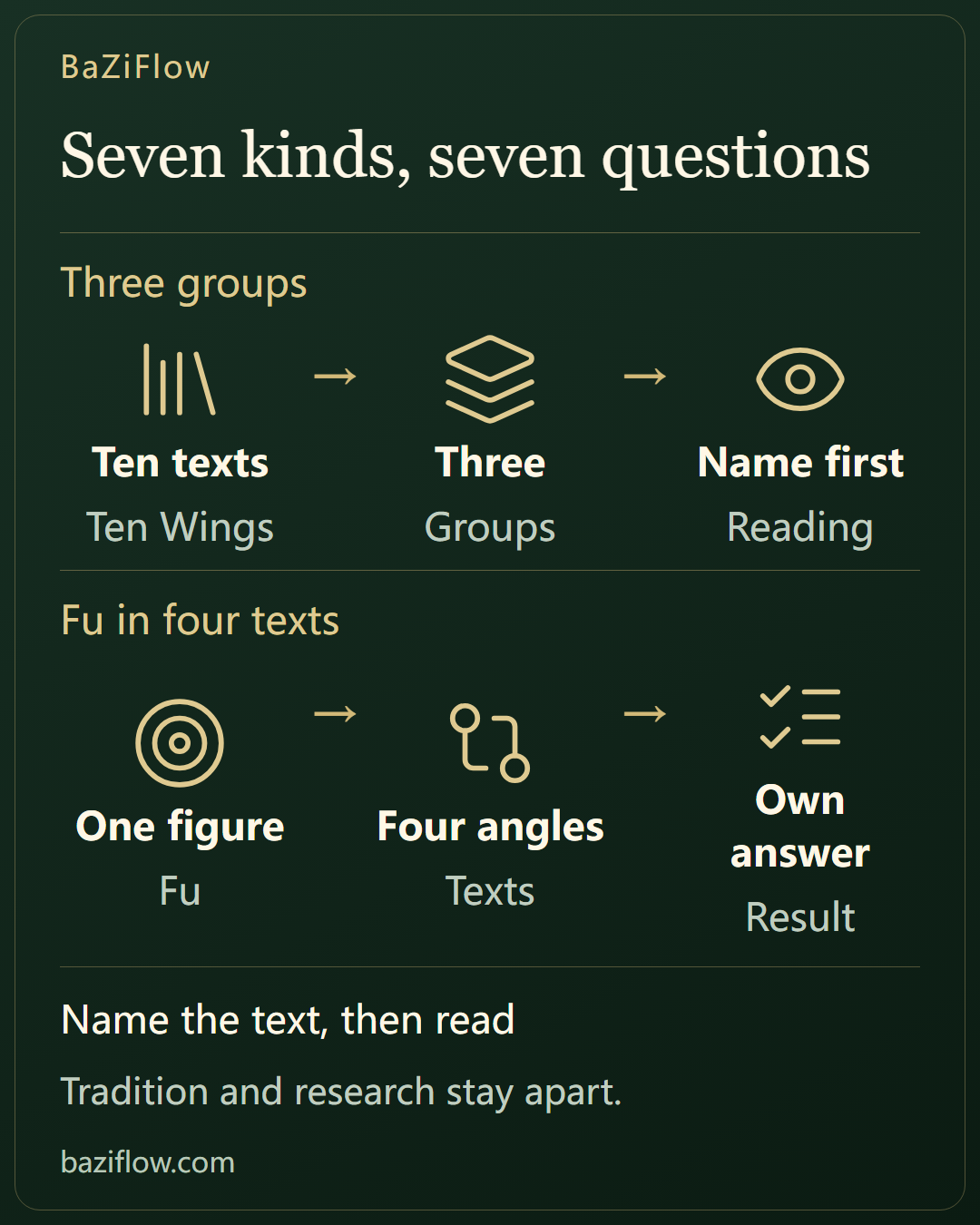
On hexagram Fu, see what each of the Ten Wings asks: the Commentary on the Judgments explains, the Great Commentary (Xi Ci) discusses, three texts are lookup tools. Tradition and modern debate stay apart.
The short version10 min read
The Ten Wings are seven kinds of writing: some explain a Judgment, some take an image, one unfolds Qian and Kun line by line, one discusses the Changes as a whole, and three look things up. Before reading any of them, ask what it is answering.
- The ten texts are seven kinds of writing, each asking its own question, so they cannot all be filed as explanations of the line statements.
- On Fu: why the Judgment reads as it does, what conduct the image suggests, why it follows Bo (剥) and what it pairs with are asked by different texts.
- What old books record and what modern scholars say about authorship and date are two kinds of material. Keep them apart and let neither stand in for the other.
Read first
Core Text and Commentaries: Telling the Zhou Yi from What Explains It ↗
Judgment and Line Statements: Whole Hexagram or Single Line? ↗
Ten texts in three groups: ask what each one answers
The Ten Wings (十翼) are ten commentary texts of seven kinds, not ten of one kind. Some follow every hexagram, one section per figure, explaining its Judgment (卦辞) or its lines; one discusses the Changes as a whole; three are lookup tools. The traditional list is in Core text and commentaries.
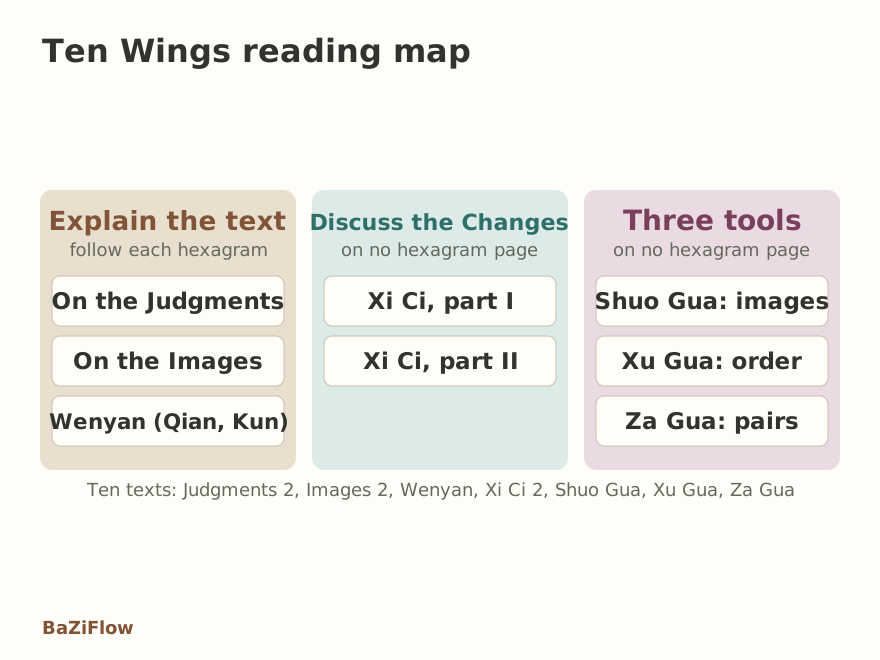
The Ten Wings sorted into three groups by the question each answers; the list of texts follows the Wikisource page for the Yi Zhuan.
The table gives the question each text answers and where it appears. Find the text first; that tells you which question to read it with.
Enlarge diagram · scroll sideways to read
On the Judgments, the Images and the Wenyan: one hexagram, three ways of asking
Fu (复) is hexagram 24, with Zhen (震) below and Kun (坤) above. On its Wikisource page the core text is followed by just two commentary blocks, one opening “The Judgment says”, the other “The Image says”; there is no Wenyan block.
Enlarge diagram · scroll sideways to read
The Commentary on the Judgments takes the Judgment’s phrases in turn and adds a clause to each. On the left is the Judgment of Fu; on the right, what “The Judgment says” puts beside it:
Enlarge diagram · scroll sideways to read
The last sentence, “Fu: is this not where one sees the heart of heaven and earth?”, has nothing to match in the Judgment; it is the commentary’s own closing. So it answers: why does this Judgment read so, and what is the hexagram about?
“The Image says” asks something else: first the whole figure, then line by line.
Thunder in the midst of the earth: Fu. The former kings, on the solstice, closed the passes; merchants and travelers did not move, and the ruler did not inspect the regions.
The Great Image follows a steady pattern: the images of the two trigrams, in most entries the name, then what the gentleman (君子) does. On Wikisource’s Great Image page 53 of the 64 entries have the gentleman as subject; most of the rest have the former kings (7). The Small Images give one clause per line, most ending in a closing particle.
Four texts: how to read, how not to
How to read
- On the Judgments: find which words of the Judgment it quotes, then see what it adds.
- Great Image: read the images taken, the name, then the conduct.
- Small Images: read the line statement (爻辞) of that line first, then its clause.
- Wenyan: read only the Qian and Kun sections; follow each “what does this mean?” back to its line statement.
How not to read
- On the Judgments: do not take its quoted words for new words of its own.
- Great Image: do not read the gentleman’s conduct as an order to you or a forecast.
- Small Images: do not read one alone; without its line it points at nothing.
- Wenyan: do not use it to explain other hexagrams; it covers only two.
The Xi Ci: a general discussion that sits on no hexagram page
The Xi Ci is attached to no hexagram; it discusses the Changes themselves. Wikisource divides the upper part into twelve chapters and the lower into nine (numbers follow Wikisource). A sentence in chapter ten of the upper part sums up what the Changes are for:
The Changes hold four of the sages’ ways: those who speak by it prize its statements; those who act prize its changes; those who make implements prize its images; those who divine prize its prognostications.
Enlarge diagram · scroll sideways to read
These are the Xi Ci’s own four uses of the Changes. It speaks of hexagrams, lines, statements and divination together, so with any chapter first decide which it is about. Another pattern recurs: a line statement paired with a passage marked “the Master said”. Initial Nine of Fu is cited that way:
One line statement, three places
Returning from not far away; no great regret; supremely auspicious.
The line statement itself, with no explanation.
“Returning from not far away” means cultivating oneself.
One clause, explaining this line alone.
Is Yan’s son not nearly there! If he had something not good, he never failed to know it; knowing it, he never did it again.
It speaks of a person first, then cites the line statement beside him.
The Xi Ci: how to read, how not to
How to read
- Decide whether the chapter speaks of hexagrams, lines, statements, divination or principle.
- Where a line statement is cited, check the hexagram page, then see why the chapter cites it.
How not to read
- Do not take one chapter for a commentary on one hexagram.
- Do not take the words after “the Master said” for the line statement itself.
Shuo Gua, Xu Gua, Za Gua: look up an image, an order, a pairing
These three texts sit on no hexagram page and explain no single line; each offers one way to look something up. Fu is the test case again, starting with the Xu Gua, a chain from Bo (剥) through Fu to Wu Wang (无妄) and Daxu (大畜):
Enlarge diagram · scroll sideways to read
Almost every step has one pattern: a trait of the earlier hexagram, then “and so it is followed by” the later one. The phrase for “is followed by” (受之) appears 61 times on Wikisource’s Xu Gua page.
Three ways to look up, all on Fu
Thunder and earth in Fu
The Great Image says “thunder in the midst of the earth”: thunder and earth are the images of the lower trigram Zhen and the upper trigram Kun, listed in the later chapters of the Shuo Gua.
Why Fu comes after Bo
“Things cannot be exhausted for good; Bo is exhausted at the top and turns back to the bottom, so it is followed by Fu.” A reason for two neighbours.
Bo is decay; Fu is turning back
The Za Gua mostly sets two hexagrams side by side and names their difference in one word.
The Za Gua keeps an order of its own: the Xu Gua puts Shi (师) before Bi (比), while the Za Gua writes “Bi is joy, Shi is worry”, Bi first. The Shuo Gua has eleven chapters on Wikisource: the first two speak of how the Changes make a hexagram, chapters three to six of how trigrams pair up, are placed and act, and the last five list qualities and images trigram by trigram, as set out in The eight trigrams: structure and images.
Three tools: how to read, how not to
How to read
- Shuo Gua: locate the chapter first, and note its number when you look up an image.
- Xu Gua: take “and so it is followed by” as a stated reason; check which trait it picks up.
- Za Gua: read in pairs, note the one word given to each, then check the hexagram page.
How not to read
- Shuo Gua: do not push all of a trigram’s images into one line statement, or take an image for a prophecy.
- Xu Gua: do not take it for a full account of each hexagram, or predict from its reasons.
- Za Gua: do not stretch one word to the whole hexagram.
Traditional attribution and the modern debate: keep them apart
Who made the Ten Wings, and when? Two kinds of material bear on it: what old books record, and what later research is said to conclude. They answer different questions, so keep them apart. First, an old book:
Late in life Confucius loved the Changes, and put in order (序) the Commentary on the Judgments (彖), the Xi (系), the Commentary on the Images (象), the Shuo Gua and the Wenyan.
The sentence names five items, lacks Xu Gua and Za Gua, and does not contain the term Ten Wings; the Han and Sui histories list other sets again, see Yijing and Zhou Yi: names and scope.
Enlarge diagram · scroll sideways to read
The cards below draw on the Chinese Wikipedia entries and relayed surveys: all second-hand, originals not read:
What the encyclopedia entries say
Authorship
The histories say Confucius made the Ten Wings; some hold they are not all from one hand, and some chapters may be collective work. Since the silk-manuscript Yi Zhuan and the Guodian slips came to light, as relayed, a number of scholars (such as Li Xueqin) have reaffirmed Confucius’s close tie to the Changes, while others object.
Views over time
As relayed by the entry: Ouyang Xiu (Northern Song) viewed the Commentaries on the Judgments and on the Images differently from the other five; Yao Jiheng and Kang Youwei (Qing) held that the Yi Zhuan is not from Confucius; Feng Youlan denied that Confucius made the Ten Wings and found many of their ideas plainly Warring States.
Date
As relayed from the Zhou Yi entry and surveys: most place them in the Warring States, a few (such as the Xu Gua and Za Gua) perhaps as late as the Han; dates differ by text.
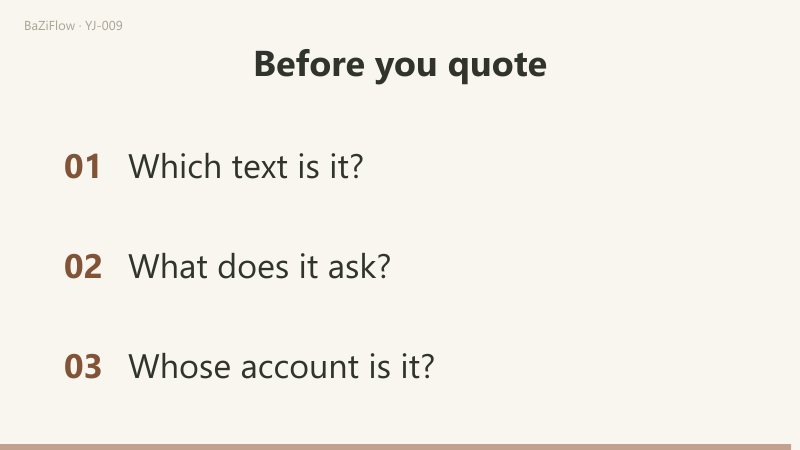
Which text is it?
Give its name; add Great or Small for the Commentary on the Images, the chapter for the Xi Ci and Shuo Gua.
What does that text ask?
Find it in the opening table and read with its question.
Whose account is it?
Keep the traditional statement, the encyclopedia’s summary and your own reading apart.
Questions readers ask next
Must the Xi Ci, Shuo Gua, Xu Gua and Za Gua be looked up hexagram by hexagram, as the commentaries on the Judgments and the Images are?
No. These four are whole texts, consulted by chapter or entry: the Xi Ci and Shuo Gua are divided into chapters, the Xu Gua strings neighbouring hexagrams into one run of “is followed by”, and the Za Gua is mostly short paired sentences.
Can the Shuo Gua, Xu Gua and Za Gua be used to judge how a matter will turn out?
They offer three ways of looking up: an image, an order, a pairing. Each answers only its own question, and the text gives no verdict on any particular affair. Treating what you looked up as a conclusion goes beyond what the text says.
Did Confucius write the Ten Wings?
Answer it in two layers. Old books connect Confucius with several of the commentaries, while the modern research summarised in encyclopedia entries is divided. Keep the two apart and give each its own source.
Was this article helpful?
Part of a learning path
Sources & references
Continue reading
Core Text and Commentaries: Telling the Zhou Yi from What Explains It ↗
Judgment and Line Statements: Whole Hexagram or Single Line? ↗
Reading Qian and Kun Together: From the Core Text to Different Explanations ↗