

The same day pillar does not justify the same personal reading
Content version · · Sources & references
Two Jia-Zi day fragments can have different valid hour pillars. Use that controlled comparison to separate shared definitions from chart-specific claims and unsupported life stories.
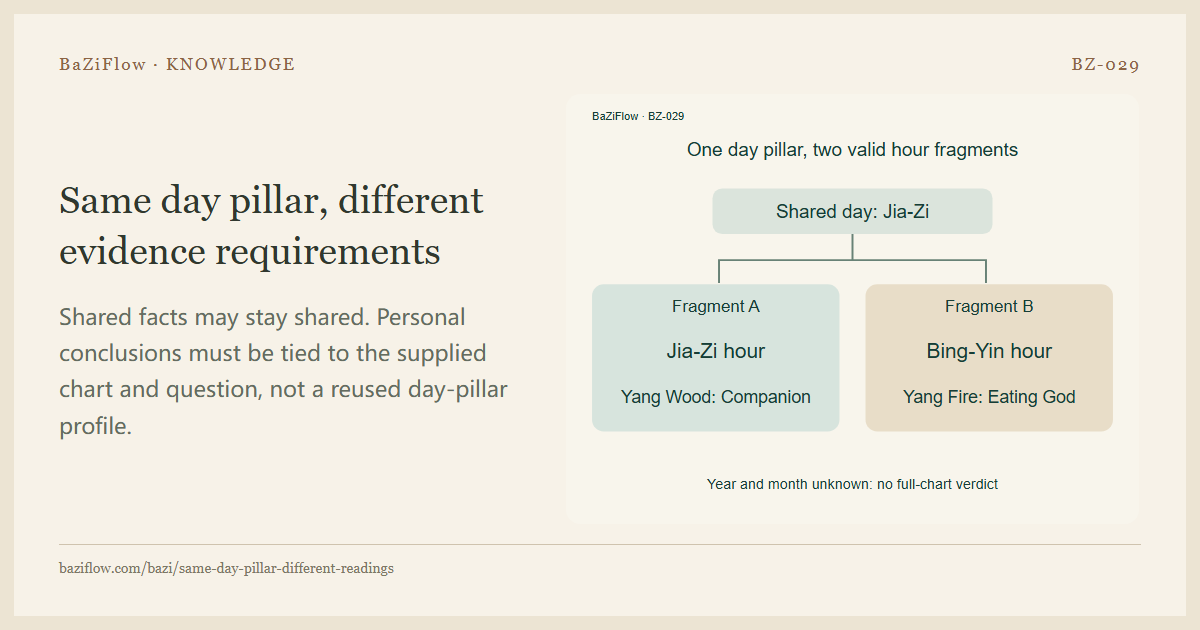
Shared facts may stay shared. Personal conclusions must be tied to the supplied chart and question, not a reused day-pillar profile.
Read first
Reading a BaZi chart for the first time: the four pillars and the Day Master ↗
What are the Ten Gods? Start from the Day Master's relationships ↗
Which part of a conclusion would survive missing information?
Take the claim “you will leave employment this year” and remove the year and month pillars, the time layers and the person's plans from the supplied record. A shared Jia-Zi day label cannot restore that missing evidence. This backwards check is useful because an unsupported event claim can follow several perfectly correct definitions.
There are different steps in the reasoning. “The hour stem is Yang Fire” identifies a field. “Yang Fire is Eating God relative to Yang Wood” applies a classification rule. A job change in a named year is a further claim with further requirements. Certainty does not pass automatically from the first two sentences to the third.
Keep the rule constant and change a field
The Hong Kong Observatory's hour-stem table gives Jia-Zi for the Rat hour on a Yang Wood day and Bing-Yin for the Tiger hour on a Yang Wood day. We can therefore construct two valid day-and-hour fragments while keeping the day pillar fixed. We do not specify their year or month, and we do not claim to have calculated two complete birth charts.
| Field | Fragment A | Fragment B |
|---|---|---|
| Day pillar | Jia-Zi | Jia-Zi |
| Hour pillar | Jia-Zi | Bing-Yin |
| Hour stem relative to Yang Wood | Yang Wood: Companion | Yang Fire: Eating God |
| Year and month | Not supplied | Not supplied |
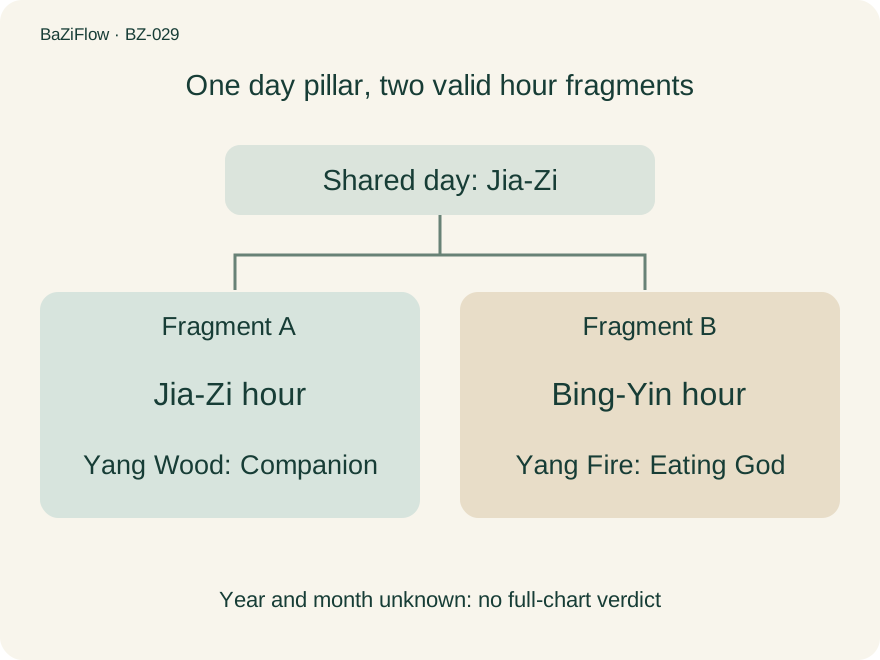
Original BaZiFlow day-and-hour comparison. Both hour pillars follow the Jia-day table; no actual birthdays or outcomes are asserted.
The different hour stems support different Ten Gods classifications relative to Yang Wood. They do not establish that A must be competitive or B must enter a creative profession. Those are additional interpretations, not facts contained in the table. The exercise is useful precisely because it stops before the evidence runs out.
We can also compare the questions attached to the same fragment. One reader may only ask what Eating God means; another may ask whether to accept an actual offer. The same classification answers part of the first question. It leaves the second reader's terms, preferences and circumstances unexamined. A different question does not justify inventing different chart facts, but it does change which missing evidence matters.
Season and position are not optional decorations
Zi Ping Zhen Quan's discussion of climatic conditions distinguishes spring Wood meeting Fire from summer Wood meeting Fire and gives the example of winter Wood meeting Fire. It treats the seasonal setting as part of the interpretation. A day-pillar label alone has not told us that setting.
Another chapter examines how the order and placement of otherwise similar stems changes the proposed reading. Its value for this exercise is the attention to positions and intervening relationships. We do not transfer its historical claims about lifespan or family outcomes to present-day readers. A textual method and a verified prediction are different things.
Consequently, counting elements without their positions loses information even before two people are compared. Read the role of the month command alongside the conditions around Ten-God combinations. A template cannot settle favorable elements first and then add the rest of the chart as decoration.
What should remain the same in both explanations?
Jia-Zi denotes a Yang Wood day stem and a Rat day branch, so the Day Master is Yang Wood in both fragments. Those definitions should agree. Likewise, the same input to the hour-stem rule should give the same pair. Randomizing a definition or a rule to make two reports look different would introduce errors.
Individual interpretation has a different obligation: show why a particular relation matters in the supplied record and where its limits lie. Sharing a day pillar leaves the other pillars unresolved. Even after all four pillars are supplied, the chart is not a complete record of education, opportunities, decisions or current resources.
Thus two reports can share a limited factual observation without sharing a personal conclusion. Genuine commonality should stay visible, just as a genuine difference should have a traceable cause. A few new adjectives cannot provide evidence that was absent from the input.
Read the two accounts without their names
Temporarily hide the names and look for the reasoning that identifies each account. Can a reader recover which placement, season, time layer or actual question led to a major claim? If both accounts reduce to “you have potential but need discipline” or “you value closeness yet need space,” the day-pillar label has not made those statements specific.
This comparison should examine the central argument, not just repeated words. A report can change every adjective while still handing both people the same unsupported sequence of conclusions. Conversely, a shared rule need not be disguised when it is genuinely the same rule.
An uncertain birth hour makes hour-dependent claims conditional. An unresolved day boundary may make the Day Master conditional too. Mark those dependencies instead of completing the account with an invented personality. Historical stories about someone with the same day pillar are not substitutes for the missing fields or the present reader's life.
Return to the employment claim at the beginning: the fragment supports a field and a relation, while the event remains unestablished. Stopping there is a meaningful result of the comparison. The same day pillar is a starting point for checking evidence, not permission to copy a person's future from a shared label.