

Seven Killings: seven places from the Day Master
Content version · · Sources & references
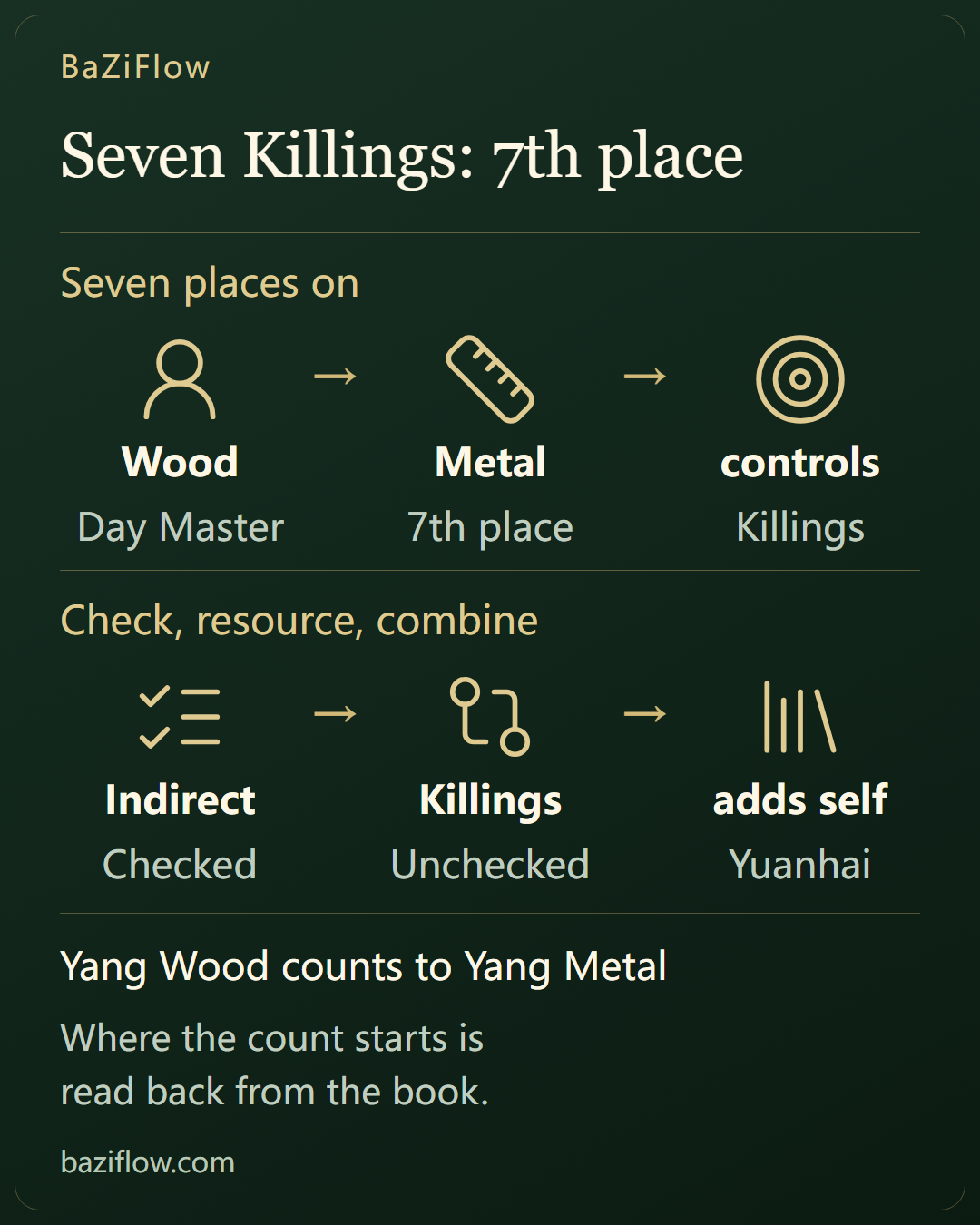
The Seven Killings is the stem seven places on from the Day Master, controlling it with the same polarity. A counting ladder, a ten-line check of the Sanming Tonghui, three routes and one Yuanhai Ziping chart.
The short version10 min read
The Seven Killings is the stem seven places on from the Day Master, controlling it with the same polarity; the old books ask first whether it is held in check, and call it Indirect Officer or Seven Killings accordingly.
- Each of the ten Day Masters has one Seven Killings, and counting agrees with the table: the seventh stem is exactly the one that controls the Day Master with the same polarity, in a yang loop and a yin loop.
- For one place the Sanming Tonghui says Indirect Officer when it is held in check and Seven Killings when it is not; the Yuanhai Ziping adds a strong or weak self. This site reads the place alone and writes Seven Killings.
- The books handle it three ways, by Eating God, by the Resource, or by a stem combination, and each way comes with a condition such as "already held in check" or "strong self" that cannot be dropped.
Read first
How the Ten Gods are derived: five relationships and two polarities ↗
Seven places apart: the "seven" is a count
The Sanming Tonghui (三命通会), a Ming-dynasty compendium, explains the "seven" in Seven Killings (七杀) plainly: it lies seven places away. Line the ten stems up in the usual order, count the Day Master as first, and the seventh stem on is its Seven Killings.
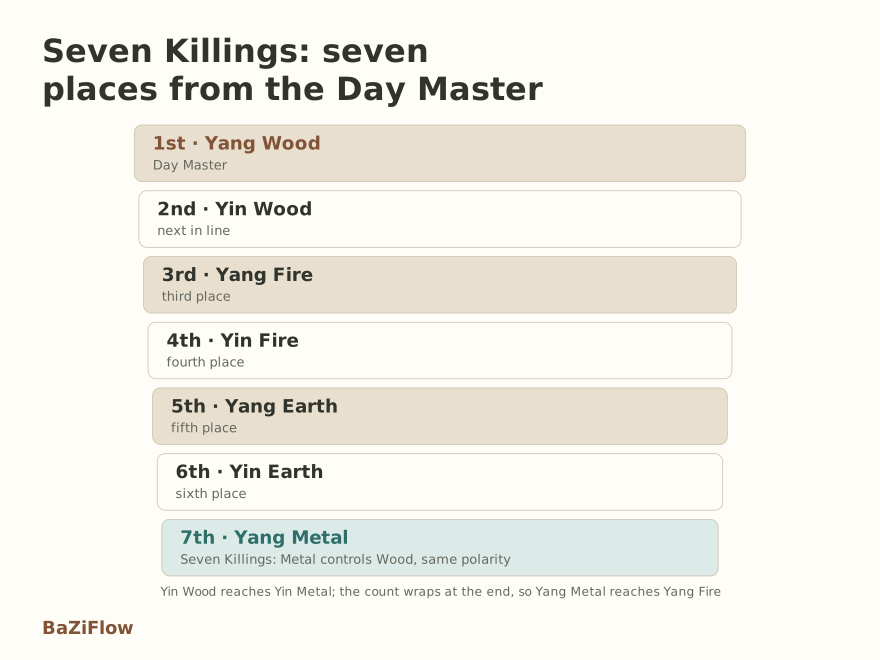
Counting ladder: Yang Wood as the example, the Day Master counted as first and the count landing on Yang Metal; data from the Ten Gods table of this site, set beside the book's "seven places apart".
Counting from Yang Wood: Yin Wood, Yang Fire, Yin Fire, Yang Earth, Yin Earth, and the seventh is Yang Metal. Metal controls Wood, so Yang Metal controls Yang Wood. The book does not say where the count starts; working back from its examples, Yang Wood meeting Yang Metal and Yin Wood meeting Yin Metal, the Day Master is counted as first.
Checked against all ten Day Masters in this site's table, the stem reached is always the one that controls the Day Master with the same polarity. At the end of the ten the count wraps to the start, so Yang Metal reaches Yang Fire. Six places apart is an even distance, so yang stems reach yang stems in one loop and yin stems reach yin stems in another. The book explains the "unmatched" and the "seven" in one breath:
The Indirect Officer is the case of Yang Wood meeting Yang Metal and Yin Wood meeting Yin Metal. It is like two men who cannot live in one place, or two women who cannot share a house: they make no pair, so it is called "unmatched" (偏). Because it lies seven places away and the two fight each other, it is called the Seven Killings.
"Make no pair" is about polarity: Yang Wood and Yang Metal are both yang, with no yin to match, hence "unmatched". The "seven" comes from the distance.
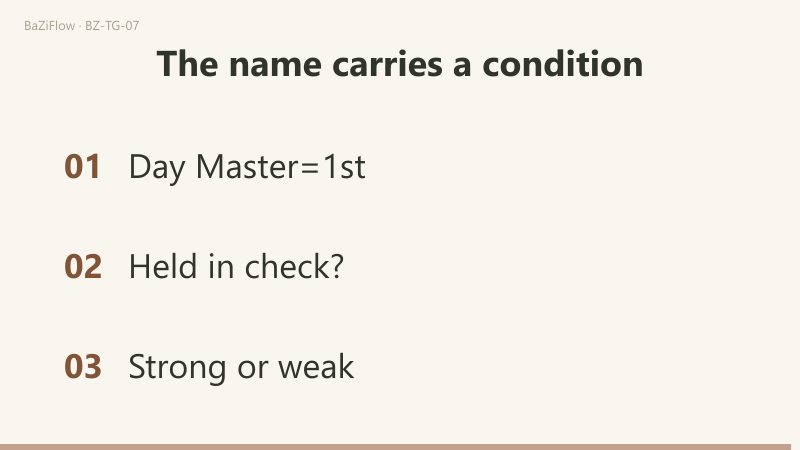
Indirect Officer or Seven Killings: the name carries a condition
A few lines on in the same entry the Sanming Tonghui forks:
So where it is held in check, call it the Indirect Officer; where it is not held, call it the Seven Killings.
"Held in check" means kept under control; the ways to do it come below. The Yuanhai Ziping (渊海子平) puts the condition on the Day Master instead:
A strong self that transforms it may have it as an Indirect Officer; a weak self with nothing to hold it down has it as the Seven Killings.
Enlarge diagram · scroll sideways to read
The two books run on from one another: one looks at whether it is held in check, the other adds a strong or weak self. So "Indirect Officer" and "Seven Killings" in the books are more than names of a place; each carries a verdict. The table of this site reads the place alone and writes Seven Killings. The Yuanhai Ziping also has a poem, which the Sanming Tonghui copies, and the first two lines are word for word the same:
Do not call the Indirect Officer ill by rule; held in check, it still brings a rich salary.
Ten couplets for ten Day Masters
In this entry the Sanming Tonghui quotes a string of couplets, each one naming a stem meeting the stem that controls it. Taking the ten out and checking them against this site's table one pair at a time, all ten agree:
Enlarge diagram · scroll sideways to read
All ten pictures are taken from the way the five elements control one another: metal chops wood, so branch and leaf wither; water covers fire, so the flame goes dark. Take the two couplets on Fire:
Blazing Yang Fire meets Yang Water and the flame turns black and loses its light; glowing Yin Fire meets Yin Water and its radiance goes out by itself.
That describes what "being controlled" looks like. Two lines follow the couplets: "when the stem sits on its salary or a growing, flourishing place it can be propped up, and the blade that comes may combine and check it". So these ten lines carry conditions, and the conditions are the next section.
Three routes the books give: check, resource, combine
Within the same entry the Sanming Tonghui keeps returning to one symmetry:
Where it was held in check from the start, its coming out is a blessing; where it was not held from the start, its coming out is a harm.
"From the start" means already in the chart, and "coming out" means the Seven Killings appearing again, in a luck pillar for instance. So the first step in reading it is whether it is held. The note under this entry lists what the book likes and fears:
Enlarge diagram · scroll sideways to read
The Yuanhai Ziping's list is close. For judging a strong or weak self see strong and weak Day Masters. The entry has a phrase for the first two routes: "once a check appears it turns noble" (the Eating God) and "the killing star helps the Resource" (the Resource). The third, "greedy for the combination, forgetting the killing" (combining), comes from the Yuanhai Ziping on the Seven Killings, and the Sanming Tonghui uses the phrase again where it discusses keeping or removing officer and killings. Putting them on Yang Fire: its Seven Killings is Yang Water, its Eating God Yang Earth, its Resource Yang Wood and Yin Wood, its Rob Wealth Yin Fire.
Enlarge diagram · scroll sideways to read
For the combining route the Yuanhai Ziping takes Yang Wood: Yang Metal is the Seven Killings, Yang Fire or Yin Fire checks it, and Yin Wood combining it is called "greedy for the combination and forgetting the killing". The table shows that what combines the Seven Killings is, for a yang Day Master, its own Rob Wealth (Yin Wood for Yang Wood), and for a yin Day Master its own Hurting Officer (Yang Fire for Yin Wood). The Sanming Tonghui on the Yang Blade has a line on the yin side: Yin Wood meeting Yang Fire, "the Yang Fire hurts its Yang Metal officer and combines the Yin Metal killing". The rules are in the Five Combinations of the stems.
A chart from the books taken apart: killings and blade, with a Resource
The Yuanhai Ziping preserves a chart: year Yin Metal Rooster (辛酉), month Yang Wood Horse (甲午), day Yang Earth Horse (戊午), hour Yang Wood Tiger (甲寅), with Yang Earth as the Day Master. The book opens its verdict with:
This chart has the killings and the blade both complete, and it has a Resource.
"Killings" are the Seven Killings, the "blade" is the Yang Blade, the "Resource" is the Resource star. What the book says next concerns luck pillars and years, so the chart is only taken apart here:
Enlarge diagram · scroll sideways to read
The Seven Killings of Yang Earth is Yang Wood, and it shows three times: month stem, hour stem, and the main qi in the Tiger. The Resource is Yin Fire, hidden in the two Horses. The "blade" is the Horse: the Sanming Tonghui on the Yang Blade has "the blade of Yang Earth is the Horse", and only the five yang stems have one. So "killings and blade complete, with a Resource" matches item by item. For hidden stems see the hidden stems of the branches.
Find the stem first
Count to the seventh place or use the table, then test it: controls the Day Master, same polarity.
Then find where it sits
Scan the stems first, then open the branches to their hidden stems; note the pillar and whether it shows.
Read the book's condition last
"Held in check", "not held" and "strong self" are conditions; see whether they stand around a line before quoting it.
Check your count
Day Master Yin Fire: which stem is the Seven Killings, and which branches hide it?
Counting on gives Yin Water as the seventh. The hidden-stem table has it in the Rat, the Ox and the Dragon.
Day Master Yang Metal: what happens when the count runs off the end?
Seven places on passes the end of the ten and lands on Yang Fire.
Who has Yin Metal as a Seven Killings?
Reverse the lookup: Yin Metal controls Yin Wood, both yin, so it is the Seven Killings of Yin Wood.
The Seven Killings and the Direct Officer both control the Day Master, and differ only in polarity: the same polarity is the Seven Killings, the opposite is the Direct Officer. How the Eating God that holds it down is counted has its own article: Eating God.
Questions readers ask next
Is the Seven Killings the worst of the ten gods?
In the Ten Gods table it is only a place: it controls the Day Master with the same polarity. The old books speak both ways. One line says "do not call the Indirect Officer ill by rule; held in check it still brings a rich salary", and they also describe the unchecked, weak-self case. Whether it is harsh depends on those conditions; the place itself settles nothing.
Are the Indirect Officer and the Seven Killings two different gods?
On this site they are one place with two names. The Sanming Tonghui gives the checked one the name Indirect Officer and the unchecked one Seven Killings, so its names carry a judgment. The table here does not assume either, and writes Seven Killings throughout.
If another stem combines the Seven Killings, does it stop being the Seven Killings?
The book calls this "greedy for the combination, forgetting the killing"; the Yuanhai Ziping's example is Yin Wood combining Yang Metal on a Yang Wood day. Yang Metal is still on the chart and the table still names it Seven Killings; it is only tied up and no longer free to attack the Day Master. Whether the pair then transforms into another element is a separate question, taken up in the article on the stem combinations.
Was this article helpful?
Sources & references
Continue reading
Direct Wealth (正财): The Stem the Day Master Controls With Opposite Polarity ↗
Direct Officer (正官): Why the Sanming Tonghui Allows Only One ↗
Output Generates Wealth and Officer Generates Resource: Chains and Conditions ↗