

Qian (謙): a mountain within the earth
Content version · · Sources & references
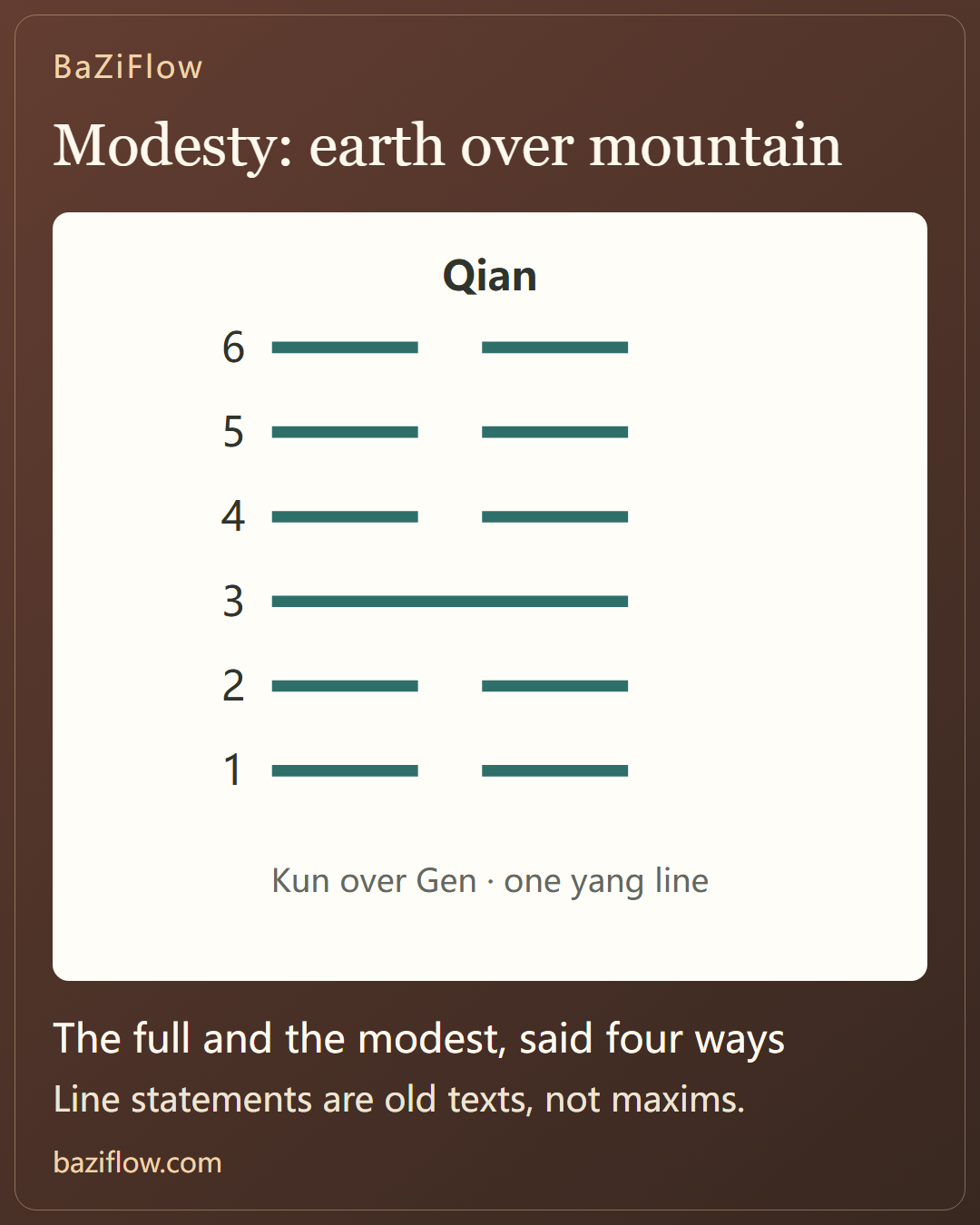
Qian (謙) is the 15th hexagram: a mountain within the earth, one yang line in the third place. The Commentary states one pattern four times, the Great Image ends on taking from many, and "ringing modesty" appears twice.
The short version7 min read
The word for modesty is set against "the full", and the Commentary runs that pair through four subjects: heaven, earth, spirits and people. Then six statements stand at six different places.
- Qian (謙) is Kun (earth) over Gen (mountain), so the mountain sits inside the earth. The only yang line is the third; it is also the only statement with "toil" and the only comment with "all the people".
- The Commentary first sends heaven's way down and earth's way up, then repeats one sentence pattern with four subjects: heaven, earth, spirits, people, each acting on the full and on the modest.
- The Great Image ends on "take from the many, add to the few, weigh things and give evenly". "Ringing modesty" occurs at lines two and six, and the two comments differ.
Read first
The Sixty-Four Hexagrams: How Upper and Lower Trigrams Form One Figure ↗
Judgment and Line Statements: Whole Hexagram or Single Line? ↗
A mountain within the earth: the high thing put below
Qian (謙) is the 15th hexagram: Gen (mountain) below, Kun (earth) above, and its Image is "within the earth there is a mountain". Only one of its six lines is yang, the third; the other five are yin. The name is spelled the same as the first hexagram when tone marks are dropped, but this one is read qiān with the first tone and the first, Qian (乾), is qián with the second.
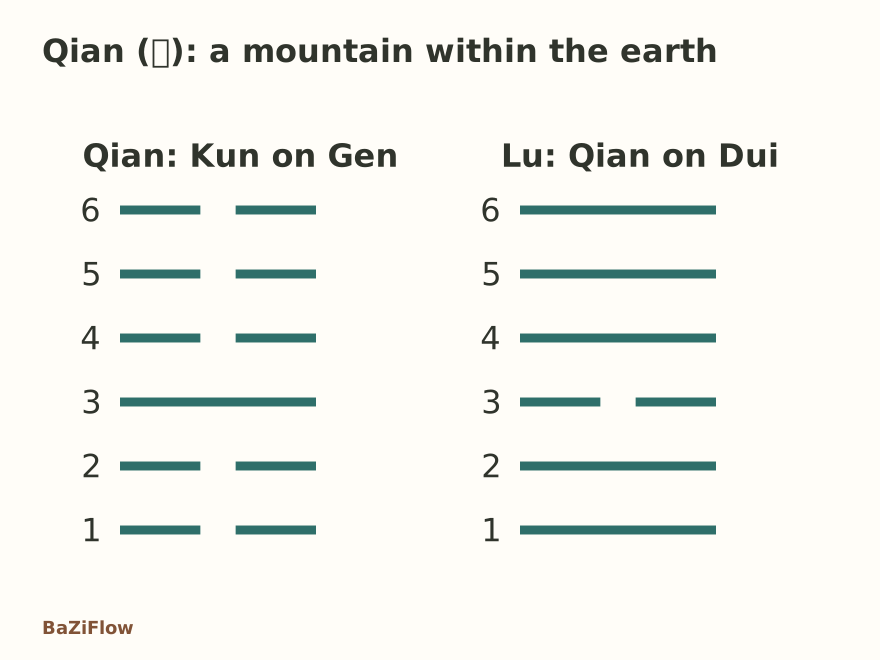
Qian (謙) and its inverse Lu: the lone yang line of one and the lone yin line of the other are both in the third place.
Enlarge diagram · scroll sideways to read
Three terms to have in hand
- Gen and Kun
- The Shuo Gua says "Gen is stopping" and "Kun is yielding", and in its list of what Kun stands for it includes "evenness", meaning level, equal.
- Full
- The Commentary keeps setting "the full" against "the modest": the two words work as a pair of opposites.
- Nine in the third
- The only yang line. It is the one statement that mentions toil, and the one comment that mentions "all the people".
A mountain is naturally high, and here it lies inside the earth: the high is put below the low. The figure repeats it. The yang third line is surrounded by yin lines, two beneath it (lines one and two) and three above it (lines four, five and six).
The Commentary says it four times: heaven, earth, spirits, people
The Commentary on the Judgments (彖传) first says: "Modesty: passage opens. Heaven's way descends to help, and is bright; earth's way is low, and rises." Heaven's way goes down and earth's way goes up, each toward the middle. Then come four sentences built the same way, with only the subject changed.
Heaven's way diminishes the full and adds to the modest; earth's way alters the full and flows toward the modest; the spirits harm the full and bless the modest; the human way dislikes the full and likes the modest.
Enlarge diagram · scroll sideways to read
The first two sentences describe change and flow: wearing down the full, adding to the modest; altering the full, flowing toward the modest. The last two describe likes and fortunes: harming the full and blessing the modest; disliking the full and liking the modest. The run goes from natural process to human feeling. It closes: "The modest, honored, shine; lowly, they cannot be overstepped: this is the noble person's ending", which picks up the second half of the judgment, "the noble person has an ending".
The Great Image: take from the many, add to the few
The judgment of Qian is "passage opens; the noble person sees it through". The Great Image (大象) gives the noble person two acts.
Within the earth there is a mountain: Qian. The noble person takes from the many to add to the few, weighs things and gives out evenly.
Enlarge diagram · scroll sideways to read
The first verb means to gather in, to take out; the second means to weigh. The image and the conduct point the same way. The mountain is high and sits inside the earth, so the high goes down; the noble person takes from where there is much and puts it where there is little, and the two ends come closer. In the Shuo Gua list of what Kun stands for there is "evenness", which lands on the same word as "evenly".
The six statements: the same two words, in different places
All six statements bear on modesty, and each is followed by a Small Image (小象) comment.
Enlarge diagram · scroll sideways to read
At the bottom, line 1: "Modest, modest, the noble person: by this he can cross the great river; good fortune." The word for modest is doubled. The Small Image says "he tends himself by staying low"; the verb is to shepherd, to look after. Line 3, the yang line: "The noble person who toils and is modest has an ending; good fortune". The judgment's "has an ending" returns, and the Small Image writes "all the people submit". Line 4: "Nothing unfavorable; modesty spread wide". The verb for "spread wide" is read in more than one way, and the Small Image says only "it breaks no rule".
Line 5: "Not rich, with his neighbors; fitting to attack and invade; nothing unfavorable". The Small Image names the target: "to subdue those who do not submit". Top line: "A modesty that rings out; fitting to send out troops and campaign against the towns and states". Its Small Image first says "the aim is not yet achieved" and then adds "troops may be used, to campaign against the towns and states". So the hexagram does not stop at bowing the head: its last two statements are about marching out.
Lu, Yu, Xie: neighbors of Qian, and why it follows Dayou
Turn Qian upside down and you get Yu (豫), whose lone yang line has risen from the third place to the fourth. This reversal gives the reversed hexagram.
Enlarge diagram · scroll sideways to read
The inverse of Qian is Lu (履), the first picture in this article: every line changes polarity, five yin lines become yang and the one yang line becomes yin, still in the third place. The nuclear hexagram is Xie (解): regroup the middle four lines, taking lines two to four as the lower trigram and three to five as the upper, and the result is Kan below, Zhen above.
The Xu Gua attaches Qian to Dayou (大有) with this sentence:
A person of great holdings must not brim over; therefore modesty comes next.
So the hexagram after Dayou is the one about not overflowing. Further on, the Xu Gua adds that a modest person of great holdings will be glad, and that is how Yu is placed next.
Questions readers ask next
Is the Qian of this hexagram the same word as the first hexagram, Qian?
No. Without tone marks both names are spelled qian, but this one is read with the first tone and the first hexagram with the second tone. The characters differ, and so do the figures: five yin and one yang here, six yang there.
Does this hexagram teach giving way every time?
The text does not say that. Lines five and six both speak of sending out troops, and the Small Image names the target as those who do not submit. The Commentary says the modest are honored and shine, which is not the language of weakness.
What does "ringing modesty" mean?
The first word is to sound out, to make a name known, and the phrase is usually read as modesty whose reputation spreads. It occurs at line two and at the top line, with the comments "attained in the heart" and "aim not yet achieved", so the position matters as much as the words.
Was this article helpful?
Sources & references
Continue reading
Dayou: one yin line in the fifth place, held up by five yang lines ↗
Yu: thunder out of the earth, and "moving in accord" from hexagram to sage ↗
The Sixty-Four Hexagrams: How Upper and Lower Trigrams Form One Figure ↗
Judgment and Line Statements: Whole Hexagram or Single Line? ↗