

Judgment and line statements
Content version · · Sources & references
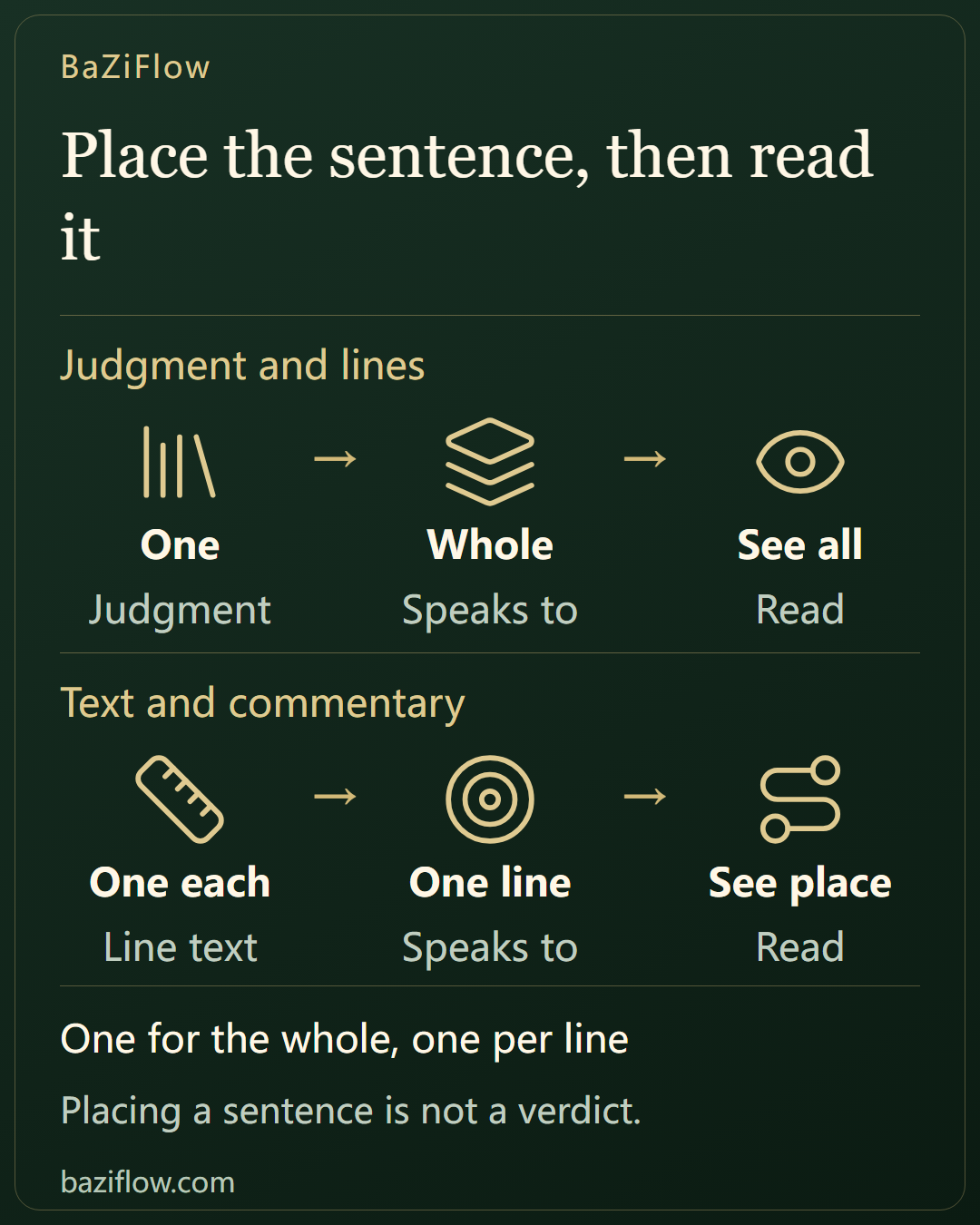
Using hexagram Tai, separate the one Judgment that speaks to the whole figure from the six line statements that speak to single lines, then set the later commentaries in their own layer.
The short version10 min read
Under each hexagram of the Zhou Yi sits one Judgment that speaks to the whole six-line figure, followed by line statements that each speak to a single line. The first step in reading any sentence is deciding which unit it belongs to.
- Hexagram Tai carries seven statements, and they split by unit: the first speaks to the entire figure, and the other six speak to one line each, from the bottom up.
- The same word in two places does not mean the same scope. The "go" in the Judgment looks at the whole figure; the "go" in the third-place line statement applies to line 3 alone.
- In the Xi Ci the text beneath a hexagram is called the Judgment (彖), while the Commentary on the Judgments (彖传) is a separate text explaining it. Same character, different layers, so check the context.
Read first
Core Text and Commentaries: Telling the Zhou Yi from What Explains It ↗
The Sixty-Four Hexagrams: How Upper and Lower Trigrams Form One Figure ↗
One hexagram, seven statements: count the units first
Open the Zhou Yi (周易) at hexagram Tai (泰) and the text under the name is not a single block. It falls into seven statements: one that speaks to the whole hexagram, then six that each speak to a single line. Reading begins with telling which of the seven a sentence is.
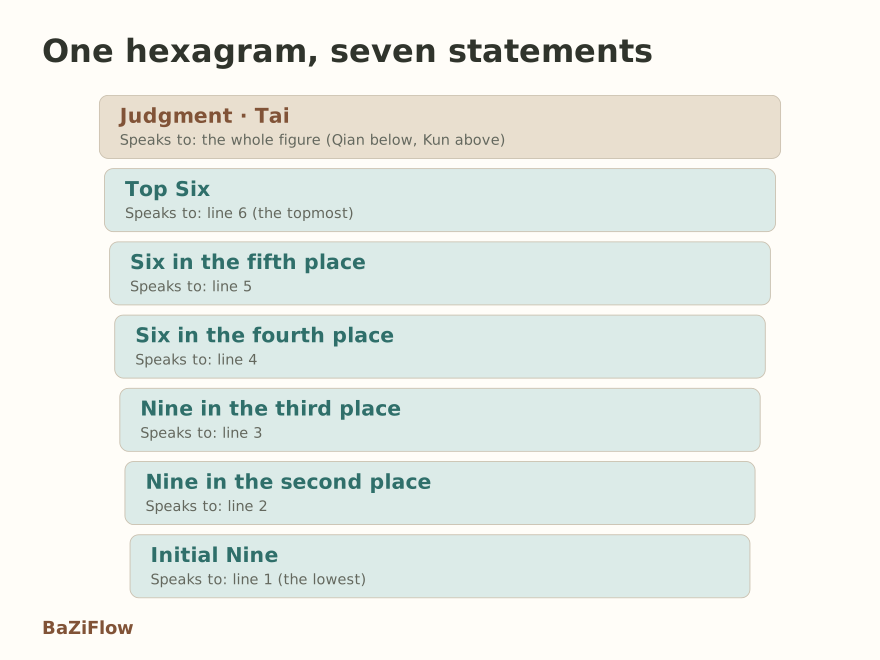
Text structure of Tai: one Judgment plus six line statements make seven. The line statements are stacked top to bottom, matching the six lines of the figure counted from the bottom up.
The seven follow the order of the figure. The Judgment (卦辞) comes first and addresses the complete six-line figure, which is built from a lower and an upper trigram. The line statements (爻辞) follow one by one, and each opens by naming its line, for example Initial Nine (初九) or Top Six (上六). "Initial" is the bottom line and "Top" is the sixth, matching the bottom-up counting used across this site. What the Nine and the Six in those labels mean is explained in the article on line positions and the Nine and Six labels.
Three names to know
- Judgment
- The statement attached to a whole hexagram. Its object is the complete figure made of two stacked trigrams. There is one per hexagram.
- Line statement
- The statement attached to one line. Its object is only the line named at its start. Each of the sixty-four hexagrams has six.
- Use Nine, Use Six
- Qian has one extra statement after its six line statements, called Use Nine (用九), and Kun has Use Six (用六). In the Wikisource text of the Zhou Yi only these two hexagrams do, so Qian and Kun carry eight statements each and the other sixty-two carry seven.
The Judgment: one sentence for the whole figure
Tai is Qian (乾) below and Kun (坤) above. Counting from the bottom, that is three yang lines and then three yin lines. Its Judgment is a single sentence placed right after the name, and it speaks to that whole figure.
Enlarge diagram · scroll sideways to read
Tai: the small go, the great come. Auspicious, and it prospers.
Nothing in this sentence names a position such as initial, second or top, and it points at no particular line. Reading it therefore means looking at the figure as a whole: what the lower trigram is, what the upper trigram is and how the two are stacked. How trigrams combine into a hexagram is covered in the article on upper and lower trigrams. The words "go" and "come" speak of direction. Commentators explain them in different ways, and the only point here is which unit the words belong to.
Kong Yingda (孔颖达), writing a subcommentary on the Great Commentary (Xi Ci, 系辞), used this very sentence as his example.
Since "the Judgment speaks of the image" and images come large and small, what sorts things into large and small lies in the hexagram. Take Tai: "the small go, the great come; auspicious, and it prospers." Take Pi: "the great go, the small come." Cases of this kind are what is meant.
He places the sentence of Tai at the level of the hexagram, to illustrate that line. It distinguishes the small from the great for the whole hexagram; it does not weigh gain and loss on any single line.
Line statements: each speaks to one line only
The six line statements of Tai each belong to one line. Each opens by naming it: Initial Nine is the first line at the bottom, and Top Six is the sixth line at the top.
Enlarge diagram · scroll sideways to read
By contrast, a Judgment names nothing and a line statement always does. What a line statement says lands on the line it names and does not turn into a remark about the whole hexagram. Here are two from Tai.
Two line statements, each in its place
Pull up couch grass, its roots bringing up their companions; to set out is auspicious.
It addresses only the lowest line, and the word "Initial" already gives the place.
There is no level without a slope, no going without a return. Steadfast in hardship, one is without blame. Do not grieve over sincerity; there is blessing in eating.
The word "going" appears here too, but it belongs to line 3 and to a different unit from the "go" in the Judgment. One cannot stand in for the other.
Chapter 3 of the first part of the Xi Ci puts the two kinds of text side by side, and Kong Yingda's subcommentary explains them in turn.
The Judgment (彖) speaks of the image. The lines (爻) speak of change. ... As for the statements, each points to where its own is going.
- "The Judgment speaks of the image": the subcommentary takes the Judgment (彖) to be the statement beneath a hexagram, describing the image of one whole hexagram, so it speaks to the whole.
- "The lines speak of change": it takes this to be the statement beneath a line, describing how that line's image changes, so it speaks to one line.
- "Each points to where its own is going": it reads this as each Judgment and each line statement indicating the direction of its own hexagram or line, so every statement travels with its own unit.
Reading by unit: put each sentence in its place
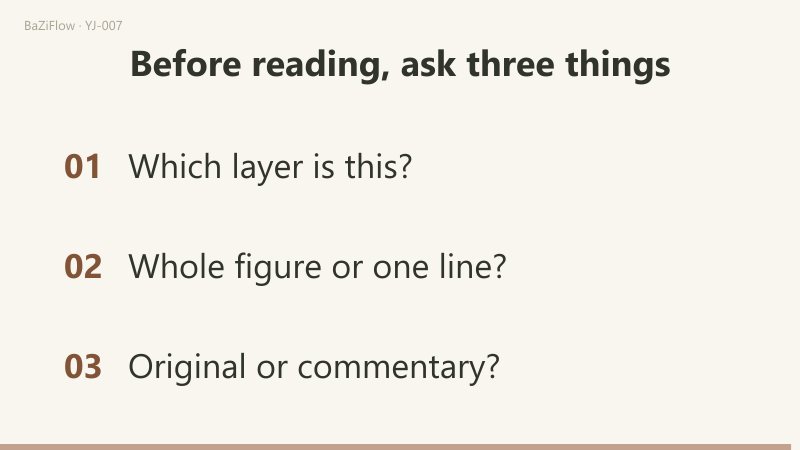
When a sentence from a hexagram turns up, do not rush to explain it. Place it in three steps: which layer it belongs to, whether it speaks to the whole hexagram or to one line, and only then what the words say. Some sentences will come from the commentaries rather than the original, the Commentary on the Judgments (彖传) or the Commentary on the Images (象传), so naming the layer comes first.
Enlarge diagram · scroll sideways to read
Name the layer
Judgment and line statements are the original text. What follows them, the Commentary on the Judgments or the Commentary on the Images, is a different layer that explains the original.
Fix the object
A Judgment speaks to the whole hexagram. For a line statement, take the line named at its start and count from the bottom: initial, second, third, fourth, fifth, top.
Then read the words
Only once the object is fixed do you read the wording, and you read it in place: the Judgment against the whole figure, a line statement against that one line in its lower and upper trigram.
In the table above, cover the last two columns and try the four sentences yourself. The first has no position word, so it faces the whole hexagram. The third carries the label Top Six, so it faces only the sixth line, the topmost in Tai. The fourth comes from the Commentary on the Images. It corresponds to line 1 but is not a line statement itself; it is a sentence from the explanatory layer.
Chapter 2 of the Xi Ci says that the gentleman, when at rest, "observes the images and savours the statements". Look at the image first, then take time over the statement. To savour a statement accurately you must know what it is attached to, so placement comes first and meaning second.
The explanatory layer, and where Liuyao parts ways
On the same page, the passages that follow the Judgment and line statements, opening with "the Judgment says" and "the Image says", are another layer. They explain the original text and are not themselves a Judgment or a line statement.
Enlarge diagram · scroll sideways to read
In Tai, the page sets out the Judgment and six line statements, then the Commentary on the Judgments, which opens with "the Judgment says", then the Commentary on the Images, which opens with "the Image says". These belong to the commentaries called the Yi Zhuan (易传), traditionally grouped as the Ten Wings (十翼); their own structure and reading belong to a separate article on the Ten Wings. Here the interest is only in how they attach to the original text.
The Commentary on the Judgments first repeats the Judgment word for word ("Tai: the small go, the great come; auspicious, and it prospers") and then goes on to explain it. The Commentary on the Images begins with one statement for the whole hexagram, which for Tai opens "heaven and earth interact; Tai", and only then hangs one statement after another beneath the individual lines. For Initial Nine, "pull up couch grass, its roots bringing up their companions; to set out is auspicious", the matching Image has just one sentence:
Pulling up the grass; to set out is auspicious: the aim lies outside.
"The aim lies outside" is a reason, and it sits outside the line statement, explaining Initial Nine. It is one way of putting things, written after the original text. It is worth consulting, but it is not the line statement itself, and when you quote it you should say it comes from the Commentary on the Images.
Move to Najia Liuyao and the same hexagram draws on different material. Liuyao has its own apparatus of assigned branches, the Self and Response lines and the Useful God, which is not the textual reading used for hexagram and line statements. How the two avoid standing in for one another is set out in the article on hexagram texts and Najia Liuyao.
Questions readers ask next
Can the Judgment and a line statement be read separately?
Yes, as long as each time you say which one you are reading and put it back with its object: the Judgment with the whole figure, a line statement with its own line inside the lower and upper trigrams. Separating them keeps the layers apart; it does not cut the text loose from the hexagram.
Is the Commentary on the Judgments the same as what the Xi Ci calls the Judgment?
No, they sit on different layers. The Xi Ci uses the character (彖) for the statement beneath a hexagram, which is how Kong Yingda explains it. The Commentary on the Judgments (彖传) is a separate text placed after the original, opening with the words "the Judgment says". The character is the same, so position and context decide.
Can reading the hexagram texts give a direct verdict on a question?
The texts do contain verdict words such as auspicious or without blame, but each belongs only to the statement it sits in and speaks of that hexagram or that line. Using one to answer a concrete question involves casting methods and interpretive rules in between, which other articles explain separately.
Was this article helpful?
Part of a learning path
Sources & references
Continue reading
The Sixty-Four Hexagrams: How Upper and Lower Trigrams Form One Figure ↗
Line positions: the six places, Nine and Six, and the sayings about them ↗