

Mercury: four signs, sign and house
Content version · · Sources & references
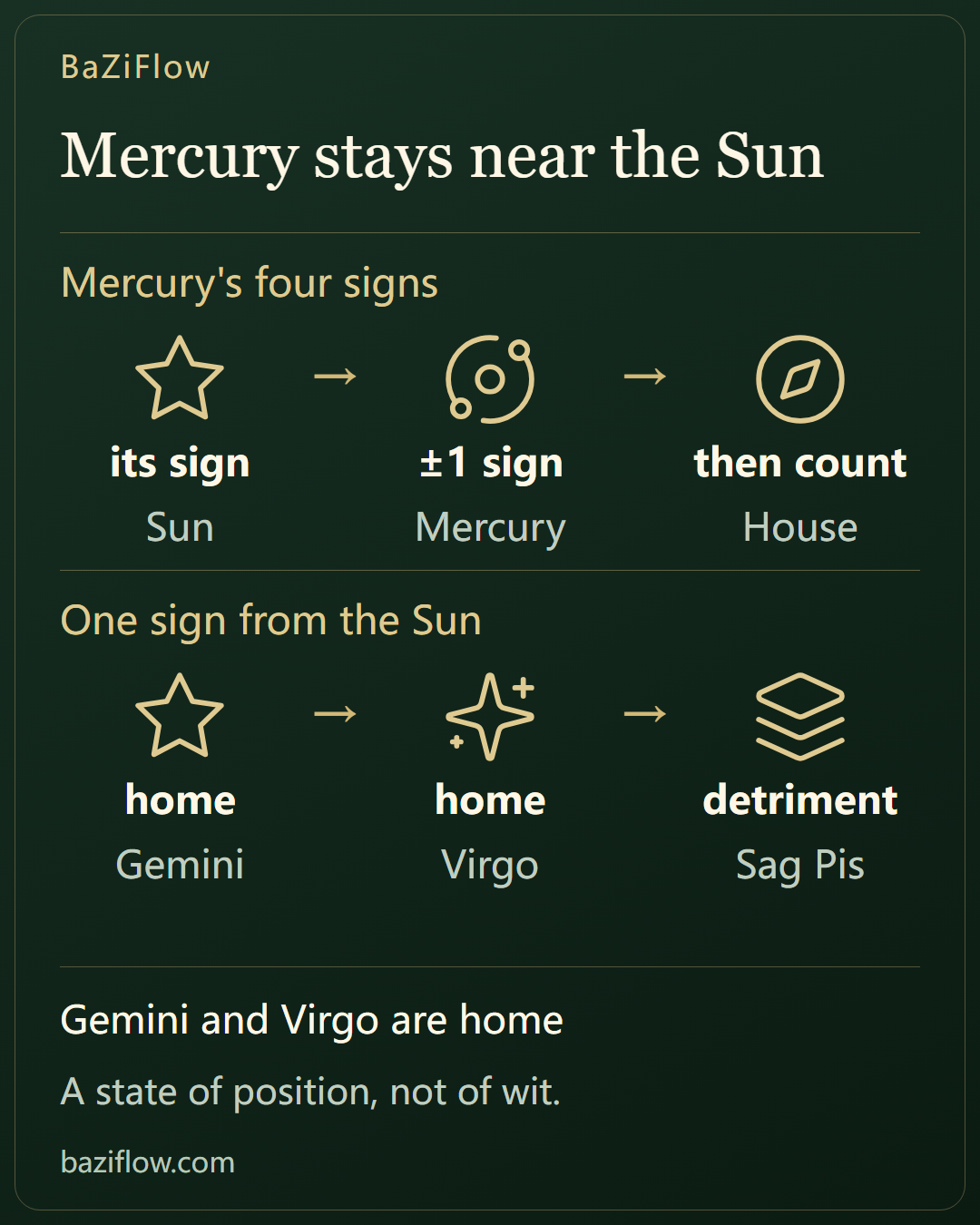
Mercury is in domicile in Gemini and Virgo and in detriment in Sagittarius and Pisces, with a second entry hidden in two. A table, Ptolemy's reasons, an engine-checked one-sign rule and house examples show the reading.
The short version6 min read
Mercury has two homes, Gemini and Virgo. Ptolemy says his orbit hugs the Sun and he never strays more than a sign from it, and the engine's daily scan of 1900 to 2100 finds only gaps of one sign or less. Once the Sun's sign is known, only three signs remain for Mercury.
- The classical table records four signs for Mercury: domicile in Gemini and Virgo, detriment in Sagittarius and Pisces. The engine's exaltation table adds Virgo and Pisces as exaltation and fall, but one state is shown per sign.
- Ptolemy calls Mercury sometimes dry and sometimes moist, each with equal force, and says he is diurnal when a morning star and nocturnal as an evening one; his homes are Gemini and Virgo because he sits nearest both lights and only those two signs remain.
- Over a daily scan of 1900 to 2100 the Mercury–Sun longitude gap peaks at 27.79 degrees and the sign difference is only −1, 0 or +1. In whole-sign houses Mercury therefore sits in the Sun's house or an adjacent one.
Read first
Personal, Social and Outer Planets: Use Groups as a Directory ↗
Two homes, two detriments, and two signs with a second entry
In plain words first: Mercury holds four signs in the site's classical table. Gemini and Virgo are home, Sagittarius and Pisces are detriment, and eight signs are blank.
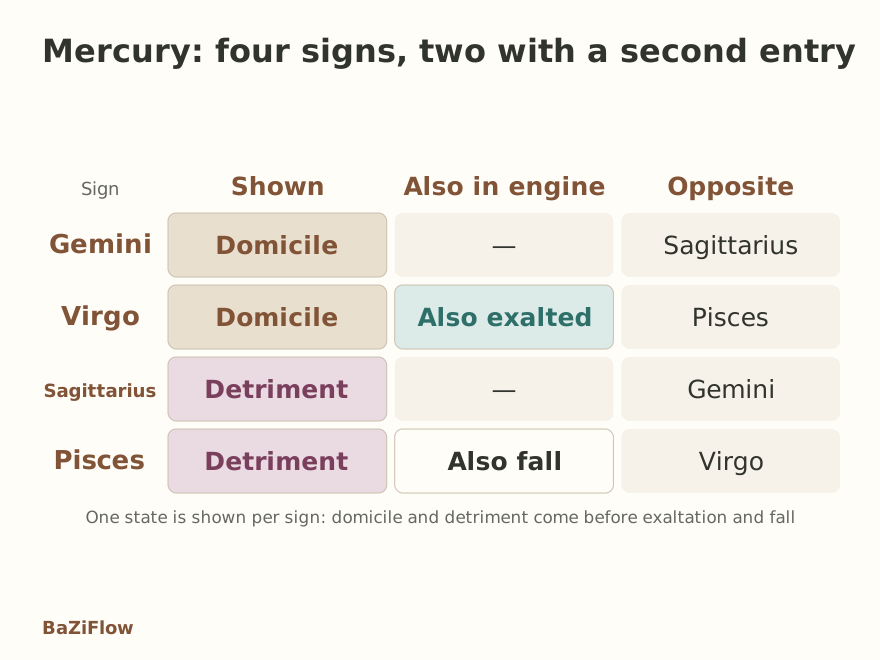
Comparison sketch: the first two columns are the state the site shows and the second entry the engine table hides; the right column gives the opposite sign.
The right-hand column shows the pattern: Sagittarius lies across from Gemini and Pisces across from Virgo, so each detriment is the opposite of a home. The middle column is the interesting one. In the engine's exaltation table Mercury is exalted in Virgo and in fall in Pisces, so Virgo carries both a home and an exaltation for him, and Pisces both a detriment and a fall.
Half moist, half dry: Mercury's nature turns with morning and evening
Ptolemy writes Mercury's nature differently from the others:
Mercury sometimes makes dryness and sometimes moisture, each with equal force. He draws off moisture and makes dryness because he is never far from the Sun; he makes moisture because he borders the Moon's sphere, the one nearest the earth. And since he keeps pace with the Sun so quickly, he swings rapidly between the two qualities.
That is why chapter 5 files him with the Sun among the "common" bodies, good or bad according to company (I.5), and chapter 6 calls him both sexes, since he has dryness and moisture in equal measure (I.6). Chapter 7 then ties this to the day. He is a morning star when he rises before the Sun at dawn, and an evening star when he sets after the Sun at dusk.
Enlarge diagram · scroll sideways to read
This day-or-night rule is unique to Mercury: the Sun is always diurnal and the Moon always nocturnal, while Mercury has to be checked for which side of the Sun he stands on.
Why Gemini and Virgo: the signs hugging the lights
Ptolemy assigns the signs working inward from Saturn, so Mercury comes last. His line for Mercury:
Mercury is never more than one sign away from the Sun, and his orbit lies below all the others, so he is nearest to both lights. The two signs left directly beside the homes of the lights, Gemini and Virgo, were therefore given to him.
Enlarge diagram · scroll sideways to read
The two short arcs are what "nearest" means: Gemini touches the Moon's home and Virgo the Sun's, while every other planet's homes lie farther off. For how the other five are laid out, compare the full table in the article on Leo.
Which sign Mercury is in: within one sign of the Sun
"Never more than a sign from the Sun" can be used directly as a filter. The engine scanned every day from 1900 to 2100 (at 12:00 UTC): the largest Mercury–Sun longitude gap is 27.79 degrees, and the sign difference takes only the values −1, 0 and +1. Turned around, each of Mercury's four signs fits only three possible Sun signs:
Enlarge diagram · scroll sideways to read
The table is symmetric: only with the Sun in those three signs can Mercury be in domicile or detriment. Once you have the Sun's sign, Mercury is down to three candidates and you need not hunt through a whole ephemeris.
Two exercises
Sun in Leo: can Mercury be in domicile?
Yes. Virgo is next to Leo, so Mercury can stand there; Gemini is two signs away from Leo and is out of reach.
Sun in Aries: can Mercury be in detriment?
Yes, in Pisces, which is next to Aries. Sagittarius is too far away.
Which house Mercury is in: the Sun's house or an adjacent one
In whole-sign houses the order of the signs turns straight into the order of the houses: Mercury within a sign of the Sun is within a house of the Sun.
Enlarge diagram · scroll sideways to read
Speaking of the first house, Lilly says Mercury rejoices there, because the house stands for the head and he for the tongue, fancy and memory. In the second row Virgo rises and Mercury is in Virgo: the sign table gives domicile, the engine's exaltation table adds an exaltation, and the house table gives Lilly's joy house. Three records from three tables, none of them strengthening another.
Two more exercises
Gemini rising, Sun in Cancer: which houses can Mercury occupy?
Houses 1, 2 and 3: the Sun is in house 2, and a sign either side of Cancer gives Gemini, Cancer and Leo, which are houses 1, 2 and 3.
Gemini rising, Mercury in Virgo: which house?
The fourth. Counting from Gemini, Virgo is the fourth sign; he is in domicile there but not in his joy house.
After Mercury comes Venus, whose leash is a little longer: Venus in sign and house lets her wander two signs from the Sun.
Questions readers ask next
Virgo is both Mercury's home and his exaltation. Why does the site show only "domicile"?
The lookup function returns one state per sign, in the order domicile, exaltation, detriment, fall. Virgo matches domicile first, so it shows domicile; Pisces matches detriment first, so it shows detriment. That is a display rule, and the exaltation and fall entries remain in the exaltation table.
Does Mercury in domicile mean people with Mercury in Gemini or Virgo are cleverer?
Domicile describes the state of Mercury as a body standing in those signs, so the subject is the planet. Ptolemy's reasons concern Mercury's orbit and nature, and the book draws no conclusion about the wit of anyone born.
Why do astrologers always say Mercury "never gets far from the Sun"?
It is Ptolemy's own statement and it agrees with the astronomy: Mercury's orbit lies inside the earth's, so seen from here he is at most a few tens of degrees from the Sun. In signs, that means the Sun's sign and the two next to it.
Was this article helpful?
Sources & references
- Ptolemy, Tetrabiblos Book I (F. E. Robbins text on LacusCurtius): planetary natures, houses, exaltations ↗
- Deborah Houlding, Traditional Sign Rulerships (2003) ↗
- William Lilly, Christian Astrology (1647), Of the Twelve Houses, pp. 50–56 ↗
- William Lilly, Christian Astrology (1647), Book I, Of the Planets (Saturn pp. 57–61, Jupiter pp. 61–65, Mars pp. 65–68, Sun pp. 69–71, Venus pp. 72–75, Mercury pp. 76–79, Moon p. 80ff; Cazimi p. 113) ↗
Continue reading
The Moon: Home in Cancer, Exalted in Taurus, and Why a Sign Change Needs the Clock ↗
Venus: Home in Taurus and Libra, Exalted in Pisces — Six Positions and a Two-Sign Rule ↗