

Qian (乾): three unbroken lines, fourteen images
Content version · · Sources & references
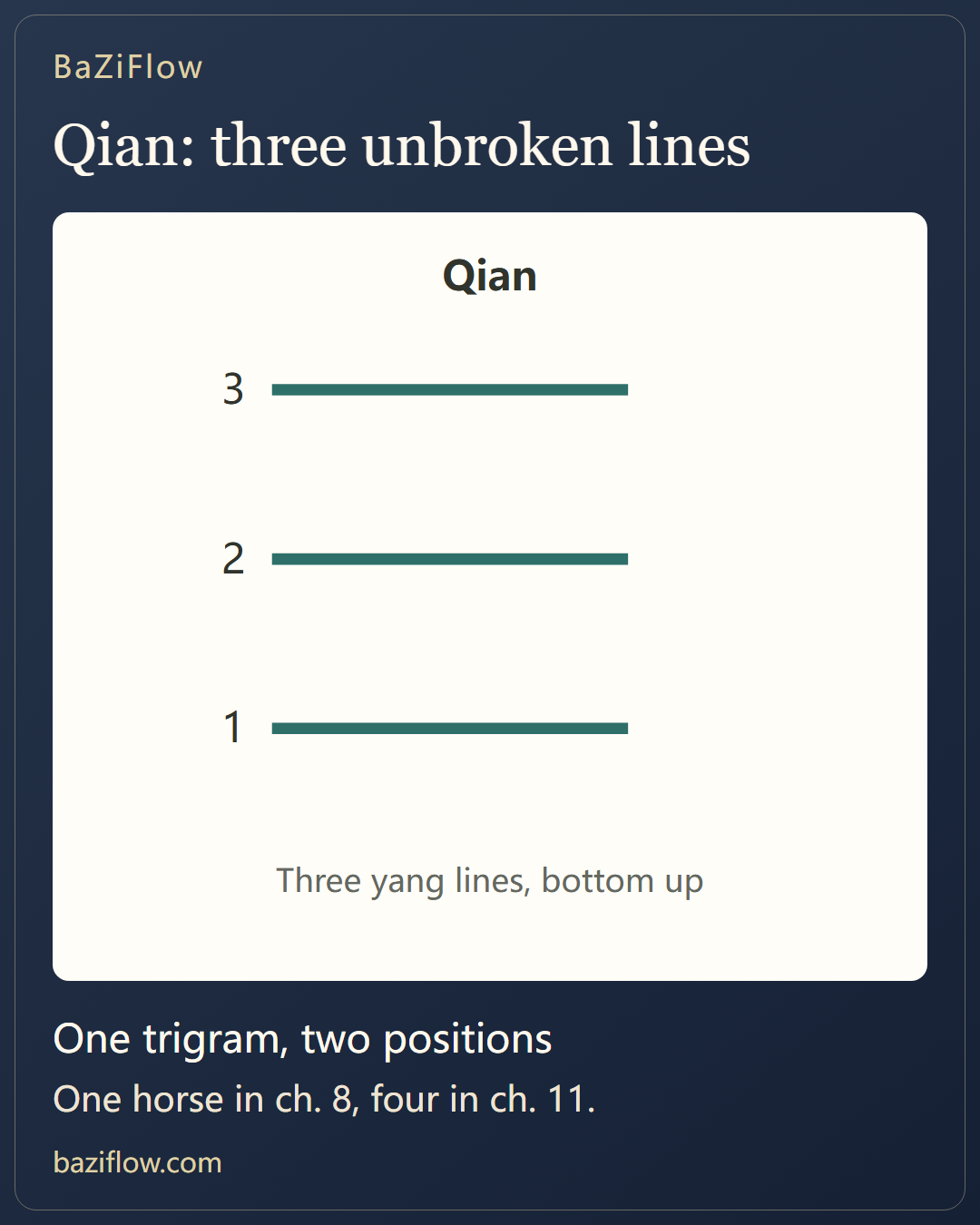
Qian is the trigram whose three lines are all yang. Read it in layers: its figure, the fourteen images of Shuo Gua chapter 11, its two positions on the later diagrams, and the fifteen six-line hexagrams it enters.
The short version6 min read
Chapter 11 of the Shuo Gua lists fourteen images for Qian in one unbroken run, four of them horses. The figure is three unbroken yang lines, and chapter 7 sums it up in one word, strength.
- Break one line of Qian and you meet a neighbor: the lowest line gives Xun, the middle gives Li, the top gives Dui.
- Chapter 11 sets heaven, ruler, father, jade, metal and ice beside a fine horse, an old horse, a lean horse and a piebald one: fourteen items in a row.
- Qian stands in the south on the Prior Heaven diagram and in the northwest on the Later Heaven one; chapter 5 says "they contend in Qian" and chapter 4 says "Qian rules them".
Read first
Eight Trigrams: Three-Line Structure and Basic Images, Read Through the Shuo Gua ↗
Three unbroken lines, and three neighbors one break away
Qian (乾) is the easiest trigram to draw: three yang lines stacked from the bottom, and none of them broken. A rhyme learned much later for remembering the shapes calls it "three joined", which is exactly what the picture shows.
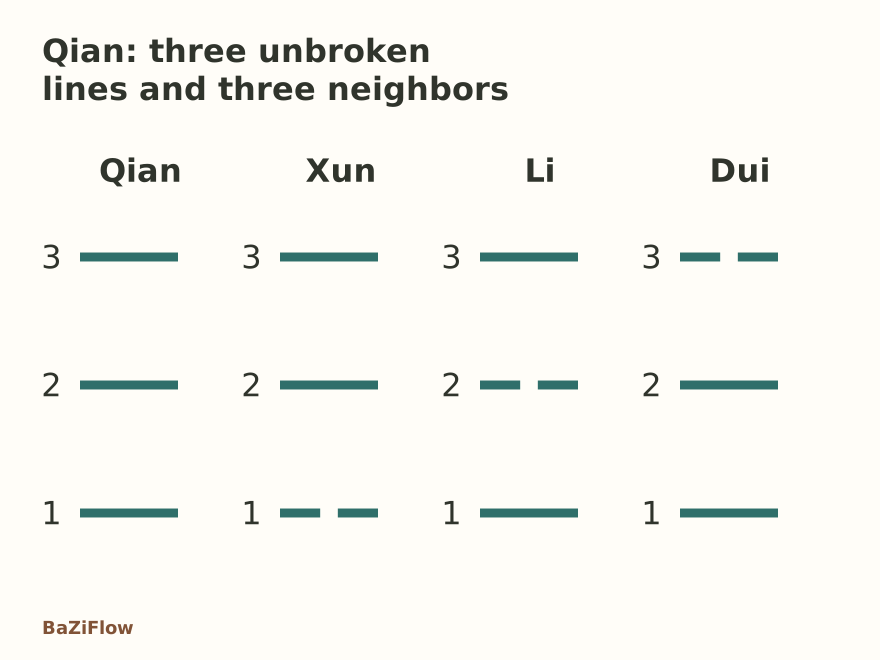
Qian and its three neighbors: each neighbor has one more broken line than Qian.
Change any one of the three lines to a yin line, a broken one, and you step to a neighbor. Break the lowest line and you have Xun (巽); break the middle line and you have Li (离); break the top line and you have Dui (兑). All three neighbors have two yang lines and one yin line. Chapter 7 of the Shuo Gua (说卦) describes them with the words entering, clinging and delight, while the word it gives Qian itself is strength.
Enlarge diagram · scroll sideways to read
In the number table used by Meihua (梅花易数), Qian comes first and counts as one when a number is turned into a trigram. That table is laid out in the Meihua primer.
Fourteen images, four of them horses
Chapter 11 of the Shuo Gua goes through the trigrams one at a time and lists their images. The other seven entries all break into clauses such as "of the ground" or "in people"; the entry for Qian has none and runs straight through:
Qian is heaven, roundness, the ruler, the father, jade, metal, cold, ice, deep red, a fine horse, an old horse, a lean horse, a piebald horse, the fruit of trees.
Count them and there are fourteen items, written side by side with no reason given for the order. The four rows below only make the list easier to read; the grouping is ours, not the text's:
Enlarge diagram · scroll sideways to read
The last row holds five items, and four of them are horses: fine, old, lean and piebald. Chapter 8 says only that Qian is a horse; chapter 11 splits that one entry into four sides of the same animal: a good horse, an aged one, a thin one, and one whose coat is mixed. The word for "round" is the old character for a circle, and it is the first item after heaven itself.
One in the south, one in the northwest
The same Qian stands in different places on two later direction diagrams. The Prior Heaven diagram follows the pairs of chapter 3, "heaven and earth fix their places, mountain and lake share their breath, thunder and wind press on each other, water and fire do not shoot at each other", and puts each pair at opposite ends: Qian in the south, Kun (坤) in the north.
Enlarge diagram · scroll sideways to read
The Later Heaven diagram follows the order of chapter 5, and the line that places Qian reads:
They contend in Qian. Qian is the trigram of the northwest. It speaks of yin and yang pressing against each other.
In chapter 5 the order is Zhen, Xun, Li, Kun, Dui, Qian, Kan, Gen, so Qian is the sixth stop, "contend" is the verb of that stop, and "pressing against each other" is yin and yang drawing close. Neither diagram is in the Shuo Gua itself. Only the Later Heaven position is written out in chapter 5; the Prior Heaven position was worked out by later readers from the paired sentences.
Above or below: the fifteen hexagrams
Qian can be stacked above or below any trigram, and Qian over Kun is a different hexagram from Kun over Qian. Of the eight partners, Qian takes the upper place once and the lower place once, but pure Qian counts only once, so the total is fifteen six-line hexagrams:
Enlarge diagram · scroll sideways to read
Read the table by position alone: keep the partner, move Qian to the other side, and the hexagram changes. Qian below and Kun above is Tai; Qian above and Kun below is Pi. The six-line Qian, hexagram 1, carries the Great Image "heaven moves with strength", which uses the same word for strength that chapter 7 gives the trigram. It is read in full in Qian, the hexagram.
The eight verbs of chapter 4, with Qian seventh
Chapter 4 names what each of eight things does. The first four sentences have natural things as their subjects, and no trigram name appears; from the fifth sentence on, the subjects are the trigrams themselves:
Thunder stirs them, wind scatters them, rain moistens them, the sun warms and dries them; Gen stops them, Dui pleases them, Qian rules them, Kun stores them.
Enlarge diagram · scroll sideways to read
The verb Qian receives is "rules", used as a verb: to govern the way a ruler does. The same word is a noun in the chapter 11 list ("Qian is the ruler"). One place gives what Qian does, the other gives what Qian is an image of. Qian is followed by Kun, whose verb "stores" is the counterpart of "rules"; to keep reading, go on to Kun, the earth trigram.
Questions readers ask next
Is the metal in "Qian is metal" the metal of the Five Phases?
Chapter 11 puts metal between jade and cold, as one item among fourteen. The Meihua table that files each trigram under a Phase also places Qian under metal. The two statements come from different texts, so say which one you are citing.
Is the three-line Qian the same as the first hexagram of the Zhouyi?
No. The Qian among the eight trigrams has three lines. The first hexagram of the Zhouyi is also called Qian, but it has six lines and is built from two Qians stacked. The name is shared; the structure and the texts are not.
Why does Qian sit in different places on the two direction diagrams?
The Prior Heaven diagram, made later, follows the pairs of chapter 3 and puts Qian in the south opposite Kun. The Later Heaven diagram follows the order of chapter 5 and puts it in the northwest. Each uses a different chapter, and neither diagram is in the Shuo Gua itself.
Was this article helpful?
Sources & references
Continue reading
Dui (兑): a gap at the top, and the word "delight" seven times in the Shuo Gua ↗
Trigram imagery: why a round clay bowl has two possible routes ↗