

Ten Evils and Great Defeat: ten days with a void emolument
Content version · · Sources & references
The Ten Evils and Great Defeat (十恶大败) are ten day pillars whose stem has its emolument on a void branch of its own group. Derived by script, with one list discrepancy and two opposite verdicts.
The short version10 min read
The Ten Evils and Great Defeat is a list of day pillars: ten of the sixty have a day stem whose emolument lands on a void branch of its own ten-day group. The site chart does not mark this star at present; what follows is the look-up from the classics.
- The definition is one sentence: the stem's emolument is one of the two void branches of the group. Running all sixty day pillars through a script gives exactly ten, which fall into six groups.
- The Sanming Tonghui list ends in a pillar that its own definition cannot produce, while the Yuan Bai Jing passage in the same chapter and the Xiejibianfang name the Yin Earth Ox day. This article follows the latter.
- The name is brutal, yet the verdicts pull in different directions: a good star in the chart turns it to good, the Yuanhai Ziping says it is not feared in a pattern, and a parallel line in juan 12 says it is greatly feared.
Read first
Symbolic Stars in BaZi: Check the Reference and Rule Before the Meaning ↗
Ten days that share one trait
The Ten Evils and Great Defeat (十恶大败) is a list of day pillars. Among the sixty stem-branch pairs, ten have a day stem whose emolument (禄) lands on a void branch of the ten-day group the day belongs to. Old books call them the Ten Evils days or the "no emolument" days. The site chart does not mark this star at present; below is the look-up from the classics, and the list itself was derived by a small script from the original definition.
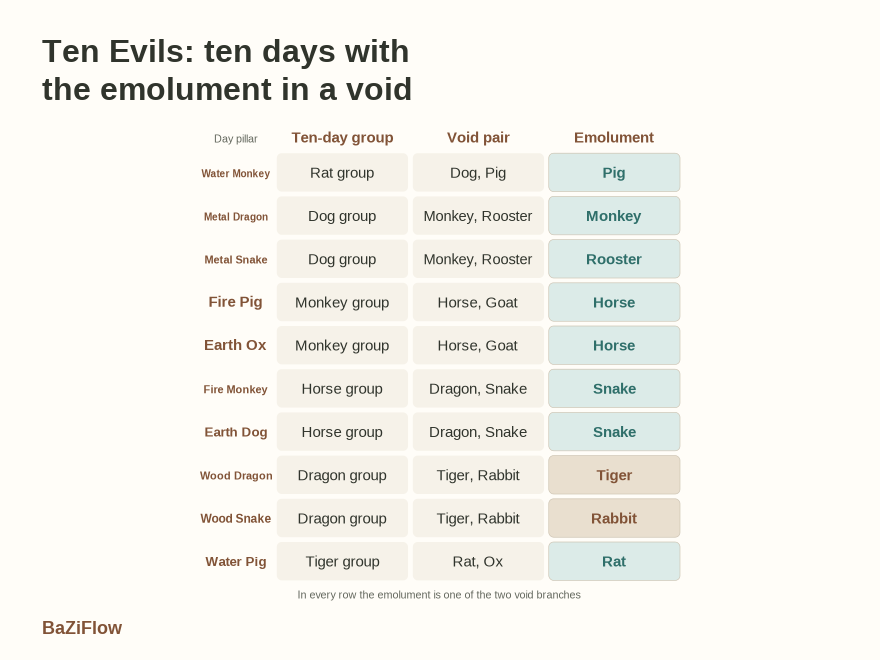
Look-up sketch: the ten day pillars by ten-day group; the middle column is the pair of branches that group never reaches and the right column is the emolument of the day stem. The Dragon-group rows use another tint because the filling example below concerns them. Derived by script from the Sanming Tonghui definition.
The ten day pillars are arranged by ten-day group. The emolument of a stem is its Build Emolument branch: Yang Wood on Tiger, Yin Wood on Rabbit, Yang Fire and Yang Earth on Snake, Yin Fire and Yin Earth on Horse, Yang Metal on Monkey, Yin Metal on Rooster, Yang Water on Pig, Yin Water on Rat. The void (空亡) of a group is the two branches left over when ten days are laid out. In all ten rows the emolument in the right column is one of the two void branches in the middle column.
The chapter "On the Ten Evils and Great Defeat" in juan 3 of the Sanming Tonghui (三命通会, a Ming-dynasty compendium) explains the name with two images and then gives the definition:
The Ten Evils are like a person who has committed the ten gravest crimes of the law, with no pardon; the Great Defeat is like a battle in which the army is routed and no one returns, a figure for the worst. Among the ten-day groups of the sixty cycle there are ten days on which the emolument falls into a void.
Running all sixty day pillars through a filter
Instead of memorizing, write the definition as a script: for each of the sixty day pillars take the emolument of the day stem and test whether it is one of the two void branches of the group. The result is exactly ten pillars in six groups, the same as the "no emolument days" list that juan 5 of the Xiejibianfang quotes from the Tongshu almanac (协纪辨方书, the Qing court almanac manual). Two of them are worked below; they sit in different groups and have a yang and a yin stem.
Enlarge diagram · scroll sideways to read
Stems that share an emolument branch show up together: Yang Fire and Yang Earth both have Snake, so Monkey and Dog days sit in the same Horse group; Yin Fire and Yin Earth both have Horse, so they share the Monkey group. That overlap is already in the table of stem emoluments.
One place where the books disagree
After the definition, juan 3 of the Sanming Tonghui lists the ten days, and the last one it names is Yin Wood Ox (乙丑). By the book's own definition that cannot be right: Yin Wood Ox belongs to the Rat group, whose void is Dog and Pig, and the emolument of Yin Wood is on Rabbit, which is not void. The same chapter goes on to quote the "Yuan Bai Jing", which reads "in a Yin Wood Goat year, beware the Yin Earth Ox day", and the Xiejibianfang list in juan 5 also has Yin Earth Ox.
Enlarge diagram · scroll sideways to read
The only grounds for this choice are the book's own definition and a second passage in the same chapter. Other editions were not consulted, so the choice is recorded here together with the discrepancy.
Juan 10 adds a different line, introduced with "one says": a stem one place above, such as Yang Wood meeting Yin Water or Yin Wood meeting Yang Wood, "is the Ten Evils and Great Defeat". That naming works from the relation between stems and is not the same method as the day-pillar list above, so it is left aside here.
The Yuan Bai Jing: narrowing ten days to year-by-year avoidance
The "Yuan Bai Jing" quoted in juan 3 narrows the ten days again. It says the ten evils are just ten days and that each year has its own to avoid, then pairs ten years with ten days. The meaning is that a day is avoided only when it clashes heaven and earth with the year pillar. The script checked all ten pairs: the stems of year and day always overcome one another and the branches always clash.
Enlarge diagram · scroll sideways to read
Juan 5 of the Xiejibianfang quotes the almanac handbook (Tongshu), which is close to the Yuan Bai Jing:
These ten days are called the "no emolument" days, also the Ten Evils and Great Defeat days; yet they are avoided only by each year and by birth sign, as a Yang Metal Dog year, and people born in it, avoid using a Yang Wood Dragon day.
That is the date-selection use. The editors' own commentary does not accept the narrowing to clashing years: it says one must ask whether the year or month fills the emolument, and it calls the rule that only the clashing year and the clashing birth sign avoid the day an "absurd and unintelligible" attempt to smooth things over. The Sanming Tonghui is about a birth chart, and there it says to look at the day pillar only: "take what is seen on the day as the standard and leave the rest out".
How bad is it? The books pull against each other
The name is heavy but the verdicts are not tidy. Set side by side, the sources show different centers of gravity:
Four lines about the verdict
Good stars turn it
The same chapter says those born under it are not all unlucky, and that when good stars support it and noble qi assists, it should be read as good.
Not feared in a pattern
It says the Ten Evils is not feared in a pattern and that meeting Wealth and Officer turns it into wealth and rank. Juan 12 has nearly the same line but writes "greatly feared".
Two ends
If it is real, a noble person becomes a general and a lowly one a bandit; it adds that the standard is what the Daoist canon records.
Filling removes the void
If the year, the month or the sun sits on Tiger, the Tiger emolument of a Yang Wood Dragon day is no longer void and the day is not a "no emolument" day; avoiding it regardless of year is rigid, and the clashing-year rule is called "absurd and unintelligible".
The two lines in juan 12 and in the Yuanhai Ziping differ in two places, "not feared" against "greatly feared" and "if it meets" against "if it joins" Wealth and Officer, with the rest identical. The site does not rule between them; it only records that the same sentence reads in opposite directions in two texts. In juan 7 the Xiejibianfang also criticizes a different usage that calls the Tiger hour of a Yang Wood Dragon day and the Rabbit hour of a Yin Wood Snake day "no emolument hours", which it likens to riding a donkey while looking for the donkey, because that hour is the day's own emolument.
Questions readers ask next
My day pillar is Yang Wood Dragon. Is that a Ten Evils day?
By the books' definition, yes: the Dragon group has Tiger and Rabbit void, and the emolument of Yang Wood is on Tiger. The Sanming Tonghui says to look only at the day pillar. Whether it counts also depends on whether the year or month fills Tiger, and the Xiejibianfang disagrees with the blanket reading.
How is this different from the ordinary void branches?
A void is the pair of branches a ten-day group never reaches, and any pillar may fall in one. The Ten Evils looks at the day pillar only and also requires the stem's emolument to be exactly one of those two branches, which leaves just ten days.
The book says "no pardon", so why does a later line say it is not feared in a pattern?
The opening of juan 3 uses a law and a battle as images of how bad it is to have no emolument to stand on. The same chapter then leaves room: with good stars supporting it, read it as good. The two lines work at different levels, and later writers often quote only one end.
Was this article helpful?
Sources & references
Continue reading
Metal Spirit: Three Hour Pillars, and the Other Metal Spirit of Direction Taboos ↗