

Screen executable times and directions first
Content version · · Sources & references
A fictional appointment window shows why departure, arrival and submission are separate events. Define the action, time zone, direction origin and feasible options before comparing traditional timing preferences.
The short version6 min read
A 09:15 departure plus forty minutes gives a 09:55 arrival. Ten further processing minutes move completion to 10:05. The chosen action changes feasibility. State the deadline, time zone and direction origin before comparing traditional chart preferences.
- Departure, arrival and completion are different timestamps tied to different criteria.
- Put source and local clocks on the same basis, including civil-date changes.
- A direction needs an origin and north reference; a route segment is not the destination bearing.
Read first
Solar Terms and Qimen Ju Numbers Are Different Layers ↗
Choosing a Qimen significator before looking for its palace ↗
The late option is still late
Suppose a location accepts arrivals between 09:00 and 10:00, and a teaching exercise assumes a forty-minute journey. Leaving at 09:30 produces a 10:10 arrival. A favorable traditional label would not change that arithmetic or extend the opening window.
This is the first useful distinction in a timing discussion: whether an option can satisfy the task is different from how a chosen tradition might classify its chart. The two questions should be answered in that order, with the assumptions visible.
| Departure | Assumed journey | Arrival | Feasibility in this exercise |
|---|---|---|---|
| 08:30 | 40 minutes | 09:10 | Inside the window |
| 09:15 | 40 minutes | 09:55 | Inside, with little spare time |
| 09:30 | 40 minutes | 10:10 | Outside the window |
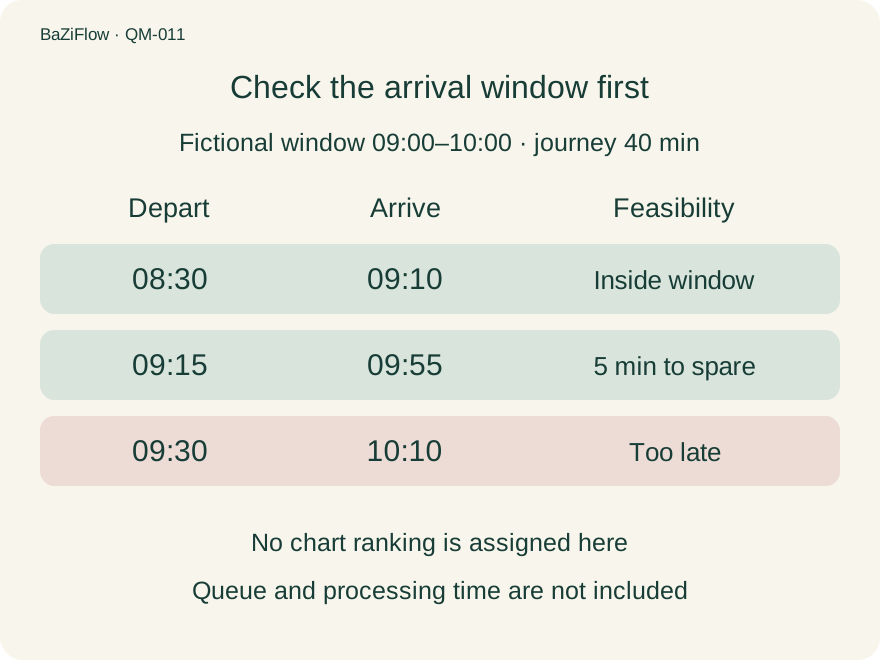
Original BaZiFlow feasibility exercise. The window and travel duration are invented assumptions, not live traffic or an actual office schedule. Candidate charts have not been calculated.
The first two rows are not ranked as more or less auspicious. No chart has been calculated for them. The example supplies neither a real date nor live traffic information; it simply screens a small candidate set against an explicit constraint.
Assumed arrival window 09:00–10:00
Which event are you actually trying to time?
Departure, arrival, beginning a conversation and submitting a document are different actions. If the question concerns the submission, a chart associated with leaving home is not automatically a chart for the same event. Name the action before selecting its timestamp.
The window in the exercise concerns arrival. If the actual requirement is to finish the process before 10:00, the table is insufficient: queuing and processing time must be added. A 09:55 arrival may provide only five minutes, and an unknown queue cannot be silently assigned a duration of zero.
Travel time is also an assumption here. In practice, uncertainty belongs in the record alongside the estimate. The decision to leave a margin is ordinary planning based on those conditions; it is not a fact discovered from a star or door name.
Some variables may be under the traveler's control, such as departure time or route. Others, including the recipient's availability and deadline, may not be. A traditional preference, if used as a personal cultural reference, has to operate within the feasible choices rather than pretending the fixed constraints can be changed.
Put the calendar source and your clock on the same basis
The Hong Kong Observatory's solar-term date and time page explicitly uses Hong Kong time, UTC plus eight hours. A displayed hour from that table cannot simply be copied onto a clock in another time zone and treated as the same instant.
This source supports the astronomical timestamp and its time convention. It does not endorse a Qimen interpretation. The later step of selecting a configuration belongs to the chosen chart method, which may require further rules in addition to the solar-term boundary.
For a candidate near a boundary, retain the original local date and time, time zone, equivalent instant and the effective time convention used by the method. Solar terms and configuration numbers explains why knowing the astronomical boundary does not by itself select every remaining chart setting.
Keep those settings consistent across candidates. Changing the convention only when another setting yields a more attractive result prevents a fair comparison. If a correction is necessary, label it and recompute the affected candidates under the corrected basis.
Hong Kong · UTC+8
- Jan 2 · 00:30
UTC
- Jan 1 · 16:30
A direction requires an origin and a meaning
“Go northeast” is incomplete without a starting point. Is the direction measured from the current location to the destination, from a home address, or within a room? Does it refer to a straight-line bearing or the first section of the route? Those are different spatial questions.
On a simple north-up local diagram, a point lying both east and north of point A is in A's northeast quadrant. Looking at the same destination from another origin C can give a different direction. A road that bends can also begin in a direction unlike the straight line from A to the destination.
Tong Zong's introductory notes include a method that enters the chart through the direction from which information is received. This helps explain why a direction can be an input in the tradition. It does not remove the need for an origin, north reference and accessible route in a modern itinerary.
A chart drawn with south at the top should not be read as though it were a north-up map. Establish the orientation before transferring a location between representations. A symbolic direction does not create access to a place that is closed or unreachable.
North ↑
y=2
- x=0
- ·
- x=1
- ·
- x=2
- C
y=1
- x=0
- ·
- x=1
- B
- x=2
- ·
y=0
- x=0
- A
- x=1
- ·
- x=2
- ·
B is NE of A, SW of C; schematic points; dots: no marked point
Preserve what was excluded and what was actually done
Fix the candidate set and the action under comparison before reviewing the results. If a candidate is excluded because it arrives late, record lateness as the reason. Recasting that ordinary scheduling failure as a successful chart prediction would blur evidence from two different sources.
The eventual action may also differ from the plan. A delayed departure, changed destination or later submission should remain visible in the review. Do not select whichever timestamp best matches the outcome after the event and call it the original choice.
Recording and reviewing a chart develops that distinction between plan, configuration and outcome. A bounded candidate set is more reviewable than repeatedly changing times and directions until a pleasing interpretation appears.
The result of this process is a clear set of executable options and declared traditional assumptions. Feasibility does not guarantee success, and a favorable label does not override the opening window, route or unresolved information. Keeping those boundaries explicit makes the discussion usable for the actual action being considered.
Planned
- Action and intended time
Actual
- Action and observed time
Questions readers ask next
Why can an on-time arrival still miss the task?
A completion deadline requires queue and processing time too. Arriving at 09:55 establishes presence, not that submission has already finished.
Does arriving exactly at 10:00 pass?
The window must specify whether its endpoint is included. Keep a boundary candidate pending until that rule is known rather than silently treating it as feasible.
Why does the direction change when destination B does not?
Direction is a relation from a stated origin to B. A new origin can change it, while a route’s first segment is a different measurement. Name which relation is being compared.
Was this article helpful?
Theme: Timing & action
Sources & references
Continue reading
Record a Qimen chart so that a later correction can be traced ↗