

Queen of Swords: sword up, hand out
Content version · · Sources & references
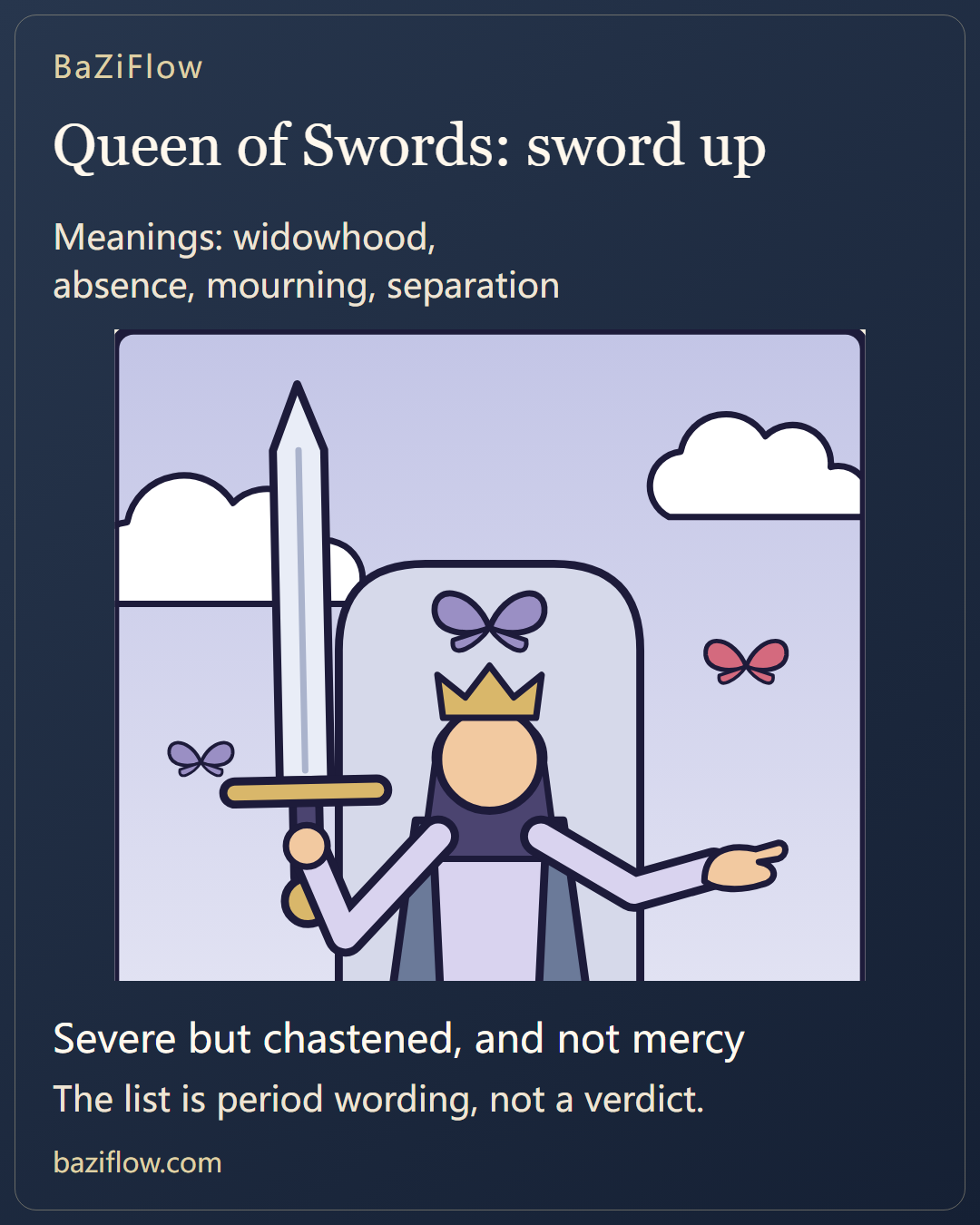
The Queen of Swords keeps a sword upright and reaches out with her other hand, severe but chastened. Separate the picture, a list made of absences and the reversed words, then practice a firm markup with reasons.
The short version7 min read
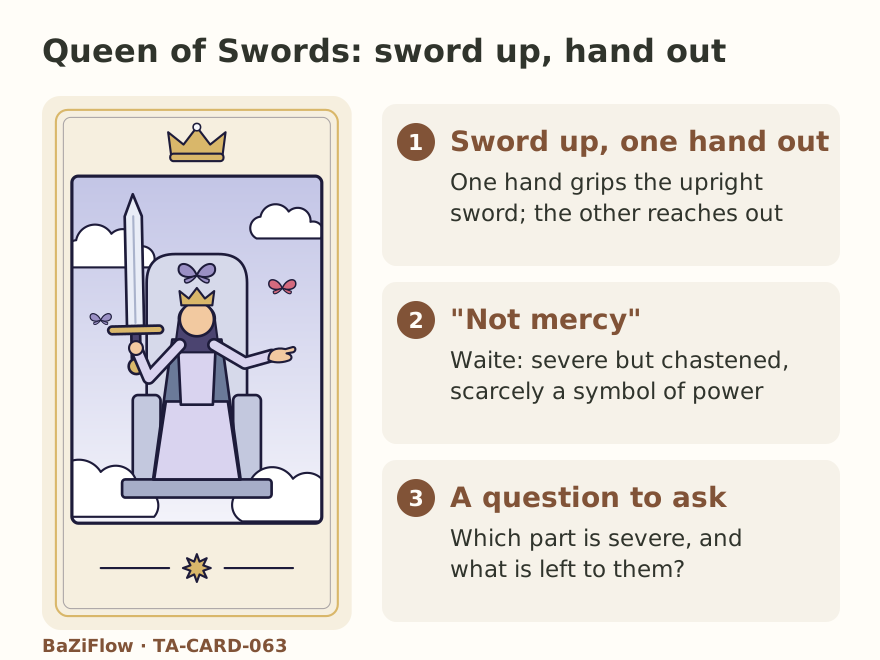
The Queen of Swords stands her sword upright beside her and reaches out with the other hand. Half of Waite's description says what she is not, and his word list is almost all about what is missing.
- Waite's description: her right hand raises the sword vertically with the hilt on an arm of the chair, the left hand is extended with the arm raised; the face is severe but chastened, suggesting familiarity with sorrow.
- He says outright that she does not represent mercy and, sword notwithstanding, is scarcely a symbol of power. The list (widowhood, sadness and embarrassment, absence, sterility, mourning, privation, separation) is nearly all about lack.
- The reversed list turns to intent: malice, bigotry, artifice, prudery, bale, deceit. The extras give only "a widow", and reversed "a bad woman, with ill-will", both period wording.
Read first
Start with the picture: one hand keeps the sword upright, the other reaches out
Waite begins with the hands. Her right hand raises the weapon vertically and the hilt rests on an arm of her royal chair; the left hand is extended, the arm raised. Then the face: severe but chastened, suggesting familiarity with sorrow. Two negations follow: it does not represent mercy, and, her sword notwithstanding, she is scarcely a symbol of power.
BaZiFlow original Queen of Swords
The original Rider-Waite-Smith card shows the queen in profile on a high stone chair, crowned, with a straight blade that rises well above her crown. Her raised left hand is open, palm outward; the front of the chair carries a carved child-like face; behind her are banks of cloud, a dark tree at lower left and a small bird in the sky. Three layers: the sword stays upright, the hand reaches out, the face holds its feeling in.
Enlarge diagram · scroll sideways to read
What Waite lists: a list made almost entirely of absences
The divinatory meanings read: widowhood, female sadness and embarrassment, absence, sterility, mourning, privation, separation. Sort them and nearly every word says that something is missing: a person is gone, something that should be there is not, and the feelings that follow.
Widowhood, female sadness and embarrassment, absence, sterility, mourning, privation, separation.
Enlarge diagram · scroll sideways to read
The extras have only two lines for this card: upright, "a widow"; reversed, "a bad woman, with ill-will towards the Querent". Both are old person-style readings, set here for comparison.
Two negations and one expression: what Waite actually draws
Half of Waite's portrait is made of what she is not: the face is "severe but chastened"; it "does not represent mercy"; and "her sword notwithstanding, she is scarcely a symbol of power". All three move aside the two impressions a reader reaches for first: the cold judge, and the queen who holds power.
Three lines, and what each is for
- Severe but chastened
- Waite's own words. "Chastened" carries the sense of being worn down by hardship and held in, so the face is stern without being fierce.
- Not mercy, scarcely power
- Waite says it outright. She is not there to console; nor does he write her as one who gives orders. Here the sword is just what she has to hand.
- The extended hand
- Waite writes only "the left hand is extended, the arm raised" and does not explain it. Reading it as "handing the choice to the other person" is a modern teaching borrowing.
Enlarge diagram · scroll sideways to read
Reading "severe but chastened" as "strict, with measure" and the open hand as "handing the choice back" lets the card become questions you can put to a particular task. They are borrowed readings, and the next section marks them as such.
How to read it: a red pen and an open hand
The card comes with a shape of three things: the sword upright, the face held in, the hand reaching out. Carried to proofreading and editing, they become three habits when you mark up someone else's draft.
Sword upright: name the exact spot
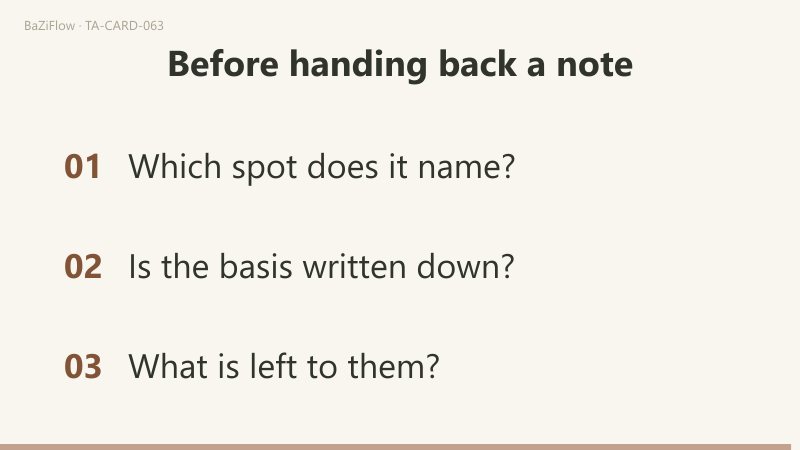
The blade stays vertical and is not swung. A note points to a page, a line, a word, and deals only with what can be pointed to; "the whole thing feels off" is not yet one spot.
Face held in: firm, with the basis shown
Cut what has to be cut, without cushioning it, but write one line of basis beside each cut: house style, a figure, an earlier paragraph. The tone lands on the draft and not on its author.
Hand out: give the decision back
Waite does not explain this hand. In teaching it can be read as offering the choice: attach an alternative wording or a question to each note, and let the author decide.
An example: a volunteer editor receives a draft for a neighborhood book club newsletter. One sentence says "our collection holds a hundred thousand volumes", while the annual count is eighty thousand. See how her notes carry the three habits:
Enlarge diagram · scroll sideways to read
Two ways to write a note
A note with a basis
- Names page and line
- States the basis
A note with only an attitude
- "This does not work"
- "Too wordy"
Add this
- Offer an alternative
- Let the author decide
Reversed, and cards that share her seat: from "lack" to "intent"
Waite's reversed list for the Queen of Swords is: malice, bigotry, artifice, prudery, bale, deceit. Set against the upright list, the center moves: upright describes what is missing in a situation; reversed describes faults in a person's intent.
Enlarge diagram · scroll sideways to read
Three cards that also keep company with sorrow and swords
Lamenting on her bed
Waite shows a woman lamenting on a couch under hanging swords, a sorrow like no other he says, a card of utter desolation; the queen's face is one familiar with sorrow, and held in.
Hoodwinked, two swords on her shoulders
Waite writes a hoodwinked woman balancing two swords, with a list of conformity and equipoise, courage; on the original card the queen looks straight out, her sword beside her and a hand reaching.
Another queen, one who sees cups
Waite says she sees, but also acts, and her activity feeds her dream; her list is devotion, wisdom, kindly service. Also seated, but the Queen of Swords' list settles on loss and separation.
Questions readers ask next
Is the Queen of Swords a cold, heartless card?
Waite writes a face that is severe but chastened, and says she does not represent mercy; words such as malice and deceit appear only in the reversed list. The upright list speaks of losses and gaps, and no word in it says she means harm.
Can "a widow" in the extras still be read that way today?
It is old wording that treats the card as a person with a status. In teaching it is more often read as a situation and a stance: after a loss, speaking little and plainly, seeing clearly. The card gives no ground for judging any real person's marital status.
What does her outstretched hand mean?
Waite only writes "the left hand is extended, the arm raised" and does not explain it. Some read it as "handing the decision back to the other person"; that is a teaching borrowing and should be labeled as one.
Was this article helpful?
Sources & references
Continue reading
Knight of Swords: a full-speed charge, and no enemy in the picture ↗
King of Swords: a drawn sword, a seated man, and power that comes from the office ↗