

A stellium in one house: where the number comes from
Content version · · Sources & references
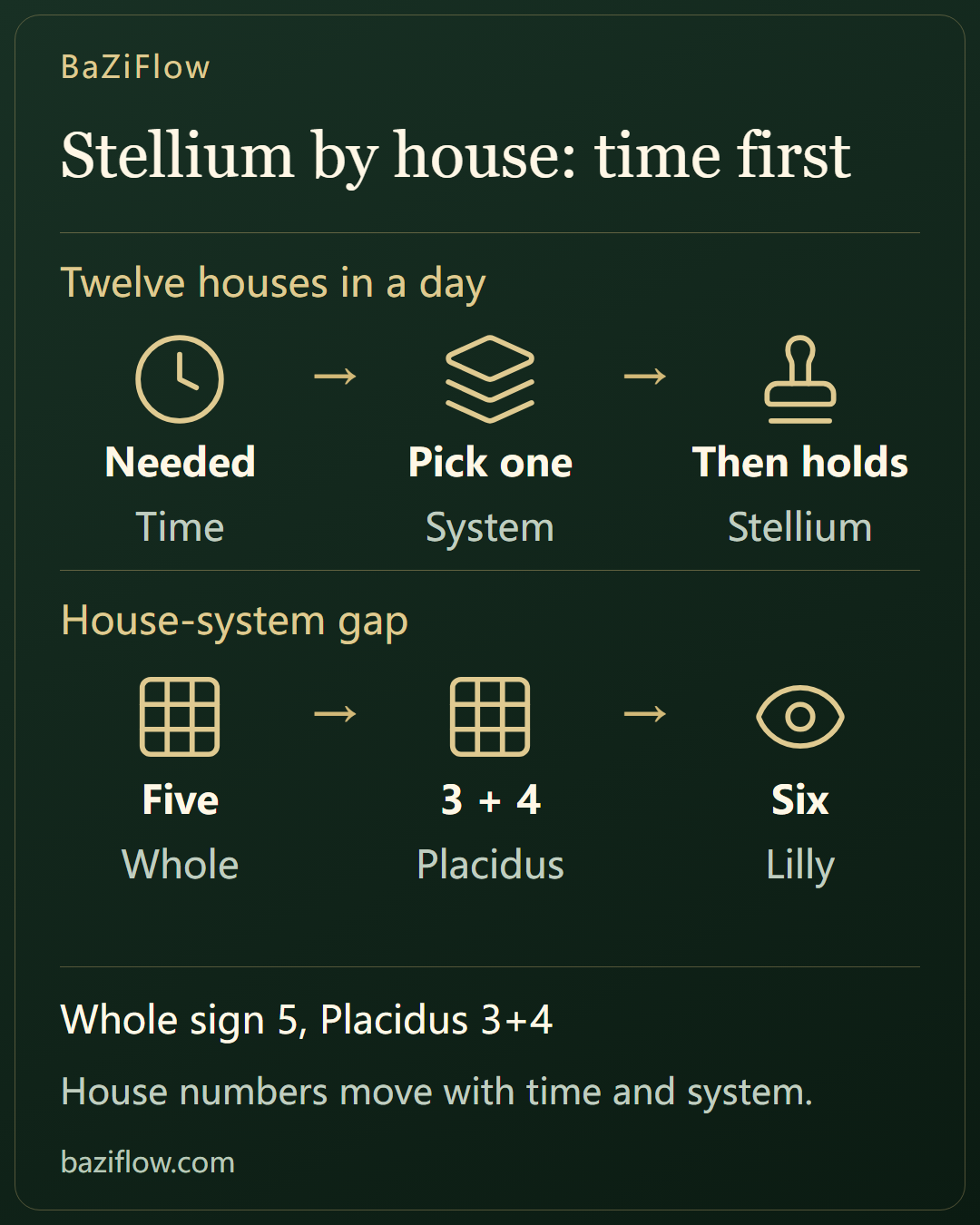
A house stellium is three or more planets in one house and needs a birth time. One London day in 2000 across twelve houses, and the 3 + 4 gap between whole sign and Placidus, show how house numbers change it.
The short version6 min read
A house stellium is three or more planets in one house, counted like a stellium in a sign with house in place of sign; the house number comes from birth time and house system, and with no time there is none.
- Under whole-sign houses a house stellium is the same set of planets as a sign stellium, with house numbers attached. In London on 5 May 2000 five bodies in Taurus visit all twelve houses in a day, each for 52 minutes to 2 hours 50 minutes.
- At one moment, 07:00 UTC, whole sign counts one stellium of five; the Placidus cusp at 15°28′ Taurus cuts it into three in the 11th house and four in the 12th.
- With no birth time there is no Ascendant, and the whole chain of house numbers goes missing; above 66° of latitude Placidus has no solution and the site falls back to whole sign and says so.
Read first
One sky, twelve houses taking turns
In plain words first: a house stellium is three or more planets in one house, counted like a stellium in a sign with house in place of sign.
A house needs a cusp, and a cusp needs an Ascendant, so a birth time is the precondition. The site defaults to whole-sign houses: the whole sign holding the Ascendant is the 1st house, and each following sign is the next house.
Take 5 May 2000. That day Venus, Mercury, the Sun, Jupiter and Saturn were all in Taurus, with the Moon and Mars just across in Gemini. Place the chart in London (latitude 51.5°, longitude 0°) and look first at 07:00 UTC:
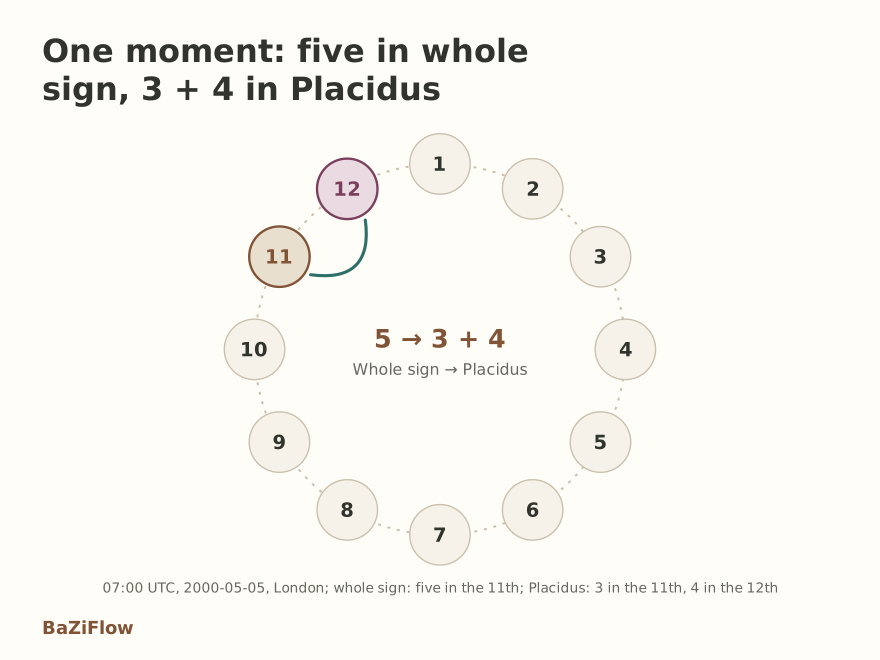
Ring of the twelve houses: 07:00 UTC on 5 May 2000 in London; the 11th and 12th are marked, and the counts are the results under the two systems.
Under whole-sign houses all five are in the 11th house, while Placidus cuts them into groups of three and four, which the next section looks at.
Now move the clock. The five stay in Taurus while the Ascendant keeps turning, and their house number changes with it:
Enlarge diagram · scroll sideways to read
Within one day all twelve houses take a turn: the shortest stretches are the 2nd and 3rd houses at about 52 minutes each, and the longest the 7th through 10th at about 2 hours 50 minutes each. Under whole sign the house stellium has exactly the members of the stellium in the sign, and only the house number changes, a number that rests entirely on an accurate birth time.
The cusp cuts the five apart
At 07:00 the Placidus 12th cusp is at 15°28′ Taurus and the Sun at 15°05′, only 23′ short of it. Three ways of counting give three results:
Enlarge diagram · scroll sideways to read
The third column comes from a sentence in Lilly's 1647 book, where he explains how to set up a chart:
If a planet stands within five degrees of the cusp of any house, its force is assigned to the house whose cusp is nearest to it.
By that rule the Sun, 0°23′ from the 12th cusp, and Mercury, 4°57′ from it, both go to the 12th house; with the Moon, Mars, Jupiter and Saturn that makes six, and the 11th is left with Venus. The site does not use the rule and looks only at which two cusps the longitude falls between. For one sky, the three methods count one, two and one stelliums, and the members of the three differ.
A house can be wider than a sign
Whole-sign houses are exactly 30° each. Placidus widths vary with latitude and time, and at London at 07:00 they are:
Enlarge diagram · scroll sideways to read
The 11th and 12th houses are 46° to 48° wide, more than a whole sign. Under Placidus, then, the members of a house stellium and a sign stellium no longer match one to one: in the 12th-house group above sit the Moon and Mars, which belong to Gemini by sign, and they share a house because the cusp falls in the middle of Taurus.
Two ways the house number goes missing
A house stellium needs a house number, and that number can break in two places:
Enlarge diagram · scroll sideways to read
A chart with an unknown time gets no half set: no Ascendant, no cusps and not one planet with a house number, only its signs. How birth time shapes the whole chart is in why birth time and place change a chart; the difference between the two house systems is in why house systems give different houses.
Two exercises
London at 11:00 UTC on 5 May 2000, rising sign 16°56′ Leo. In which whole-sign house are the five Taurus bodies?
Counting from Leo as the 1st house, Taurus is the 10th, so all five are in the 10th, matching the 09:25-12:15 row above.
On a chart with an unknown birth time five planets share Taurus. Is there a house stellium?
No. With no Ascendant there are no house numbers; only a stellium in the sign can be named.
Confirm the birth time first
With no reliable time there is no house stellium to count.
Name the house system
Whole sign and Placidus can differ by a whole stellium, so the record should say which one was used.
Look at the cusps
When a planet sits minutes or a few degrees from a cusp, another counting method can move it to another house.
With the count settled, go on to what the house is about: the 11th house and the 12th house are the two houses of the example above.
Questions readers ask next
How does a house stellium differ from a sign stellium?
The grouping key differs. A sign stellium asks which sign a planet is in, a house stellium asks which house, and the second needs an Ascendant and cusps first. Under whole sign the two sets agree; under Placidus they can differ.
Which house does a planet near a cusp belong to?
The site looks only at which two cusps the longitude falls between. Lilly has another practice: a planet within 5° of a cusp has its force given to the house whose cusp is nearest. The site does not use it, so the two ways of counting can return different results.
Can I read a house stellium if my birth time is uncertain?
Without a reliable time there is no reliable Ascendant, so house numbers have no basis. Only the stellium by sign is available, since planets' signs do not depend on birth time.
Was this article helpful?
Sources & references
- Swiss Ephemeris documentation, §6: angles and house systems ↗
- Astrodienst — A Brief Introduction to Astrology: Houses ↗
- IANA Time Zone Database: historical civil-time rules ↗
- William Lilly, Christian Astrology (1647), Of the Twelve Houses (cited for the passages named in the text; chapter and page cross-check pending) ↗
Continue reading
A Stellium in One Sign: How to Count It and Read It, From Six Bodies in Aries in 2026 ↗