

Wonders in the tomb: table first, palace second
Content version · · Sources & references
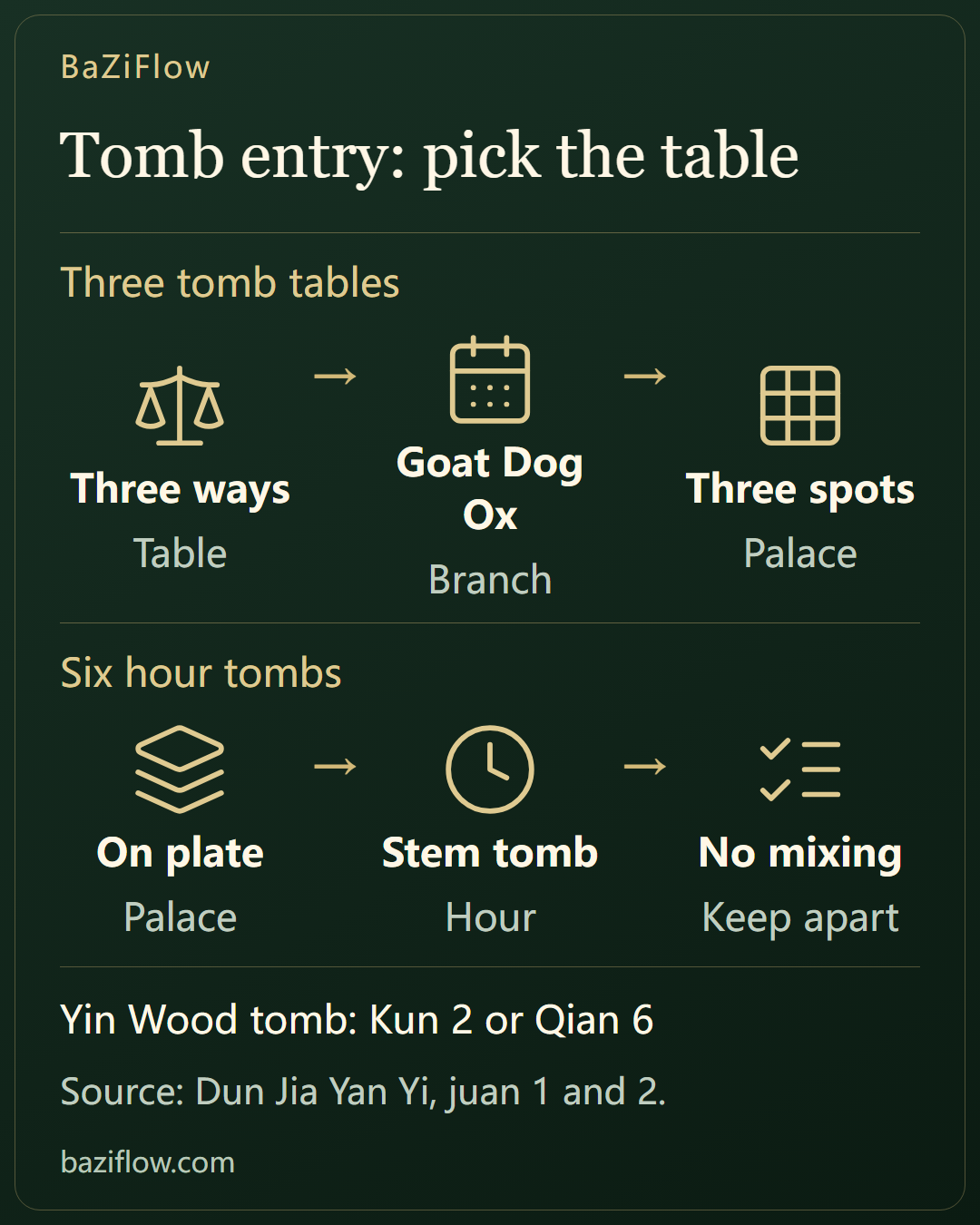
Before checking a palace, choose the tomb table: the book gives Yin Wood at Kun Two, Yang Fire at Qian Six and Yin Fire at Gen Eight, and two other tables disagree. Then the six hour tombs and one worked case.
The short version9 min read
The Three Wonders entering the tomb (三奇入墓) means Yin Wood, Yang Fire and Yin Fire standing on their tomb spots; the hard part comes earlier, in which table gives the spot, and the book's three rows match no single whole table.
- Four passages point to one three-row list: Yin Wood tombs at Goat in Kun Two, Yang Fire at Dog in Qian Six, Yin Fire at Ox in Gen Eight; the juan 1 verse leaves out Yin Fire, and the juan 2 verse gives Yang Fire a tomb branch but no palace.
- The Goat for Yin Wood follows the element-treasury rule and the Ox for Yin Fire follows the yang-forward yin-reverse rule, so no single whole table yields all three rows.
- Hour-stem tombs are a separate kind that looks at the pillar of the hour itself: Bing Xu, Ding Chou, Wu Xu, Ji Chou, Ren Chen and Gui Wei, matching this site's twelve-stage table one by one.
Read first
Choose the tomb table first: one Yin Wood wonder, two tomb places
Before asking "which palace", the Three Wonders entering the tomb need an earlier question answered: which table supplies the tomb.
The Three Wonders are Yin Wood, Yang Fire and Yin Fire, and each has a tomb, one stop on the twelve life stages (the whole table is in the tomb stage of the twelve life stages). Three ways of getting it can be set side by side: Wang Zhang's three rows in the book; the twelve-stage table in which yang stems run forward and yin stems backward, which is the table in this site's BaZi engine; and one shared treasury per element, Goat for Wood, Dog for Fire and Earth, Ox for Metal, Dragon for Water. All three give Dog for Yang Fire, and they split on Yin Wood and Yin Fire:
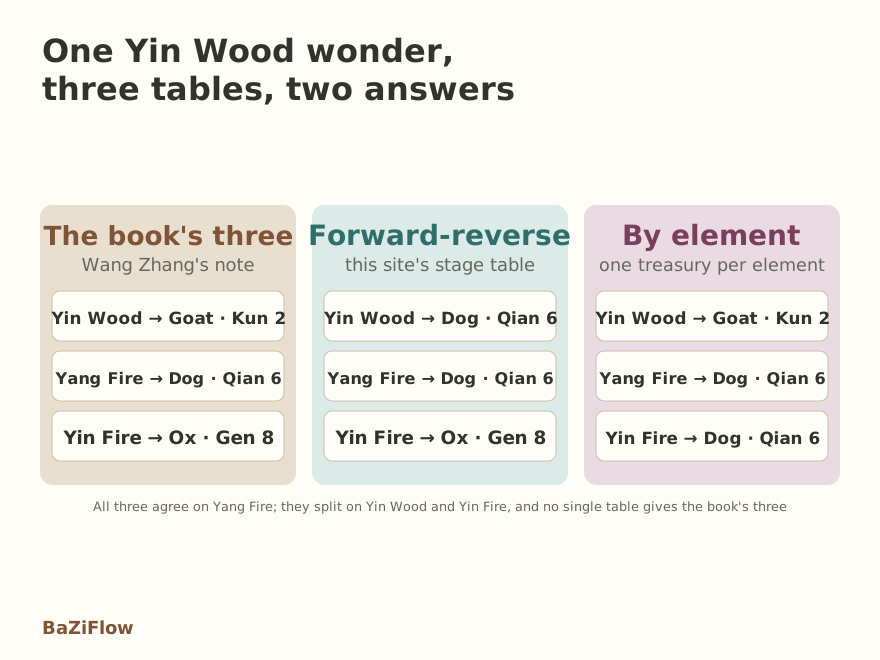
Three tomb tables side by side: the book's three rows come from Wang Zhang's note in juan 2 of Dun Jia Yan Yi, the forward-reverse table is this site's twelve-stage table, and the element treasuries are Goat, Dog, Dog, Ox and Dragon for Wood, Fire, Earth, Metal and Water.
The book puts Yin Wood at the Goat (Kun Two), which agrees with the element treasury but not with the Dog the forward-reverse table gives; it puts Yin Fire at the Ox (Gen Eight), which agrees with the forward-reverse table but not with the Dog of the Fire treasury. In other words no single whole table yields the book's three rows, and each row looks as if it took its own road.
Four passages, one three-row list
The book points a wonder to its tomb in more than one place. Side by side:
| Passage | Yin Wood | Yang Fire | Yin Fire |
|---|---|---|---|
| Verse in juan 1 | at the second | fire's tomb is Dog; Moon wonder at the sixth | not written |
| Verse in juan 2 | at the Goat | fire's tomb is Dog | Star wonder at the eighth |
| Juan 2, Wang Zhang's note | second palace | sixth palace | eighth palace |
| Juan 2, the quoted classic | at Kun | above Qian, on the Dog | toward the Ox |
The four never disagree and all land on the same three rows: Yin Wood in Kun, Yang Fire in Qian, Yin Fire in Gen. The only differences are gaps in the two verses: juan 1 has Yin Wood at the second palace and the Moon wonder (Yang Fire) at the sixth but says nothing of Yin Fire; juan 2 has Yin Wood at the Goat and the Star wonder (Yin Fire) at the eighth, while Yang Fire gets only "fire's tomb is Dog" and no palace; Wang Zhang's note gives all three as palace numbers. In the note the three wonders, Yin Wood, Yang Fire and Yin Fire, are called the Sun, Moon and Star wonders in that order.
The tombs of the Three Wonders: the Sun wonder Yin Wood lands in the second palace, the Moon wonder Yang Fire reaches the sixth palace, the Star wonder Yin Fire lands in the eighth; that is what is meant by the Three Wonders entering the tomb.
From tomb branch to palace: where Goat, Dog and Ox land
Each tomb is first a branch and then, through the later-heaven trigram arrangement, a palace: the Goat is in Kun (the Monkey shares it), the Dog is in Qian (the Pig shares it) and the Ox is in Gen (the Tiger shares it).
Enlarge diagram · scroll sideways to read
These three palaces carry other position labels too: Kun Two is where Yin Earth takes its punishment, Gen Eight where Yang Metal does, and Qian Six hosts none (see what makes six-instrument strike punishment hold). One palace can be several kinds of position at once, and each label is counted by itself.
The other kind of tomb: six pillars of the hour
The second half of the verse changes the object:
There are also hour stems that enter the tomb: in a chart the hour below must be avoided: Wu Xu, Ren Chen and also Bing Xu, Gui Wei, Ding Chou are alike unlucky.
This kind looks at the stem and branch of the very hour the chart is cast for, and has nothing to do with the palace a wonder stands in. In the note Ge Hong adds Ji Chou and gives a reason for each: for Bing Xu "the stem is yang fire, whose tomb is the Dog", for Ding Chou "the stem is yin fire, whose tomb is the Ox", for Gui Wei "the stem is yin water, whose tomb is the Goat"; Earth follows Fire because "Yang Earth is born with Yang Fire at the Tiger, Yin Earth with Yin Fire at the Rooster".
Enlarge diagram · scroll sideways to read
The six hour tombs, grouped by tomb branch
Dogtomb branch
Oxtomb branch
Dragontomb branch
Goattomb branch
Checked against this site's twelve-stage table, the hour stem's tomb in each of the six is exactly the branch of the hour; and among the sixty pillars, the ones whose stem sits on its own tomb are exactly these six, no more and no fewer. Under the element-treasury rule the list would instead be Bing Xu, Wu Xu, Ren Chen, Yi Wei and Xin Chou, sharing only three with the book's six. So the hour-tomb list agrees with this site's stage table, and the three palace rows do not.
One recomputed case: Yin-mode ju 4, a Yang Fire or Yin Metal day, the Geng Yin hour
The book's example reads:
Suppose Yin-mode ju 4, a Yang Fire or Yin Metal day, the Geng Yin hour: the Moon wonder Yang Fire lands in the sixth palace, and that is called the Moon wonder entering the tomb.
Recomputed on the rotating plate: the Geng Yin hour belongs to the Jia Shen decade, whose instrument is Yang Metal. In Yin-mode ju 4 Yang Metal sits on the earth plate in Kun Two, and the Chief, Tian Rui, carries it; the hour stem is also Yang Metal, in Kun Two too, so the Chief does not move and the heaven plate coincides with the earth plate. Yang Fire sits on the earth plate in Qian Six, so it is still in Qian Six on the heaven plate; the Dog is in Qian, which is Yang Fire's tomb place, so "the Moon wonder enters the tomb" holds.
Enlarge diagram · scroll sideways to read
For why the Chief stays put, go back to the duty chief and the duty door. Now widen the view to 1080 hour charts (nine Yang and nine Yin ju, sixty hours each): under the book's three rows, 370 charts have at least one wonder on its own tomb palace; under the forward-reverse table 358; under the element-treasury table 363. The three numbers are close but are not the same charts, and on 437 charts the three tables give different verdicts.
Three tomb-table look-ups
Yin Wood stands in Qian Six. Is it in the tomb by the book's three rows?
No. The book's tomb for Yin Wood is Kun Two. Qian Six is what the forward-reverse table gives it, which is why the table has to be chosen first.
A chart is cast in a Ding Chou hour. Is that the Three Wonders in the tomb?
Ding Chou is one of the six hour tombs, but that is the other kind; the Three Wonders entering the tomb asks where the Yin Fire wonder stands, and Gen Eight is its tomb place.
Does a Jia Chen hour count as an hour-stem tomb?
The tomb of Yang Wood is the Goat, while Jia Chen has the Dragon as its branch, so they do not match; only the six listed hours have a stem sitting on its own tomb.
That example is a chart in which nothing moved, exactly the kind counted in what makes Fu Yin hold.
Questions readers ask next
Why does one Yin Wood wonder have two tomb places?
Yin Wood is Wood. Under the element-treasury rule the Wood treasury is the Goat, which lands in Kun Two and is what the book uses; under the yang-forward yin-reverse count a yin stem runs backward, so Yin Wood's tomb is the Dog, landing in Qian Six. The two tables give different palaces, so say which one you follow.
Are wonder-in-tomb and hour-stem tomb the same thing?
They are two kinds. The first looks at the palace where a heaven-plate wonder stands; the second looks at the stem and branch of the hour the chart was cast for, such as a Bing Xu or Ding Chou hour. The inputs differ and cannot fill each other's gaps, and the book writes them in separate passages.
Can the site's Qimen experiment already return a tomb verdict?
Not yet. The rule register keeps tomb entry pending: Yin Fire and other tomb rules differ between editions, and palace tombs and hour tombs are not unified under one label. This article therefore only compares tables and recomputes, and judges no chart.
Was this article helpful?
Sources & references
Continue reading
Strike Punishment (六仪击刑): Which Instrument, Which Branch, Which Palace ↗
Fu Yin (伏吟): Star Layer, Gate and Chief, and the "Hour Pattern" Are Three Different Things ↗