

Check the transition, yuan and ju separately
Content version · · Sources & references
Solar longitude identifies a seasonal reference, while a chosen Qimen method supplies cycle and ju rules. Three named classical examples show why a solar-term label is not a complete setup.
The short version6 min read
Solar longitudes 315, 330 and 345 degrees identify Start of Spring, Rain Water and Awakening of Insects. The cited classical rows give 8/5/2, 9/6/3 and 1/7/4 across their three yuan. Astronomy supplies a time reference; the chosen method establishes how the cycle and table apply.
- Solar terms divide longitude into fifteen-degree steps, not equal blocks of fifteen civil days.
- Different yuan select different ju within one term, so preserve the method and evidence used to choose the column.
- Yang Wood/Yin Earth (甲/己) cycle-head days and astronomical transitions are separate sequences whose adjustments belong to a named procedure.
Read first
Fifteen degrees is not a fixed block of fifteen dates
The Hong Kong Observatory defines the twenty-four solar terms by successive 15-degree steps of solar longitude. Start of Spring (立春) is at 315 degrees, Rain Water (雨水) at 330 and Awakening of Insects (惊蛰) at 345; the next step reaches the spring equinox at zero. The equal divisions are angular, not a rule that every term begins on the same civil date or lasts exactly fifteen civil days.
Near a boundary, consult the actual year's transition time and its time-zone convention. A calendar date marked with a solar term can contain times both before and after the transition. This article supplies no year-specific transition timestamp; its diagram cannot replace an ephemeris.
That astronomical reference is one layer of the problem. A Qimen method must still specify how it uses the reference to determine the relevant cycle and ju number. Correct astronomy does not, by itself, validate a traditional prediction or complete the chart setup.
Start of Spring
315°
Rain Water
330°
Awakening of Insects
345°
Spring Equinox
0°
Equal angle steps, not equal civil-day blocks
Three terms, three columns of ju numbers
The following correspondences are explicitly used in the “Further corroboration” examples in volume one of the Siku edition of Dun Jia Yan Yi. The table extracts those named examples; it does not invent a new selection procedure.
| Solar term | Upper yuan | Middle yuan | Lower yuan |
|---|---|---|---|
| Start of Spring | Yang 8 | Yang 5 | Yang 2 |
| Rain Water | Yang 9 | Yang 6 | Yang 3 |
| Awakening of Insects | Yang 1 | Yang 7 | Yang 4 |
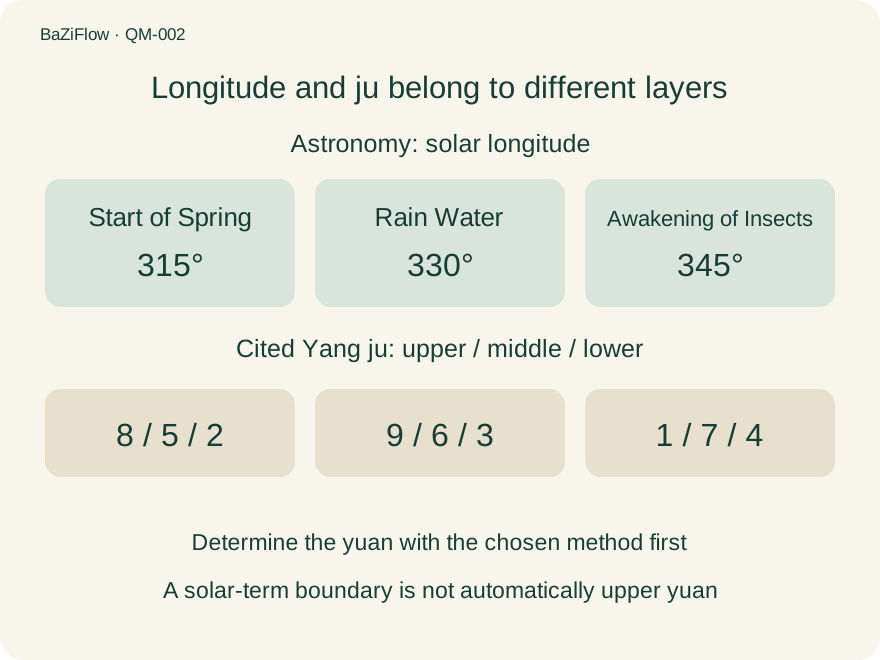
Original BaZiFlow comparison. Longitudes follow the Hong Kong Observatory; the three ju rows follow the Siku edition of Dun Jia Yan Yi, volume one. This is not a complete date-selection algorithm.
If the chosen method has already identified middle-yuan Start of Spring, this table gives Yang five. Lower-yuan Start of Spring instead gives Yang two. The term name therefore does not determine a single number without the yuan condition. The lookup is easy; establishing why that column applies is the step that must not disappear from the notes.
A ju number is not a quality score or the term's position in an annual list. Nor does “Yang eight” mean that the entire reading consists only of palace eight. The number participates in setting up the chart. Review the nine-palace grid to keep that setup role distinct from the final location of a particular door or star.
Term
Start of Spring
- Upper
- 8
- Middle
- 5
- Lower
- 2
Rain Water
- Upper
- 9
- Middle
- 6
- Lower
- 3
Awakening of Insects
- Upper
- 1
- Middle
- 7
- Lower
- 4
Yang ju in the cited edition
Two sequences do not have to meet at the same instant
The same classical volume identifies Yang Wood (甲) and Yin Earth (己) days as cycle-head markers and classifies their branches: Rat, Horse, Rabbit and Rooster (子午卯酉) for the upper yuan; Tiger, Monkey, Snake and Pig (寅申巳亥) for the middle; Dragon, Dog, Ox and Goat (辰戌丑未) for the lower. These are conventions in the method being cited, not alternative astronomical definitions of a solar term.
That volume’s discussion of “advance” (超神) and “connection” (接气) concerns cases where the cycle marker arrives before the term, or the term arrives before the relevant marker. That is why “Start of Spring has begun” cannot automatically be rewritten as “upper-yuan Start of Spring begins at this instant” for this text's procedure.
Likewise, taking every transition timestamp and cutting the following interval into three exact five-day blocks does not reproduce the full procedure described there. The text discusses additional adjustments, including intercalation and partial or supplementary setups. The article is identifying the distinction, not presenting an incomplete shortcut as a working algorithm.
Intercalation in that Qimen discussion is not simply the lunar calendar's leap month. Similar terms in modern manuals should be checked in their own definitions. A word shared with a historical text does not guarantee identical rules across every modern chai-bu (拆补) or intercalation method.
Yang Wood–Rat (甲子)
- Rat group: upper
Yang Wood–Tiger (甲寅)
- Tiger group: middle
Diagnose the disagreement before changing the clock
Suppose two charts differ near a transition. First compare the target timestamp, time zone and solar-term source. Then compare the chosen method's treatment of the cycle and the resulting yuan and ju. Those are separate opportunities for disagreement.
If the methods differ, preserve that fact rather than altering one timestamp until the pictures agree. The later choice of rotating or flying plate settings can introduce another kind of difference. Mixing all of these into a single claim that one app is wrong makes the actual cause harder to locate.
A recheckable note names the timestamp, astronomical source, method version, Yin or Yang mode, yuan and ju. At a boundary, include the reason for selecting that yuan. A final screenshot is helpful but does not explain the missing decision.
Know which source is doing which job
The Observatory supplies an astronomical framework. The named classical edition supplies the traditional correspondences and cycle discussion used in this exercise. Neither source should be made to answer a question outside that role: the classical example is not a modern ephemeris, and the longitude table is not evidence of divinatory accuracy.
The three table rows and angular positions can be checked independently. Calculating a full chart for an arbitrary date still requires the remaining rules of the selected method. Understanding the connection between solar terms and ju numbers means keeping those dependencies visible, rather than reducing the process to a term name followed by a supposedly universal number.
Source
Astronomy
- Supplies
- Solar longitude
- Separate evidence
- Chosen instant and zone
Traditional table
- Supplies
- Term + yuan → ju
- Separate evidence
- Named yuan-selection method
Questions readers ask next
Does finding Start of Spring middle-yuan Yang five complete the setup?
It completes one conditional table lookup. The record still needs the reason for selecting that yuan, its timestamp, mode and method. Later star and door placement follows additional rules; the ju number alone does not supply every palace assignment.
Does a date marked with a term use the new term all day?
A particular time may precede or follow the year’s transition. Compare both timestamps under one time-zone convention. A day-level label cannot replace that comparison or automatically decide the traditional method’s yuan.
Should differing charts be reconciled by adjusting the clock?
Keep the original input fixed while comparing transition sources, time zones and cycle methods. A rule difference need not be a time error. Locate the differing layer first; moving the clock merely to match the picture destroys the comparison.
Was this article helpful?