

Saturn-return position conditions
Content version · · Sources & references
A worked comparison separates a natal Saturn conjunction from an age label, an orbital period and an orb window. Use it to audit return dates without prescribing a crisis.
The short version6 min read
Approaching thirty suggests a search range, not a personal return calculation. Compare natal and transiting Saturn longitudes, then separate exact conjunction from an allowance window. Discussion of responsibility needs actual commitments and arrangements.
- About 29.4 years describes Saturn’s orbit around the Sun, not a universal number of days to add for a personal geocentric return.
- Transit Saturn at 351° is 0° from natal 351° but a short arc of 14° from natal 5°; a shared sky still needs a personal target.
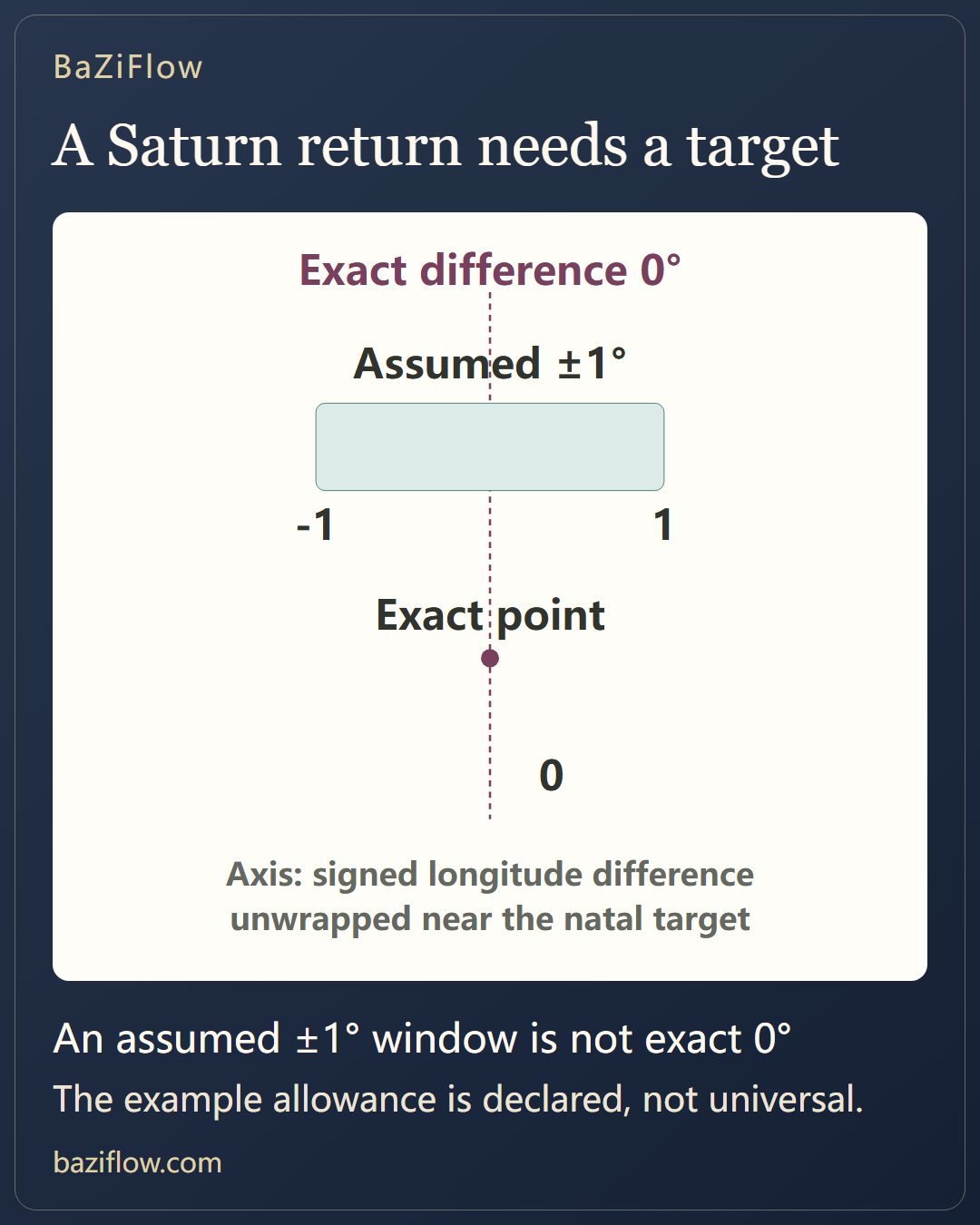
- A one-degree window is not exact zero. Search the ephemeris for repeat contacts rather than preassigning their count or associated life events.
Read first
One sky, different natal targets: how transits are compared ↗
Three kinds of approximation can get bundled together
NASA gives Saturn's orbit around the Sun as about 29.4 Earth years. That is a useful scale for understanding why first-return discussions cluster around thirty, but a heliocentric orbital period is not a personal geocentric ephemeris. The observing Earth moves too. Adding one rounded period to every birth date does not replace a search for a specified longitude condition.
There is also a difference between an age range used to start a search and the narrower window chosen for an interpretation. Neither is the exact contact itself. In this article, the calculation condition is equality between geocentric transiting and natal Saturn longitudes in the chosen zodiac. If a program uses another convention, record it before comparing its answer.
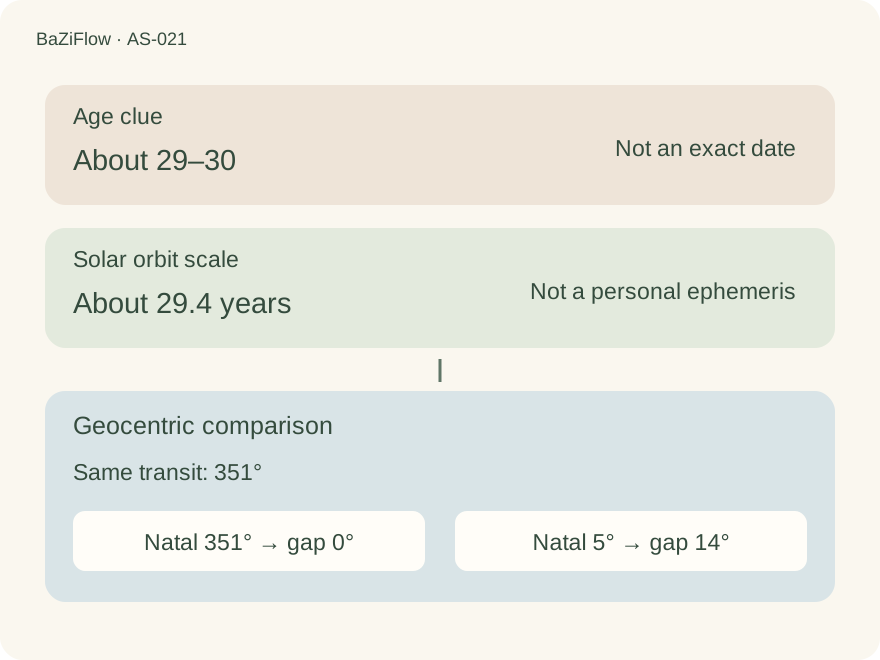
Original teaching diagram. The longitudes are invented; none of these boxes supplies a real return date.
A date claim needs a target
Suppose a friend shares an app screen saying that Saturn is at 351° today. Does that establish your Saturn return? Only if the position being used for your natal Saturn is also 351°, under matching coordinate settings. Without that personal reference, the screen describes the current sky and leaves the return question unanswered.
For a second hypothetical person, natal Saturn is at 5°. The shorter distance from the same transiting 351° is 14°: nine degrees to the end of the circle, then five beyond zero. Subtracting the two labels gives 346°, but that is the longer separation. No birth years are supplied here; the example is a test of the comparison, not a claim that these two people have the same age.
| Natal target | Transiting position | Shorter separation | Result of this exercise |
|---|---|---|---|
| 351° | 351° | 0° | Exact longitude match |
| 5° | 351° | 14° | No exact match |
Nothing in that table measures either person's level of maturity, the difficulty of their week or their likelihood of changing jobs. Those would be additional claims requiring their own support. Keeping them outside the calculation is particularly useful when a persuasive narrative makes an unverified date seem obvious.
A: exact match
N351° / T351°
B: short arc 14°
T351° → N5°
Separate relative dials; the second starts at T351° and ends at N5°
Separate the exact point, its window and repeated passes
Consider a separate boundary example: natal Saturn at 359.5° and transiting Saturn at 0.5°. Their short separation is 1°. A practice rule allowing an inclusive 1° conjunction orb admits this pair; a 0.5° rule does not. The longitude match is still not exact under either rule. Changing a tolerance changes the window you have defined, not the two supplied positions.
An entry and exit date for that window require positions over time. One screenshot cannot establish its duration. A date-only display also has a different precision from a time-stamped calculation. It is worth asking what the product actually displays before treating a whole day's interpretation as an exact astronomical contact.
Several contacts do not assign several events
The TimePassages manual describes the possibility of repeated exact Saturn contacts during retrograde motion. A useful record therefore preserves the contacts actually found and their direction of motion. It should not assume that every return contains exactly three, or require the reader to find one dramatic event for each.
Imagine an event journal with one major decision and many ordinary weeks. If the calculation supplies several contacts, splitting that one decision into an obligatory beginning, test and resolution would be an editorial choice. The geometry does not establish that plot. Conversely, finding several memorable events does not verify the search settings or prove that the dates were calculated correctly.
A reader can audit this without accepting or rejecting every symbolic use of astrology. Ask which natal longitude was used, what zodiac was selected, which contacts the search returned, and whether the stated period is an orb window or an interpretive convention. Keep the actual event log alongside those details, without rewriting either to fit the other.
Exact difference 0° · 0
−2° ↔ +2°
- Assumed ±1° · -1–1
- Exact point · 0
Axis: signed longitude difference unwrapped near the natal target
Make the reflection specific enough to be useful
A return can be used as a chosen occasion to review commitments. That is a reflective exercise, not a consequence demonstrated by the orbital calculation. For example, a person who helps run a community workshop might list opening duties, tool checks and newsletter editing, then discover that all three have silently landed with the same volunteer.
The useful next question is who agreed to which task and whether other members can share it. Opening the room may need a fixed schedule; checking tools may require particular training; editing the newsletter may be reduced in frequency. These are different responses to different practical facts. Calling all three “lessons in responsibility” adds no information unless the writer connects the phrase to those arrangements.
A quiet period does not need a manufactured crisis. Equally, an inconvenient commitment can be renegotiated before a return date arrives. The practical record should show what was agreed, what changed and what feedback followed. Do not count the effects of your own deliberate changes as automatic proof of a planetary cause.
Actual arrangement
Open room
- Condition
- Fixed session time
- Specific check
- Agree on a schedule
Tool checks
- Condition
- Training needed
- Specific check
- Identify qualified help
Newsletter
- Condition
- Flexible schedule
- Specific check
- Review frequency
Preserve the personal calculation record
Finally, state the limits of the birth information. Slow motion can make some time errors less consequential for Saturn's longitude than for an angle, but it does not make missing data universally irrelevant. Reading houses or angles in a return chart introduces further time, place and house-system requirements. A solved conjunction does not supply those settings by itself. The transit comparison guide explains the two time layers; secondary progressions and solar arc use different rules and should not be substituted for this search.
Fix the natal reference
Verify Saturn’s source longitude, zodiac and observation center.
Save the contact search
Record exact instants, allowance intervals and the actual number of repeats separately.
Keep practical evidence distinct
Log commitments and feedback without deriving experiences from age.
The whole-chart reading order helps organize calculated relations separately from interpretive and personal evidence.
Questions readers ask next
Does my twenty-ninth birthday establish an exact Saturn return?
No. Age can identify a rough search region, but the instant requires matching transit and natal Saturn longitudes under the same zodiac and geocentric settings. A mean orbital period cannot replace that search.
How far apart are natal 359.5° and transiting 0.5°?
Their shorter distance is one degree across zero. This meets an inclusive one-degree allowance but not a half-degree limit. Neither setting turns the supplied pair into an exact zero-degree match.
Do repeated contacts require several major life events?
No. Retrograde motion may create multiple exact contacts, but the count comes from an ephemeris while events come from life records. Do not assign a crisis to every contact or recast quiet periods as hidden problems.
Was this article helpful?
Sources & references
Continue reading
Solar returns: solve the time, then choose the chart location ↗
Secondary progressions and solar arc: different operations ↗