

How to read a BaZi case
Content version · · Sources & references
Work through two examples from Ziping Zhenquan by separating recorded pillars, rule checks, interpretation and outcome evidence. A consistent chart fragment does not verify a biography.
The short version5 min read
The two Officer-chapter records pass four limited month/hour table checks. That does not verify the people or their ranks. Work through those checks, then distinguish copied positions from the author’s explanation and independent outcome evidence.
- Year–month and day–hour matches establish local rule compatibility, not a complete date or a verified biography.
- Yang Water is Direct Resource relative to Yin Wood but Indirect Wealth relative to Yang Earth; ownership and reference must remain explicit.
- Several features differ between the cases, so their reported outcomes do not isolate the effect of the Yin Fire–Yang Water combination.
Read first
Reading the BaZi classics: questions, passages and textual layers ↗
How the Ten Gods are derived: five relationships and two polarities ↗
What would count as evidence against the story?
A published case gives you the example an author chose to discuss. It rarely supplies every similar chart left out of the book. Before asking why the reported outcome happened, ask what comparisons are missing. Without that denominator, selected stories cannot provide a predictive success rate.
There is a second gap: when was the interpretation recorded? An explanation written after an event has different evidential value from a prediction preserved beforehand. If the source does not resolve that question, record the uncertainty. An elegant explanation does not supply its own date.
These questions do not prevent close reading. They distinguish learning an author's reasoning from testing whether that reasoning predicts lives. The two cases below are useful for the first task, with clear limits on the second.
Selected cases
- Examples in the book
Missing comparison
- Unselected cases
- Prior prediction record
Two kinds of case-study checks
- Local check
- A test of one specified correspondence using the supplied fields.
- Independent evidence
- A source appropriate to the claim, rather than another repetition of the same chart calculation.
Keep the two records intact
In the Direct Officer chapter of Ziping Zhenquan, two configurations illustrate an argument about Wealth and Resource. Here they are labelled in source order. Neither the people nor their reported ranks have been independently verified for this article.
| Position | Example one | Example two |
|---|---|---|
| Year | Jia-Shen (甲申) | Ren-Xu (壬戌) |
| Month | Ren-Shen (壬申) | Ding-Wei (丁未) |
| Day | Yi-Si (乙巳) | Wu-Shen (戊申) |
| Hour | Wu-Yin (戊寅) | Yi-Mao (乙卯) |
Start the comparison by marking everything that differs. The Day Master changes from Yin Wood to Yang Earth; the month and other placements also change. This is not a controlled experiment in which only one combination varies. A difference in reported rank cannot be assigned solely to that combination on the strength of these two records.
Do not repair this problem by inventing two matched charts. That would produce a new teaching exercise, not improve the historical evidence. Likewise, an inconvenient stem must not be silently changed to fit an interpretation. Keep variant readings and editorial corrections separately, with their edition.
Day Master
- Example one
- Yin Wood
- Example two
- Yang Earth
Month
- Example one
- Ren-Shen (壬申)
- Example two
- Ding-Wei (丁未)
Other pillars
- Example one
- Also differ
- Example two
- Not held constant
Separate the label from the explanation
For the Yin Wood Day Master in example one, month-stem Yang Water is Direct Resource and hour-stem Yang Earth is Direct Wealth. The source emphasizes Yin Wood between them and interprets the placement as avoiding interference. The copied positions, the Ten-God classifications and that interpretation are three distinct claims.
For the Yang Earth Day Master in example two, year-stem Yang Water is Indirect Wealth and month-stem Yin Fire is Direct Resource. The passage emphasizes the Yin Fire–Yang Water combination in its account of the arrangement. Identifying the traditional pairing does not establish transformation, nor prove a restriction on a person's career. See combination and transformation for that distinction.
This lets you state what the passage actually does: it uses relative position and a combination to explain its different assessments. You can reconstruct that argument while leaving its real-world conclusion unverified. Agreement with the vocabulary is not agreement with every resulting claim.
Example one
- Day Master
- Yin Wood
- Yang Water placement
- Month stem
- Classification
- Direct Resource
Example two
- Day Master
- Yang Earth
- Yang Water placement
- Year stem
- Classification
- Indirect Wealth
Run the checks that the supplied fields permit
The Hong Kong Observatory's month and hour tables support four local checks: a Yang Wood year gives Yang Water in the Monkey month; a Yang Water year gives Yin Fire in the Goat month; a Yin Wood day gives Yang Earth in the Tiger hour; and a Yang Earth day gives Yin Wood in the Rabbit hour. Both written records agree with those correspondences.
That result has a narrow scope. It does not identify a complete civil date, recover a birthplace, establish a person's identity or verify an official rank. Write “the listed year–month and day–hour pairs agree with the tables,” rather than “the case is verified.” Missing birth details remain missing even after a successful lookup.
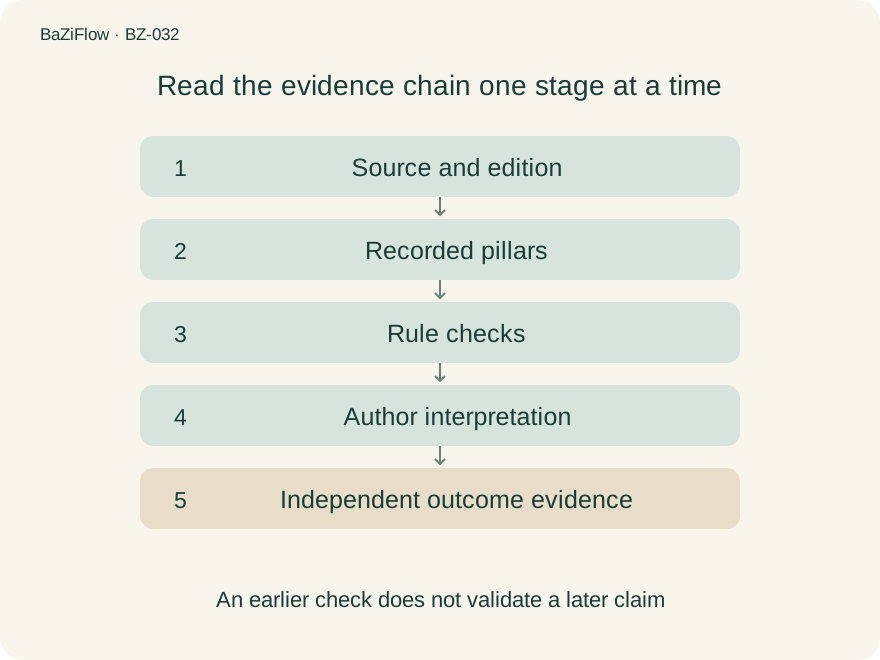
Original BaZiFlow case-reading sequence. Arrows indicate review order, not an established predictive cause.
The diagram is a review sequence. Its arrows do not turn a successful transcription into outcome evidence. Each later claim needs support appropriate to that claim; the same calculation cannot do every job.
Example one
- Month check
- Yang Wood + Monkey → Yang Water
- Hour check
- Yin Wood + Tiger → Yang Earth
Example two
- Month check
- Yang Water + Goat → Yin Fire
- Hour check
- Yang Earth + Rabbit → Yin Wood
Preserve what you thought before reading the ending
For a first reading, cover the reported outcome and save a note about the supplied data and the argument you can reconstruct. After uncovering the ending, add a separate note. You can then see which explanations appeared only after you knew the result, instead of overwriting the earlier uncertainty.
Keep four categories in that record: source information, rule checks, interpretive claims and outcome evidence. For these examples, a defensible summary says that the passage compares Wealth and Resource arrangements, four local table checks agree, multiple features differ, and identity and rank remain independently unverified.
The guide to classical texts and editions explains how base text and later commentary can share a page. Use that distinction alongside the four categories. A memorable ending is worth examining, but it must not make the missing evidence disappear.
Record
- What to preserve
- Edition and written pillars
Rules
- What to preserve
- Four table checks
Reading
- What to preserve
- Position-based argument
Outcome
- What to preserve
- Identity and rank unverified
Write before seeing the outcome
Save the pillars, edition and missing information with the reported ending covered.
Label the evidence
Record each table check separately from the classification and the author’s explanation.
Add a second note afterwards
Keep any explanations added after the ending visible; retain unverified identity and rank as open questions.
Questions readers ask next
Do four matching table checks verify the whole case?
No. They establish local correspondences, not a complete date, birthplace, identity or biography.
Why is Yang Water classified differently in the two records?
The Day Master changes. Yang Water is Direct Resource for Yin Wood and Indirect Wealth for Yang Earth, so the reference cannot be omitted.
Do these cases prove that Yin Fire–Yang Water combination limits rank?
No. Other placements and the Day Master differ, and the historical outcome has not been independently verified.
Was this article helpful?
Sources & references
Continue reading
Stem Combinations: A Pair Is Not Yet a Transformation ↗
BaZi pattern formation: follow the conditions and assistance ↗
Same day pillar, different readings: what the shared pair does not supply ↗