

Trace each chart column to its input
Content version · · Sources & references
Build the annotations of a supplied Qian hexagram, trace relatives to palace Metal, and compare Yang Wood and Yang Fire day stems without confusing the columns.
The short version7 min read
At Qian’s bottom line, Yang Wood Rat, Descendants and Azure Dragon come from three sources: lower Qian’s assignment, Metal generating Rat Water, and the Yang Wood day’s starting spirit. Separating those dependencies makes a date-only comparison possible without rewriting the supplied hexagram.
- Lower Qian uses Yang Wood Rat, Yang Wood Tiger and Yang Wood Dragon; upper Qian uses Yang Water Horse, Yang Water Monkey and Yang Water Dog, beginning at position four.
- The relative categories compare branch phases against the whole hexagram’s palace phase, which is Metal for this Qian example.
- Spirits follow a cycle upward from a starting point selected by the casting day stem, rather than a person’s birth-year stem.
Read first
Read the columns before reading a verdict
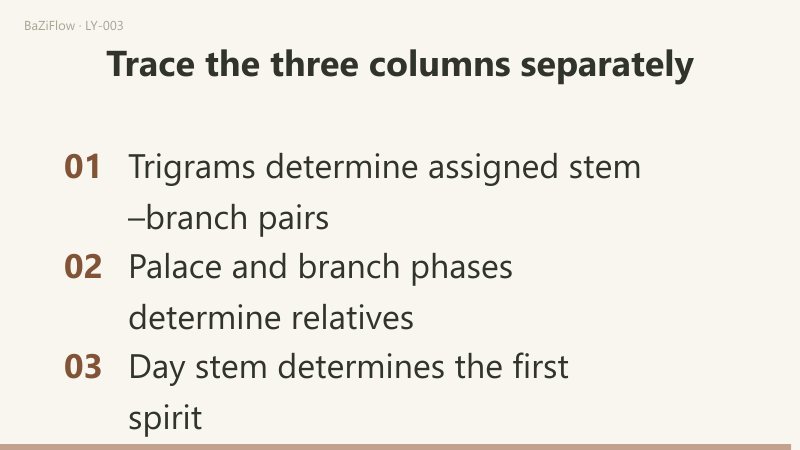
A Liuyao chart can place Yang Wood Rat (甲子), Descendants, and Azure Dragon (青龙) beside the same line. These are three different annotations, not three translations of a single idea. Najia assigns stem–branch pairs to positions in the trigrams; the Six Relatives classify a branch's phase relative to the hexagram's palace phase; the Six Spirits are arranged from the day stem.
We will hold one supplied hexagram fixed: Qian, with six solid lines. This is an assembly exercise, not a claimed coin-casting session or a prediction about a person. If you need to reconstruct the lines first, start with recording six coin throws. An annotation should add information to that record, not silently alter it.
Build a small dependency map
For this Qian example, the lower and upper trigrams determine the assigned stem–branch sequence. The entire hexagram belongs to the Qian palace, whose phase is Metal. That palace phase and each assigned branch phase determine the relative category. Separately, the stated day stem determines the starting spirit at line 1.
The distinction matters when checking an error. A different day stem can change the spirit column without changing the supplied Qian structure or its relative categories. A different hexagram may change the trigram assignments and palace reference. Neither operation licenses changing the original six recorded line states.
The sources used here are the Najia and spirit-placement sections of Bushi Quanshu, preserved in volume 544 of the Art section of the Gujin Tushu Jicheng, and the corresponding chapters of Zengshan Buyi. They supply traditional placement rules. These rules are reproducible conventions within the method; correctly reproducing them does not establish predictive accuracy.
Assignment
- Lower Qian → Yang Wood Rat
Relation / spirit
- Metal → Water: Descendants
- Yang Wood day → Azure Dragon
Assign stems and branches from the bottom upward
For lower Qian, the three pairs are Yang Wood Rat (甲子), Yang Wood Tiger (甲寅), and Yang Wood Dragon (甲辰). For upper Qian they are Yang Water Horse (壬午), Yang Water Monkey (壬申), and Yang Water Dog (壬戌). Line 4 is the bottom of the upper trigram. Najia is the name of the assignment method; it does not mean that every line receives the stem Yang Wood (甲).
| Line, counted upward | Assigned pair | Branch phase | Relative in the Metal palace |
|---|---|---|---|
| 1 | Yang Wood Rat | Water | Descendants |
| 2 | Yang Wood Tiger | Wood | Wealth |
| 3 | Yang Wood Dragon | Earth | Parents |
| 4 | Yang Water Horse | Fire | Officials/Ghosts |
| 5 | Yang Water Monkey | Metal | Siblings |
| 6 | Yang Water Dog | Earth | Parents |
A table may list line 1 first, while a drawn hexagram puts line 6 at the top. Read the position number before transferring a value. The visual order of a table is not itself the assignment rule. Also, this is a Qian table: another lower or upper trigram requires its own prescribed sequence.
Lower Qian
- 1 Yang Wood Rat
- 2 Yang Wood Tiger
- 3 Yang Wood Dragon
Upper Qian
- 4 Yang Water Horse
- 5 Yang Water Monkey
- 6 Yang Water Dog
What makes a branch a “relative”?
The reference in this exercise is the palace's Metal, not a birth-year element or the day master used in Bazi. Metal generates Water, so Rat (子) Water is Descendants. Metal controls Wood, making Tiger (寅) Wood Wealth. Earth generates Metal, so both Dragon (辰) Earth and Dog (戌) Earth are Parents. Fire controls Metal, giving Horse (午) Fire the Officials/Ghosts category. Monkey (申) Metal matches the palace phase and is Siblings.
The traditional label Six Relatives therefore does not require six unique categories across six lines. These five phase relationships can repeat, and a particular category need not appear among the six visible assignments. Replacing the second Parents entry merely to remove repetition would destroy the calculation.
English names vary. Wealth here renders the traditional category commonly called Wife/Wealth; Officials/Ghosts renders a technical label, not evidence of an actual official, spirit, or danger. Similarly, Parents does not by itself identify a particular parent. Selecting which category represents the subject of a question is a subsequent interpretive step.
Qian is a convenient introductory case because its trigram name and palace name agree. In a mixed hexagram, establish the palace membership of the whole hexagram instead of assuming that its upper trigram supplies the palace phase. Otherwise every relative label can be consistently calculated from the wrong reference.
Descendants
- Palace Metal → Rat Water
Parents
- Dragon/Dog Earth → palace Metal
Change the day stem and watch the spirits rotate
The upward cycle is Azure Dragon, Vermilion Bird (朱雀), Gou Chen (勾陈), Serpent (螣蛇), White Tiger (白虎), and Black Tortoise (玄武). Yang Wood or Yin Wood (乙) days start with Azure Dragon at line 1; Yang Fire (丙) or Yin Fire (丁) with Vermilion Bird; Yang Earth (戊) with Gou Chen; Yin Earth (己) with Serpent; Yang Metal (庚) or Yin Metal (辛) with White Tiger; and Yang Water (壬) or Yin Water (癸) with Black Tortoise. Continue upward through the cycle and wrap around after its last member.
On a Yang Wood day, lines 1–6 receive that cycle in the order just listed. On a Yang Fire day, they receive Vermilion Bird, Gou Chen, Serpent, White Tiger, Black Tortoise, and Azure Dragon. The source's Yuan Wu (元武) and the Black Tortoise label used in modern charts are treated here as alternative labels for the same position, not an additional spirit.
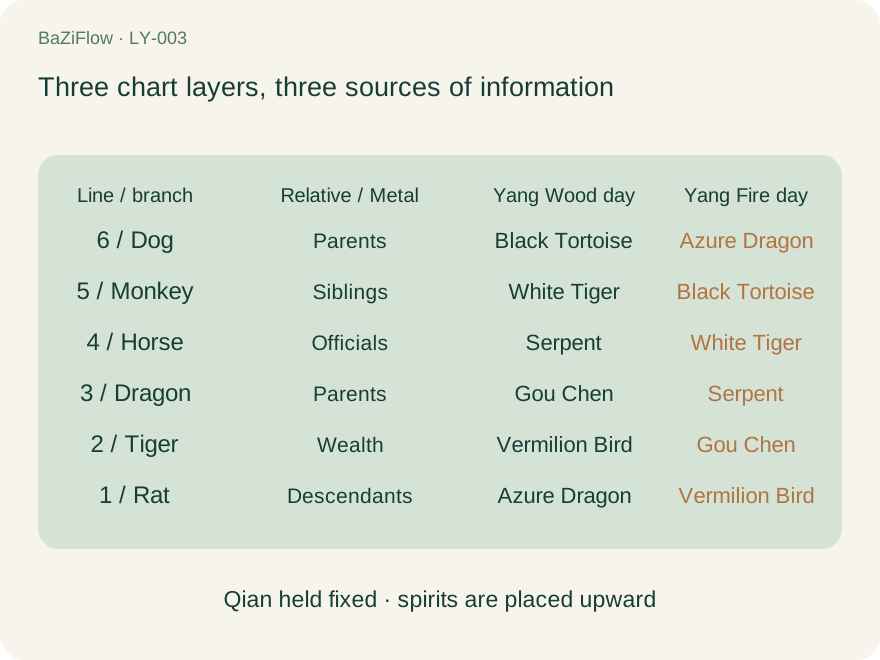
Original BaZiFlow assembly comparison: a supplied Qian hexagram and two day stems, without a personal reading.
Only the spirit starting point is isolated in this comparison. Two actual dates can also differ in their branches and other calendar conditions. Other interpretive inputs may differ between two actual readings. If the relevant date is unresolved, preserve that uncertainty instead of choosing an attractive spirit name.
Yang Wood day
- 1 Azure Dragon
- 2 Vermilion Bird
- 6 Black Tortoise
Yang Fire day
- 1 Vermilion Bird
- 2 Gou Chen
- 6 Azure Dragon
Check the annotation without promoting it into a fact
Zengshan Buyi's Six Spirits chapter explicitly criticizes judging from an auspicious or threatening name alone. Its discussion makes the spirits supplementary to other considerations. Reading White Tiger as proof that harm has occurred, or Azure Dragon as a guarantee of success, goes beyond the placement rules taught here.
For an audit, trace each column to its own input. Can the assigned pairs be recovered from the lower and upper Qian trigrams? Can every relative be explained against palace Metal? Does the first spirit match the stated day stem, with the remaining five following upward? These are separate checks, so a repair can stay confined to the mistaken column.
The next layer is locating Self and Response. Those are positional markers with their own rule. Do not infer them from the presence of Parents, a moving line, or a spirit with a favorable-sounding name. Keeping these layers separate makes a traditional chart easier to inspect without claiming that its labels are observations about the world.
Questions readers ask next
Does the name Najia assign Yang Wood to every line?
The method name is not the value of a stem field. In this example the lower group uses Yang Wood while the upper uses Yang Water, even though both trigrams are Qian. Keep each line index and its inner or outer group when checking the pair.
Why are there not six different relative categories?
The traditional collective label refers here to five directed phase relationships. Six positions may share a category, so a repeated label is compatible with a correct calculation. Its frequency neither counts people nor supplies missing real-world identities.
What can be assembled before the day is known?
With a fixed figure and verified palace membership, assigned pairs and their relative categories can already be calculated. The day-dependent starting spirit remains unresolved. That missing field does not require erasing the known line pattern.
Was this article helpful?
Part of a learning path
Liu Yao: from casting to the Useful God and movement · Step 3 of 3 available