

Willow: three tables and the gaps
Content version · · Sources & references
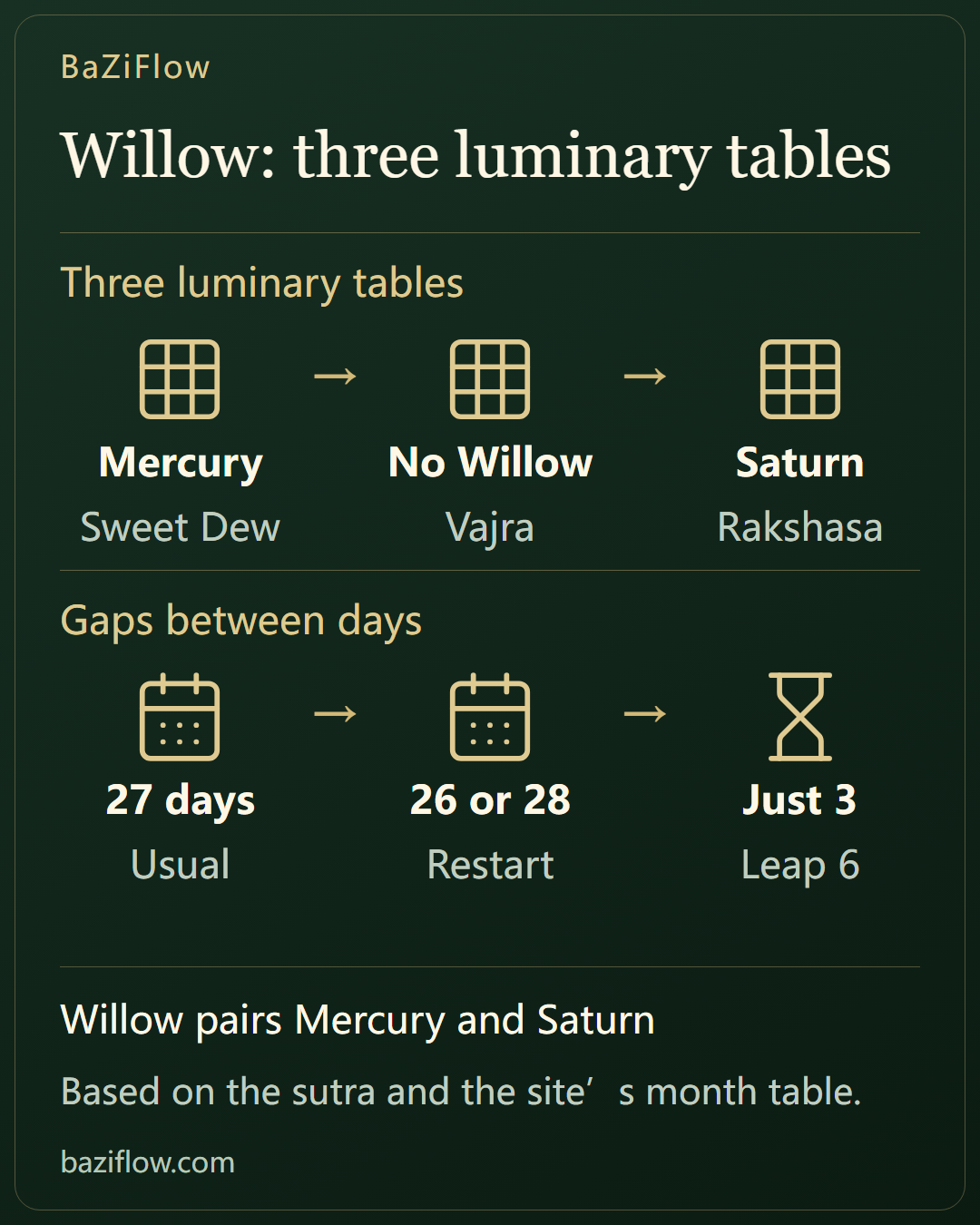
Willow (柳) is position 7. In one 7×3 grid the sutra’s three luminary tables have 21 cells but 18 mansions, Willow, Ghost and Tail twice; also the picture’s missing deity, gaps between Willow days, and class partners.
The short version5 min read
Willow (柳, Ryū in Japanese) is position 7 on the site’s ring, between Ghost and Star. Set the sutra’s three luminary-and-mansion tables side by side and their 21 cells hold only 18 different mansions, Willow being one of the three that appear twice.
- The Sweet Dew, Vajra Peak and Rakshasa tables have seven pairs each, 21 cells in all; Willow pairs with Mercury in the first and Saturn in the third, and Ghost and Tail also appear twice, so there are only 18 different mansions.
- The Willow picture reads "six stars shaped like a snake. A deity," with the deity’s name missing in this edition; Jingfeng’s note gives eight stars in Chinese astronomy and a southern mansion.
- On the site’s calendar Willow days average 27 days apart. Across 2000 to 2099 there are 1,342 Willow days and mostly 26, 27 or 28 days between them; only five gaps are as short as two or three days, all around a leap sixth month.
Read first
What is Sukuyō astrology? How a birth mansion is found ↗
Sukuyō 27 mansions vs the 28 lunar mansions: what is the difference? ↗
A snake-shaped mansion and a deity without a name
Willow (柳, Ryū in Japanese) is position 7 on the site’s ring, between Ghost (鬼) and Star (星), and the sutra draws it as six stars shaped like a snake.
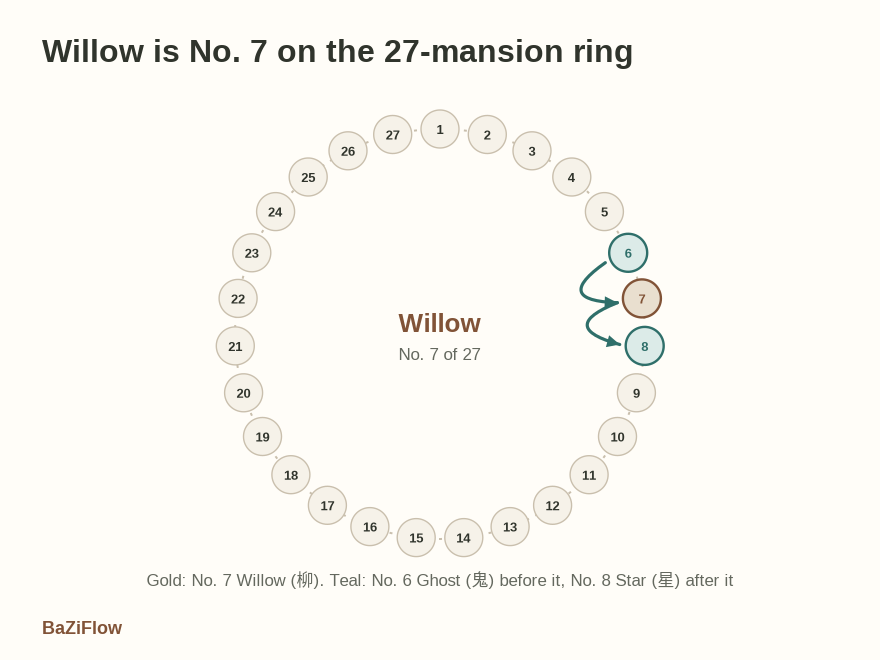
Willow sits at position 7 between Ghost and Star; at one place a day, a Willow day should come round every 27 days.
The Willow picture is one short line:
Willow has six stars shaped like a snake. A deity.
Compared with the other pictures, one thing differs. Hairy Head reads "a fire deity" and Well "a sun deity," and names such as Prajapati and Rudra precede "a deity" elsewhere, whereas the Willow line has nothing before it. Jingfeng’s note gives Willow eight stars in Chinese astronomy, governing the kitchen, a southern mansion; six against eight is, again, two numbers from two layers.
Twenty-one cells, eighteen mansions
The sutra pairs the seven luminaries with mansions in three tables: Sweet Dew days, Vajra Peak days and Rakshasa days, seven pairs each, giving one mansion to each weekday luminary from the Sun through Saturn. Willow is in two of them. The Sweet Dew set reads:
Star with Saturn, Tail with Mars, Willow with Mercury… these seven days are called the Sweet Dew days.
and the Rakshasa set ends:
Willow with Saturn. These seven days are called the Rakshasa days.
Arranged by luminary as a 7 by 3 table, it is easier to see:
Enlarge diagram · scroll sideways to read
Of the 21 cells, Willow, Ghost and Tail each fill two, so there are only 18 different mansions. The Mercury row is the most curious: across the three tables it takes Willow, Hairy Head and Three Stars, positions 7, 1 and 4 on the ring.
How many days between Willow days
The site’s calendar steps one place a day around 27, so a given mansion should return every 27 days. A month in Japan’s old calendar (new moon by Tokyo time) has only 29 or 30 days and restarts from its day-1 mansion, which lengthens or shortens some gaps. Laying out every Willow day of 2025, the days between successive ones are 27, 28, 27, 28, 27, 27, 27, 3, 27, 26, 27, 27 and 28. Of those 13 gaps most are 27 or 28 days, one is 26 and just one is 3. That one lies between 23 July (old month 6, day 29) and 26 July (leap month 6, day 2): a leap month reuses month 6’s day-1 mansion, and Willow days fall on days 2 and 29 of month 6, so the leap month runs the sequence again.
Stretching the window to 2000 through 2099 gives 1,342 Willow days and 1,341 gaps, distributed like this:
Enlarge diagram · scroll sideways to read
The five short gaps fall in 2025, 2036, 2055, 2074 and 2093, all around a leap sixth month.
Willow’s class partners, as the three-nine names see them
The sutra puts Willow in one class with Three Stars, Heart and Tail:
Three Stars, Willow, Heart and Tail are the "poisonous" mansions.
The four sit at positions 4, 7, 16 and 17. Starting from Willow and using the three-nine method, the other three come out like this:
Enlarge diagram · scroll sideways to read
Three class partners are three different three-nine relations to Willow: Three Stars forms a Break–Ease pair, Heart a Karma–Womb pair, and Tail a Prosper–Kin pair. The class name says only that they belong together and says nothing of their relations. How the three-nine names are derived is in the derivation of the six relation types, and the distance bands are in how near, middle and far are drawn.
Questions readers ask next
Which luminary does Willow pair with in each of the three tables?
Mercury in the Sweet Dew days and Saturn in the Rakshasa days, and Willow is absent from the Vajra Peak days. Willow is thus in two of the three tables, with a different luminary in each; that is how the book arranges them, and one table cannot be derived from the other.
Why are Willow days usually 27 days apart, yet sometimes 26 or 28?
The site’s calendar steps one place per day on a ring of 27, so the same mansion would come every 27 days. But old months have 29 or 30 days and each restarts from its day-1 mansion, which stretches some gaps to 28, squeezes others to 26 and occasionally gives 29 or 30.
Why does the Willow picture say only "a deity," with no name?
Other pictures put a name before "a deity": Hairy Head has "a fire deity" and Well "a sun deity," while the Willow line has nothing in front of it. That is what this edition shows, and it cannot tell us whether a word dropped out, so a citation should give only the text that is there.
Was this article helpful?
Sources & references
Continue reading
Ghost (鬼): Two Class Lists in One Sutra, 27 and 28, and a Leap Month That Counts It Twice ↗
Star (星): Where the Twelve-House Table Begins, and the Sutra’s Six Stars ↗