

Tai (泰): passage, and the turn inside it
Content version · · Sources & references
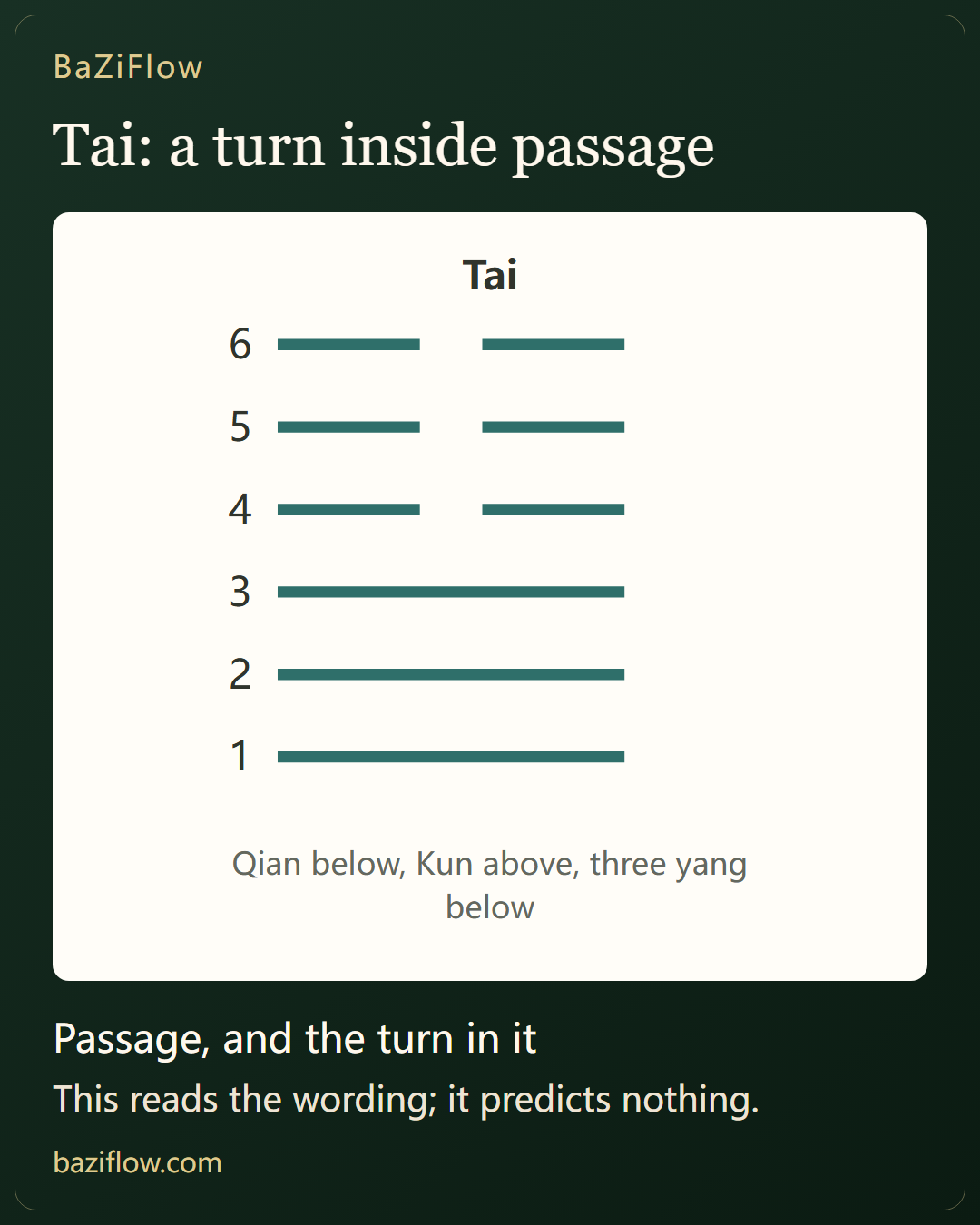
Tai has Qian (heaven) below and Kun (earth) above: three yang under three yin. Read the Judgment, its inner-outer pairs, line 3 and "no going without a return", and the falling wall of the top line.
The short version7 min read
Tai puts three yang lines below and three yin lines above, and both the Commentary on the Judgments and the Great Image call this an interaction. While the text speaks of passage, it plants the turn at the seam: "no going without a return" in line 3, and "the wall falls back into the moat" in the top line.
- Tai stacks Kun (earth) on Qian (heaven). The Commentary on the Judgments says heaven and earth interact and all things pass through, then sets inner against outer: yang within, yin without; strong within, yielding without; noble within, petty without.
- The Judgment is six characters: "the small go out, the great come in; good fortune, success". By the Commentary on the Judgments, small is yin and great is yang: yin lines outside, yang lines inside.
- The turn sits in the middle. The Small Image on line 3 says "the boundary of heaven and earth", the seam between three yang and three yin; by the top line, "the wall falls back into the moat".
Read first
The Sixty-Four Hexagrams: How Upper and Lower Trigrams Form One Figure ↗
Judgment and Line Statements: Whole Hexagram or Single Line? ↗
Heaven below, earth above: the shape of Tai
Tai (泰) puts Qian (乾, heaven) at the bottom and Kun (坤, earth) on top, and reads as Qian below, Kun above. Counting up, the first three are yang and the last three yin, a clean split into yang underneath and yin above. The Shuo Gua's words for the two are strength and yielding.
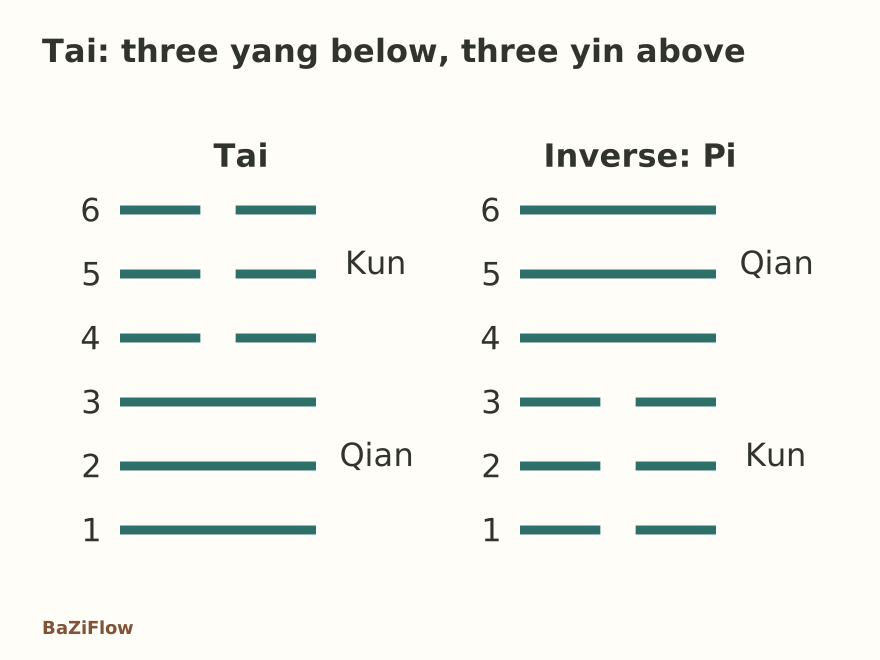
Tai and Pi: swap the polarity of every line and you get the inverse hexagram, turn it upside down and you get the reversed hexagram, and both land on the same hexagram.
Enlarge diagram · scroll sideways to read
Three words that keep returning in Tai
- Interact
- The Great Image and the Commentary on the Judgments both use this word: "heaven and earth interact: Tai", "heaven and earth interact and the ten thousand things pass through". Tai puts heaven underneath and earth on top, and the text calls that arrangement interaction.
- Go out and come in
- The two verbs of the Judgment. The Commentary on the Judgments answers them with "inside yang and outside yin": yang lines in the inner trigram, yin lines in the outer, the small outside and the great inside.
- Inner and outer
- The lower trigram is the inner one and the upper is the outer one. The Commentary on the Judgments lines up its pairs in exactly that order, inner first and then outer.
The Judgment: the small go out, the great come in
The Judgment of Tai is six characters: "the small go out, the great come in; good fortune, success". The Commentary on the Judgments first repeats it and then explains:
Tai: the small go out, the great come in; good fortune, success. This is heaven and earth interacting and the ten thousand things passing through; above and below interacting and their aims being the same.
Enlarge diagram · scroll sideways to read
All three pairs follow one pattern, inner first and outer second: yang against yin, strong against yielding, noble against petty. When the pairs are laid out, the Commentary on the Judgments sums up: "the way of the noble person grows, the way of the petty person fades".
The Great Image: heaven and earth interact, and the sovereign acts
The Great Image (大象) of Tai reads: heaven and earth interact, Tai; the sovereign uses it to cut and complete the way of heaven and earth, to assist what heaven and earth make fitting, and so to help and guide the people. The first half is the figure. The subject of the second half is "the sovereign", neither the "noble person" of Qian's Image nor the "former kings" of Bi. Three things are to be done, in a chain.
Enlarge diagram · scroll sideways to read
The first character stands for "cut", so the phrase is usually read as cutting to shape and completing; "assist" is to aid, "help and guide" is to support, and "what suits" means the fitting form of each place. The objects of the three acts shrink in scale: the way of heaven and earth, what suits heaven and earth, the people.
Six lines: line 3, the seam between passage and return
The six line statements of Tai split into two halves: below, three yang lines about going forward; above, three yin lines about what comes once one is outside. The dividing line runs between nine in the third place and six in the fourth.
Enlarge diagram · scroll sideways to read
Enlarge diagram · scroll sideways to read
First nine, "pulling up thatch grass, roots and all together by their cluster: setting out brings good fortune": thatch comes up root by root and one pull lifts a whole bunch. "By their cluster" is going along with their own kind, and the Small Image says "his will is directed outward". Nine in the second place, "embracing the wild; fording the river on foot; not neglecting what is distant; the cliques vanish; he gains support in following the middle way": "embracing the wild" is usually read as taking in what is remote and rough, and the Small Image comments "by being bright and great".
Six in the fourth place: "fluttering; not rich with their neighbors; not warned, yet sincere." Fluttering is a darting, flying manner. The Small Image comments in two parts: "all have lost what is solid" and "it is what they wish at heart". Six in the fifth place: "Di Yi gives his young daughter in marriage; there is blessing, supreme good fortune", with the Small Image "in the middle, he acts on his wish".
The top line is the last statement: "The wall falls back into the dry moat. Do not use the army. From the town, orders are announced. Steadfast, but regret." The Small Image gives only four characters: "his orders are in disorder".
The neighbors of Tai: Pi and Guimei
The inverse hexagram and the reversed hexagram of Tai are one and the same: Pi. Swap the polarity of every line of Tai and you get Pi; turn Tai upside down and you still get Pi. The nuclear hexagram of Tai is Guimei, from lines two to five regrouped into two trigrams, Dui below and Zhen above. Guimei is a name that also occurs in line 5, in "Di Yi gives his young daughter in marriage".
Enlarge diagram · scroll sideways to read
After treading comes Tai, and then there is peace, so it was followed by Tai; Tai means passage.
The Xu Gua gives Tai the word "passage", and says peace comes after the treading of Lü. The reason it gives for what follows, Pi, is: things cannot pass through forever. Passage cannot go on without end. The Za Gua puts the pair into one sentence: "Pi and Tai are opposite kinds".
Questions readers ask next
Why does Tai say "the small go out, the great come in", and not the other way round?
The two orders belong to Tai and Pi. The Commentary on the Judgments of Tai explains it by inner and outer: yang lines are in the inner trigram and yin lines in the outer, so the small go out and the great come in. The Judgment of Pi is the exact reverse. Read going out as outward and coming in as inward, and the words match the figure.
What does "Di Yi gives away his young daughter" in line 5 mean?
Literally, Di Yi marries off a young woman, and the line goes on to "there is blessing, supreme good fortune"; the Small Image says "in the middle, he acts on his wish". Notice that the nuclear hexagram of Tai is named Guimei, the same two words as in this line.
What does "no level ground without a slope" mean?
A slope is a slope; the line says there is no flat stretch without one, and no going without a coming back, and the Small Image sums it up as the boundary of heaven and earth. In a hexagram named for passage, these two sentences are the turning point.
Was this article helpful?
Sources & references
Continue reading
Lü (履): one tiger's tail, three different endings ↗
Pi (否): from "wrapping up" to "overturning", how a blockage runs its course ↗
The Sixty-Four Hexagrams: How Upper and Lower Trigrams Form One Figure ↗
Judgment and Line Statements: Whole Hexagram or Single Line? ↗